Badminton Service Rules and Faults Explained
The badminton service law explained: the 1.15 m height rule, feet and racket movement, service courts, faults during rallies and when a let is called.
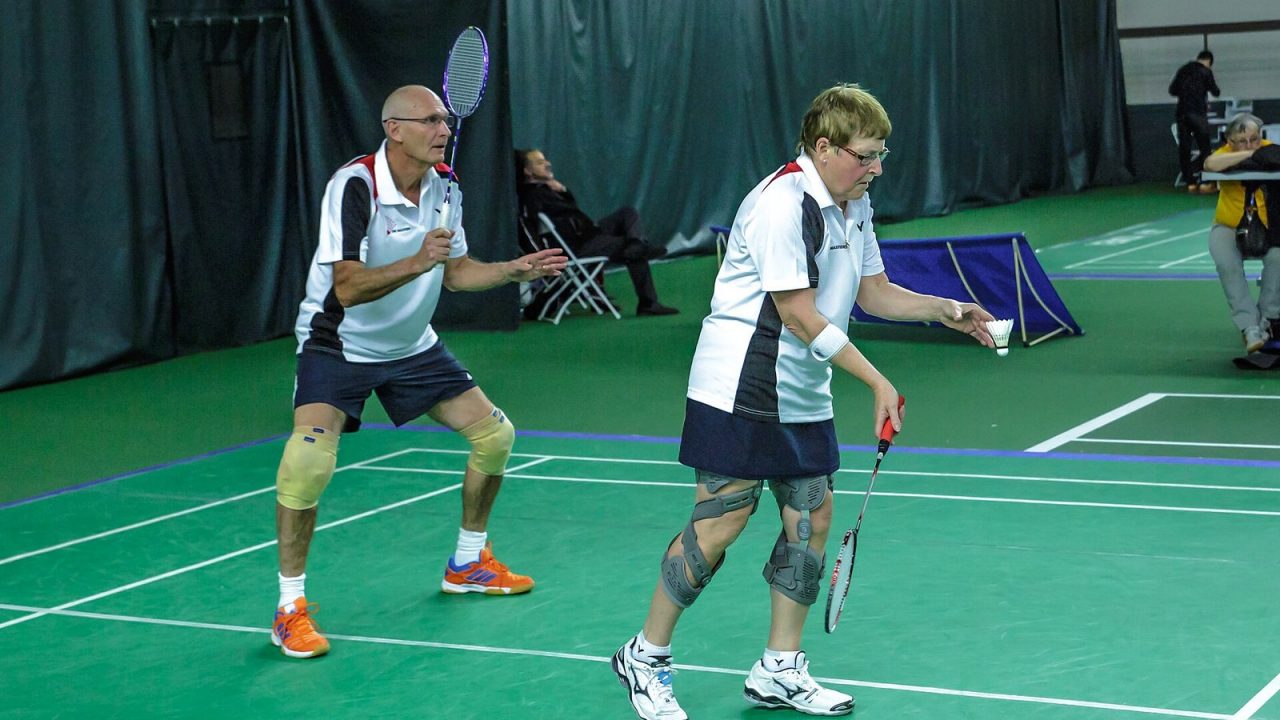
The serve is the only shot in badminton where the player has complete control: no opponent’s shot to react to, no time pressure beyond the rules. That is exactly why the Laws of Badminton regulate it so closely. Over the years, a series of changes has tried to stop servers from gaining an unfair advantage, culminating in the fixed 1.15-metre service height that now applies in elite play.
This guide walks through the service law as written in the BWF Laws of Badminton, the service courts in singles and doubles, the most common faults during rallies, and the situations in which a let is called. It reflects the Laws in force for the 2026 season; a revised set of Laws, adopted by the BWF on 25 April 2026, takes effect on 4 January 2027 alongside the new 3×15 scoring.
What makes a correct service
Law 9 sets out the conditions for a correct service. In plain language:
- The shuttle must travel upwards from the server’s racket and pass over the net so that, if not intercepted, it would land in the receiver’s service court (on or within the lines).
- No undue delay. Neither side may unduly delay the service once both players are ready. Once the server’s racket head has completed its backward movement, any delay before starting the forward swing counts as undue delay.
- Diagonally opposite courts. Server and receiver must stand within diagonally opposite service courts, without touching the boundary lines of those courts.
- Feet in contact and stationary. Some part of both feet of the server and the receiver must stay in contact with the court surface in a stationary position from the start of the service until it is delivered.
- Hit the base first. The server’s racket must initially hit the base (the cork) of the shuttle, not the feathers.
- Below 1.15 metres. The whole shuttle must be below 1.15 metres from the court surface at the instant it is hit.
- Continuous forward movement. Once the service has started, the server’s racket must keep moving forwards until the service is delivered. No pausing or feinting mid-swing.
- Don’t miss. If the server attempts to serve and misses the shuttle, it is a fault.
The Law also defines the start and end of the service. The first forward movement of the server’s racket head, once the players are ready, is the start of the service. The service is delivered when the shuttle is hit, or when the server misses it in an attempt to serve.
The current text of the Laws also requires the server to release the shuttle without adding spin. That provision first appeared as an experimental variation in the 2023 edition of the Laws and is included in the Laws text adopted in April 2026.
The 1.15-metre rule: why it exists
For most of the sport’s history, the height limit at service was defined relative to the server’s body. Under the old rule, the shuttle had to be below the server’s waist when struck, with the waist defined as an imaginary line level with the lowest part of the server’s bottom rib. Because players are different heights and service judges had to estimate rib height from a side view, the rule was hard to apply consistently, and tall players could serve from a relatively high point.
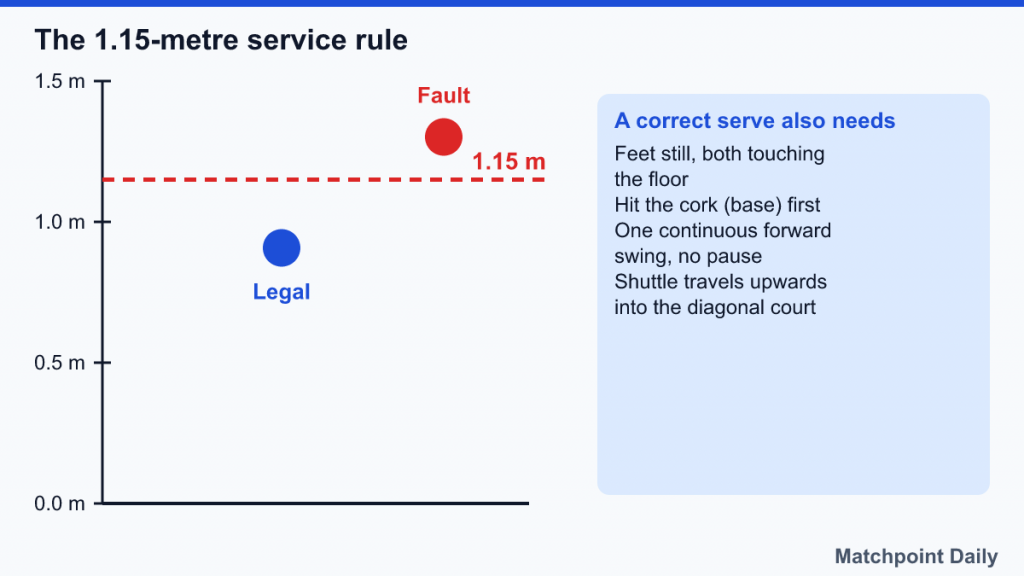
The BWF began testing a fixed-height service law in March 2018, first at the German Open and then at the All England Championships. Under the experimental law, the whole shuttle had to be below 1.15 metres from the court surface at the moment of contact. The trial was not universal: the 2018 Commonwealth Games in Gold Coast kept the old waist-based rule by agreement between the Commonwealth Games Federation and the BWF.
The fixed height became the standard at high-level tournaments and now appears in Law 9.1.6. Several leading players criticised the change when it was introduced, and the BWF said at the time that the rule would stay, though the exact height might be adjusted. The core idea has held: one fixed, measurable height for everyone.
What this means for club players
At club level there is usually no service judge with a measuring device, and opponents are rarely in a position to judge height precisely. In practice, the rule encourages a serve struck clearly low, with a flat or slightly downward-pointing racket head. If your serve technique relies on contacting the shuttle near chest height, it is worth adjusting.
Service courts in singles and doubles
Singles
In singles, the server serves from the right service court when they have scored zero or an even number of points in the game, and from the left when they have an odd score. If the server wins the rally, they score and serve again from the other court. If the receiver wins, the receiver scores and becomes the server.
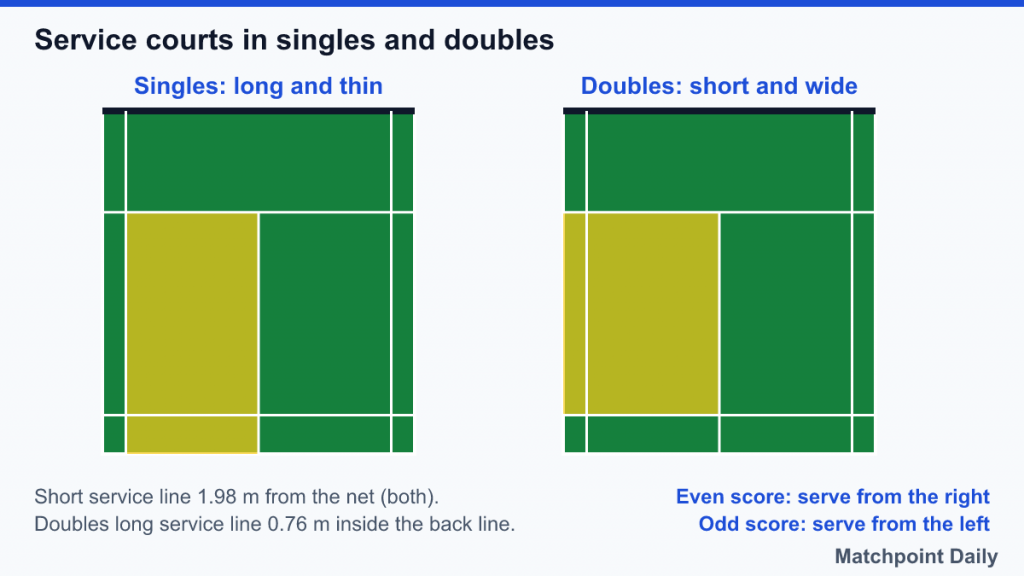
The singles service court is long and narrow: it runs to the back boundary line but uses the singles sideline.
Doubles
In doubles, the serving side serves from the right court when its score is even and from the left when it is odd. The players of the receiving side stay in the same service courts until they win a point on their own serve. Only the player diagonally opposite the server receives.
The doubles service court is short and wide: it uses the doubles sidelines, but the long service line for doubles sits 0.76 metres inside the back boundary. The short service line, 1.98 metres from the net, applies to both singles and doubles.
The right to serve in doubles passes in a fixed sequence: from the initial server, to the partner of the initial receiver, to the partner of the initial server, to the initial receiver, and back to the initial server. During the service, the partners of the server and receiver may stand anywhere in their own courts, as long as they do not block the opposing server’s or receiver’s view. For the tactical side of this, see our guide to doubles formations and rotation.
Service court errors
A service court error occurs when a player serves or receives out of turn, or from the wrong service court. If it is discovered, the error is corrected when the shuttle is not in play, and the existing score stands.
Faults at service
A fault at service is called if the service is not correct under Law 9. In addition, the service is a fault if the shuttle:
- is caught on the net and remains suspended on top of it;
- passes over the net and is caught in it;
- is hit by the receiver’s partner.
Typical service faults include contact above 1.15 metres, feet moving or lifting during the serve, a pause or “double motion” in the forward swing, and hitting the feathers before the cork. At club level, stepping or dragging a foot and serving from the wrong court are familiar examples.
Faults during a rally
Once the shuttle is in play, Law 13 lists the faults. It is a fault if the shuttle:
- lands outside the court boundaries;
- fails to pass over the net;
- touches the ceiling or side walls (subject to any local bye-laws for unusual halls);
- touches a player’s body or clothing;
- touches any other object or person outside the court;
- is caught and held on the racket and then slung during the stroke;
- is hit twice in succession by the same player (although hitting the head and the strings in one stroke is not a fault);
- is hit by a player and then by that player’s partner in succession;
- touches a player’s racket and does not travel towards the opponent’s court.
It is also a fault if, while the shuttle is in play, a player:
- touches the net or its supports with racket, body or clothing;
- invades the opponent’s court over the net with racket or body, except that a striker may follow through over the net after making contact on their own side;
- invades the opponent’s court under the net in a way that obstructs or distracts the opponent;
- obstructs an opponent from making a legal stroke where the shuttle is followed over the net;
- deliberately distracts an opponent, for example by shouting or gesturing.
A player guilty of flagrant, repeated or persistent misconduct can also be faulted under the Laws on continuous play and behaviour.
Clarifying common arguments
- “The shuttle touched the net on the way over.” In a rally, that is fine as long as it passes over and lands in.
- “My racket crossed the net.” Legal only if you contacted the shuttle on your own side and the racket followed through.
- “Double hit.” A shuttle that hits the frame and strings in one stroke is legal; two separate hits by the same player are not.
When a let is called
A let stops play, and the rally is replayed with the same server serving again. Under Law 14, it is a let if:
- the server serves before the receiver is ready (although a receiver who attempts a return is deemed to have been ready);
- during service, both server and receiver are faulted at the same time;
- after the service is returned, the shuttle is caught on the net and remains on top, or passes over the net and is caught in it;
- during play, the shuttle disintegrates and the base separates completely from the rest;
- in the umpire’s opinion, play is disrupted or a player is distracted by a coach;
- a line judge is unsighted and the umpire (or an instant review system) cannot make a decision;
- any unforeseen or accidental situation occurs.
Note the contrast with service: a shuttle caught on top of the net from a serve is a fault, but a shuttle caught on top of the net during a rally after the return of serve is a let.
Practical tips for a legal, effective serve
- Set your feet before you start and keep both in contact with the floor until you hit.
- Make one smooth forward motion. If you feel the need to pause, reset completely before starting again.
- Contact the cork first and keep the hit low and in front of the body.
- In doubles, practise the low backhand serve until it is reliable, then add the flick as a surprise.
- In singles, the high serve to the back of the court remains a sound option because the singles service court runs all the way to the back line.
For the full scoring system that surrounds the serve, including intervals, end changes and the upcoming switch to 3×15, see our guide to badminton rules and scoring.