The FIVB Volleyball World Championships Explained
How volleyball's World Championships work: history since 1949, the 32-team format and odd-year schedule from 2025, qualification, and the most successful nations.
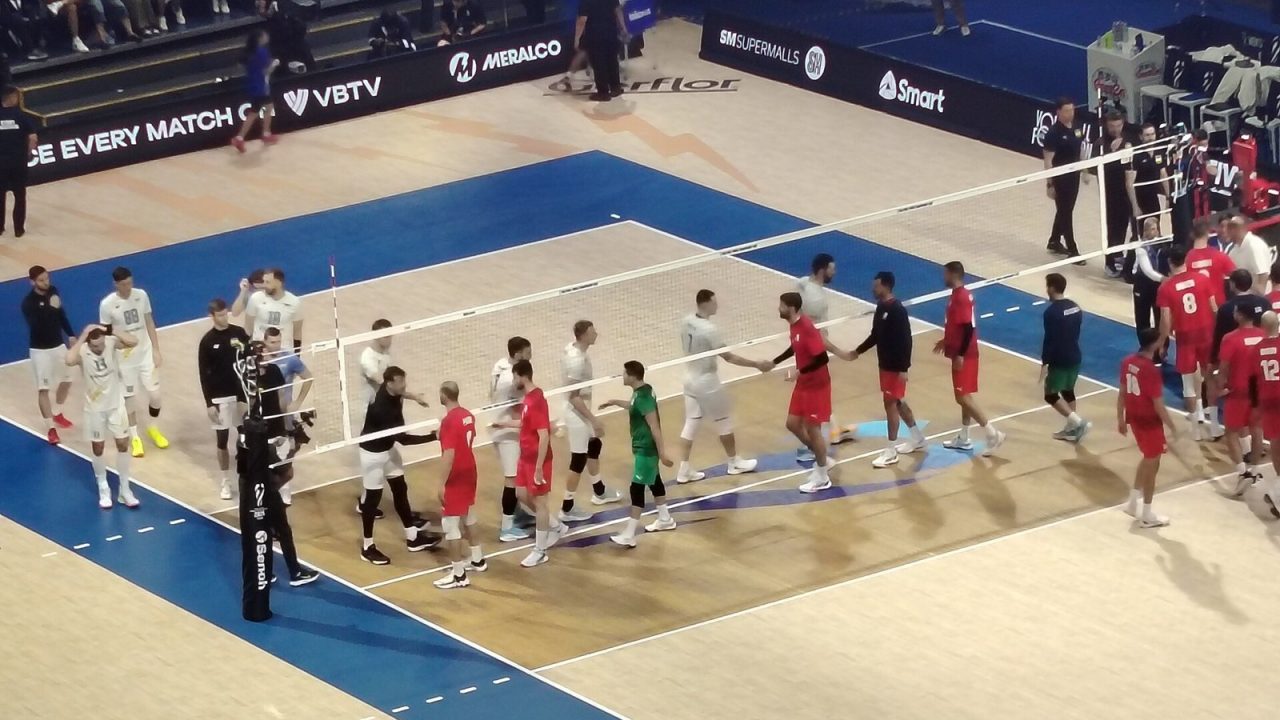
For national volleyball teams, two titles stand above all others: Olympic gold and the World Championship. The World Championship is the older of the two, first contested in 1949, fifteen years before volleyball’s Olympic debut. In recent years it has also been reshaped more than any other major volleyball event, growing to 32 teams and moving from a four-year cycle to every other year.
This guide explains how the tournament began, how the current format and qualification work, which nations have won the most, and how the championship fits alongside the Olympics and the annual Volleyball Nations League. Records are given through the 2025 editions.
A brief history
The FIVB was founded in Paris in 1947, and it moved quickly to create a world title. The first men’s World Championship was held in 1949 in Prague, Czechoslovakia, and the first women’s World Championship followed in 1952, with the Soviet Union as host and champion. Our history of volleyball covers the wider story of the sport in that period.
The early decades were dominated by Eastern Europe. The Soviet Union won the first two men’s titles and went on to collect six men’s and five women’s world titles in total before its dissolution. Czechoslovakia won two men’s titles, and the championships were a natural showcase for the strong state-supported programmes of the region.
From the 1960s onward, other powers emerged. Japan’s and Cuba’s women each won three world titles and China’s women two, while among men Italy, Brazil and Poland built the strongest records of the modern era.
For most of its history the tournament was held every four years, usually in the even-numbered year between Olympic Games, with men’s and women’s events held separately, sometimes in different countries.
The modern format: 32 teams from 2025
The FIVB’s 2025–2028 international calendar, approved in June 2023, changed the championship in two major ways:
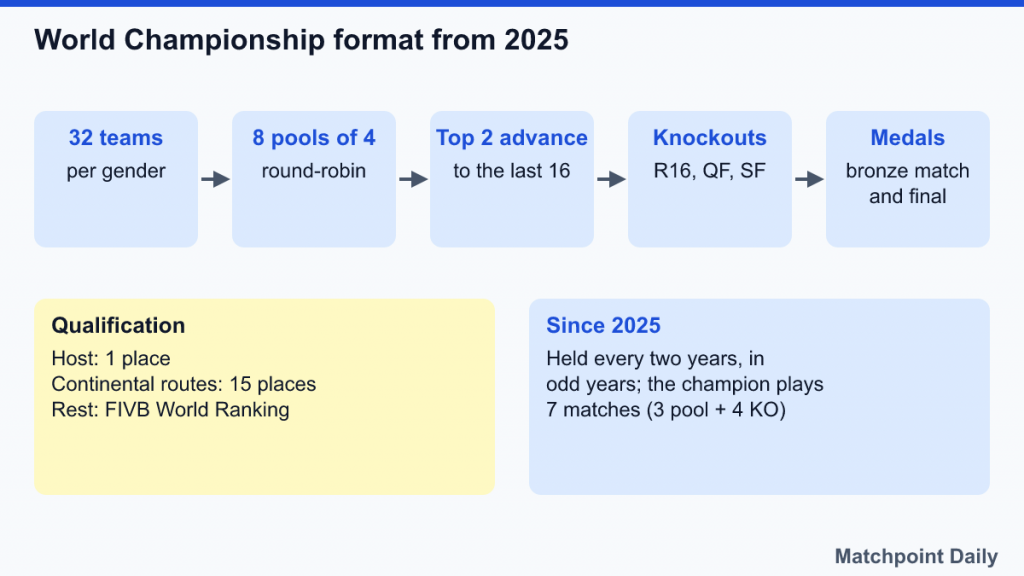
- Every two years, in odd years. From 2025, the World Championships are held biennially in odd-numbered years, rather than every four years.
- Bigger field. The men’s tournament expanded from 24 teams to 32, and the women’s tournament also features 32 teams.
The 2025 men’s championship in the Philippines used the new format:
- Pool phase: eight pools of four teams, each playing a round-robin.
- Knockout phase: the top two teams from each pool advance to a round of 16, followed by quarter-finals, semi-finals, a bronze-medal match and the final.
The format is shorter and simpler than some older editions, which used multiple group rounds. With a straight knockout from the last 16, a single bad match can end a strong team’s campaign, which makes the later rounds unpredictable and dramatic.
How teams qualify
Qualification now runs over a roughly three-year window before each championship. For the 32-team format from 2025:
| Route | Places |
|---|---|
| Host nation | 1 |
| Continental champions and qualifiers: three places for each of the five confederations (Africa – CAVB, Asia – AVC, Europe – CEV, North/Central America and Caribbean – NORCECA, South America – CSV) | 15 |
| Highest-ranked non-qualified teams in the FIVB World Ranking | Remaining places (about 15) |
| Total | 32 |
Two routes therefore matter: continental results and world ranking. Because the ranking now uses a match-based system in which results at major events carry the heaviest weighting, consistent performances across the Volleyball Nations League, continental championships and previous world events all feed into who qualifies. Our guide to the Volleyball Nations League explains how VNL results move the ranking.
Most successful nations (through 2025)
Men
| Nation | Gold | Silver | Bronze |
|---|---|---|---|
| Soviet Union | 6 | 2 | 3 |
| Italy | 5 | 1 | 0 |
| Brazil | 3 | 3 | 1 |
| Poland | 3 | 2 | 1 |
| Czechoslovakia | 2 | 4 | 0 |
| United States | 1 | 0 | 2 |
| East Germany | 1 | 0 | 0 |
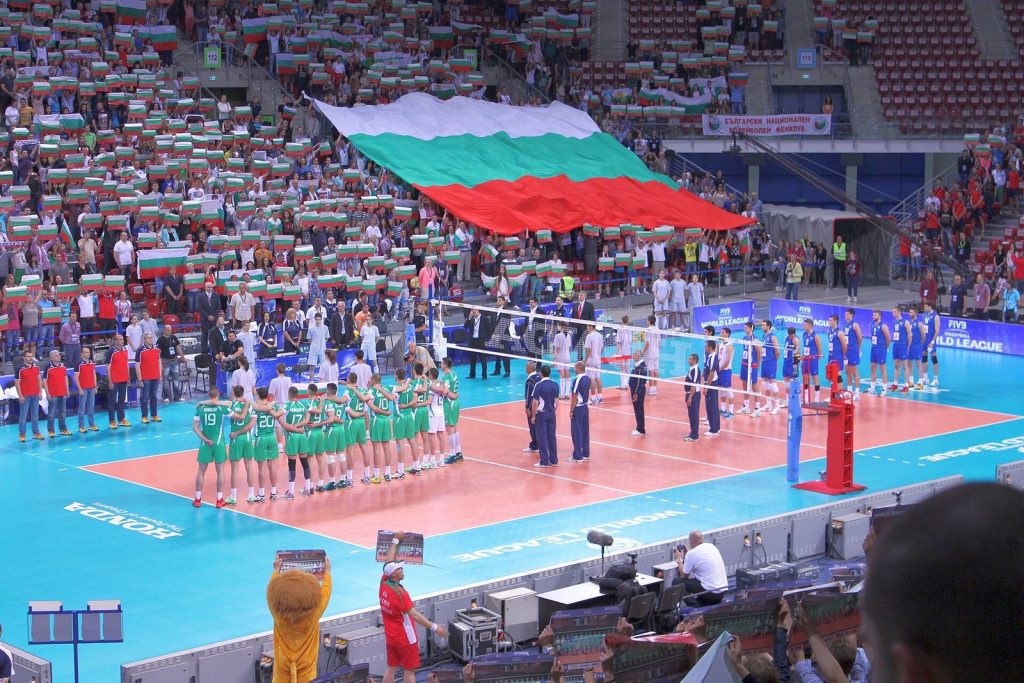
Italy’s fifth title came in 2025, when it beat Bulgaria 3–1 in the final in the Philippines, with Poland taking bronze. Italy had also won in 2022, while Poland won in 2018. Bulgaria, with two silvers and four bronzes, has the most men’s medals without a world title.
Women
| Nation | Gold | Silver | Bronze |
|---|---|---|---|
| Soviet Union | 5 | 2 | 1 |
| Japan | 3 | 3 | 1 |
| Cuba | 3 | 1 | 0 |
| China | 2 | 3 | 1 |
| Italy | 2 | 1 | 1 |
| Russia | 2 | 0 | 3 |
| Serbia | 2 | 0 | 0 |
| United States | 1 | 2 | 2 |
The 2025 women’s championship in Thailand was won by Italy, who beat Turkey in the final; Brazil took bronze and Japan finished fourth. Before that, Serbia won back-to-back titles in 2018 and 2022, and the United States won its first women’s world title in 2014. Brazil’s women have four silver medals and two bronzes but have not yet won the world title.
Storylines from recent editions
Italy’s double in 2025
The first editions under the new biennial format produced a rare sweep: Italy won both the men’s title in the Philippines and the women’s title in Thailand in 2025. For the men, it was a fifth world title and a successful defence of the 2022 crown, which moved Italy within one title of the Soviet Union’s record of six. For the women, it was a second world title, and it came in the same summer in which they also won the Volleyball Nations League.
Serbia’s back-to-back women’s titles
Serbia’s women won in 2018 and again in 2022. Serbia’s two titles came in its own right as an independent nation, separate from the single bronze won earlier by Serbia and Montenegro.
Firsts and near misses
The United States women won their first world title in 2014. Brazil’s women, despite four silver medals and two bronzes, are still waiting for a first title, and Bulgaria’s men, despite six medals, have never won gold. Turkey’s women reached their first world final in 2025, finishing with silver.
How a 32-team championship plays out
If you are following a World Championship for the first time, it helps to know the rhythm of the event:
- Pool phase. Each team plays three round-robin matches. With only two teams per pool advancing, a single loss can be costly, and the set ratio sometimes decides who goes through.
- Round of 16. The first knockout round pairs teams from different pools, and it is often where emerging nations get their best chance against established powers.
- Quarter-finals and semi-finals. By this stage most teams are from the established elite, and matches often go to four or five sets.
- Medal matches. The bronze-medal match and the final are usually played on the last weekend.
A champion plays seven matches in a short period, so depth of squad and the ability to recover between matches matter as much as the starting six. That is one reason why the offensive systems and substitution patterns teams use, and the role of specialists such as the libero, are so visible over a long championship.
What to watch for
- Serve pressure. At elite level, aggressive serving is often what separates teams in tight sets.
- Side-out efficiency. Teams that convert reliably when receiving serve rarely lose long runs of points.
- Emerging nations. The expanded field is the best chance for teams from smaller volleyball nations to test themselves against the very best.
World Championship vs Olympics vs VNL
| Event | Frequency | Teams (per gender) | Role |
|---|---|---|---|
| Olympic Games | Every four years | 12 | Most prestigious title; smallest field |
| World Championship | Every two years (odd years) from 2025 | 32 | The sport’s own world title; broadest elite field |
| Volleyball Nations League | Annual | 18 | Regular international season; ranking points |
The Olympic tournament’s small field makes it extremely hard to reach, which is part of its prestige; our guide to volleyball at the Olympics covers its format. The World Championship, by contrast, now offers more nations a chance to compete against the elite, especially teams from Africa, Asia and the Americas that rarely qualify for the Olympics. Both events carry the top weighting in the FIVB World Ranking.
Why the changes matter
Moving to a biennial, 32-team event has several consequences:
- More chances to become world champion. Players now have two opportunities in each Olympic cycle rather than one.
- Wider participation. Eight extra places give emerging nations more top-level matches, which helps their development and their ranking.
- Busier calendars. National-team summers now often include the VNL, a continental event and a World Championship, adding to the workload on elite players who also have long club seasons.
- Shorter route to the title. A champion now plays three pool matches and four knockout matches, so winning requires sustained form over a relatively short period.
Frequently asked questions
Is the World Championship the same as the World Cup?
No. The FIVB Volleyball World Cup was a separate event that was historically used as an Olympic qualifier. It no longer features in the FIVB ranking system as of 2025, while the World Championship continues as the sport’s main world title outside the Olympics.
Do Russian or Soviet titles count together?
No. Records list the Soviet Union and Russia separately. The Soviet Union’s titles were won before its dissolution in 1991; Russia’s titles came afterwards, as a separate nation.
When is the next edition?
Under the odd-year schedule, the next World Championships after 2025 are due in 2027.