Legal Serves in Table Tennis: The Service Rules Explained
Every requirement of a legal table tennis serve explained: open palm, 16 cm toss, behind the end line, no hiding the ball, umpire warnings and doubles serving.
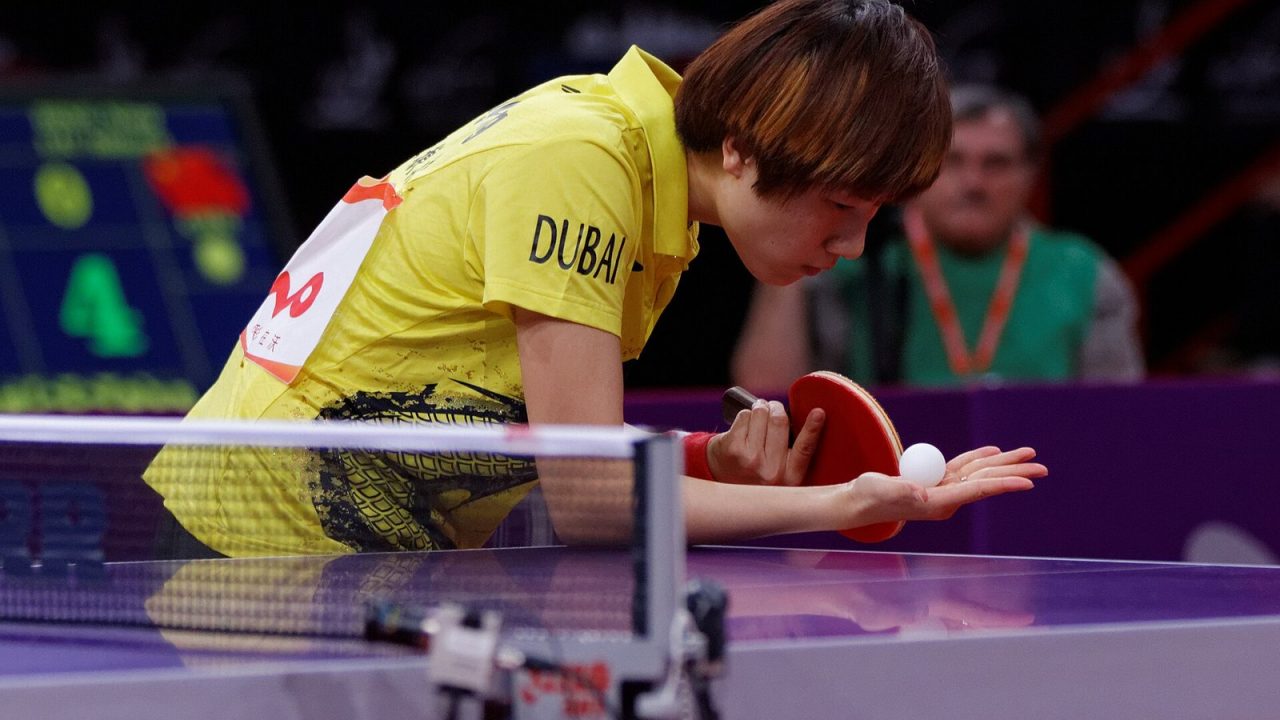
The serve is the one moment in table tennis when a player has complete control of the ball, which is exactly why the laws about it are so detailed. Over the years, players found ways to make serves almost impossible to read: hiding the contact with the body, throwing the ball sideways to add spin, or dropping it straight from the hand. The current service law is designed to close those loopholes and keep the serve visible and fair. This guide walks through each requirement in the order a serve happens, using the Laws of Table Tennis from the 2026 ITTF Statutes.
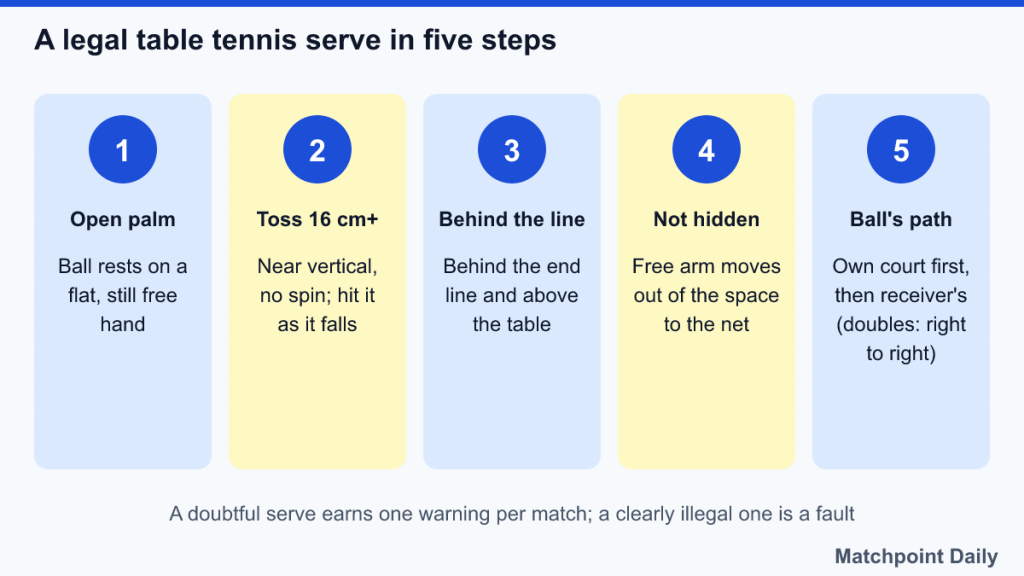
Step 1: the ball rests on an open palm
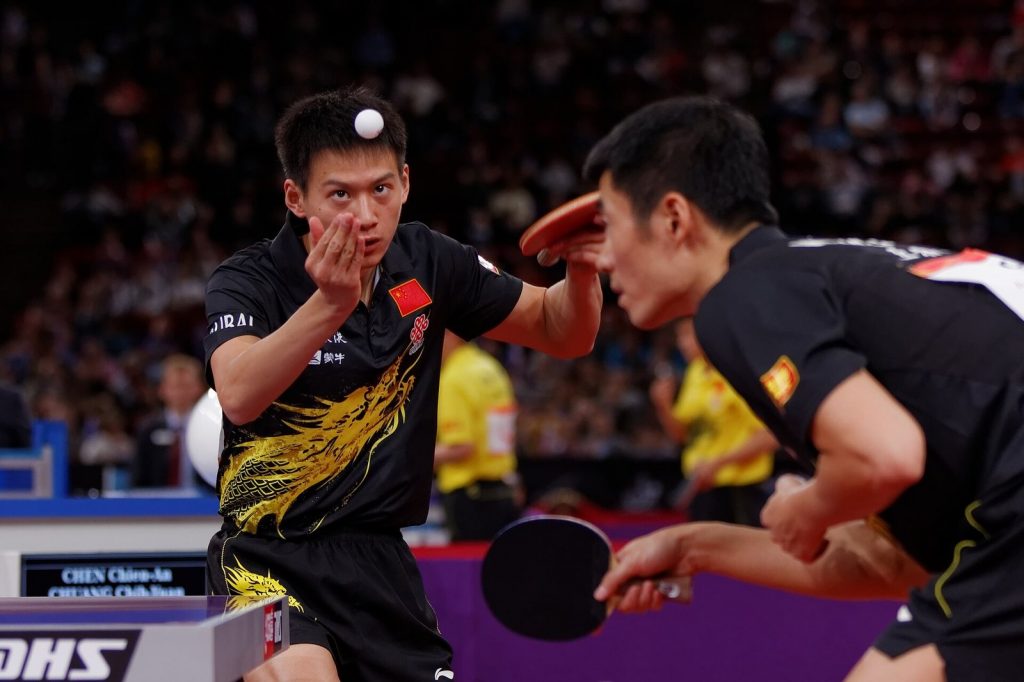
Service starts with the ball resting freely on the open palm of the server’s stationary free hand.
- Open palm: the hand must be flat, not cupped, and the ball must not be held in the fingers. This stops players from gripping the ball to spin it during the toss.
- Stationary: the free hand must be still at the start of the service. A moving hand makes it easier to disguise the toss.
- Free hand: the hand not holding the racket.
The laws also define the exact moment the ball comes into play: the last moment at which it is stationary on the palm of the free hand before being intentionally projected in service.
Step 2: a near-vertical toss of at least 16 cm
The server must then project the ball near vertically upwards, without imparting spin, so that it rises at least 16 cm after leaving the palm, and then falls without touching anything before being struck.
- Near vertically: a toss angled sharply towards the body, the net or sideways is not allowed. Small deviations are tolerated, which is why the law says “near”.
- At least 16 cm: about the height of the net (15.25 cm) plus a little. There is no maximum; some players use very high tosses to add speed and spin to the racket contact.
- Struck as it falls: the ball must be on its way down at contact. Hitting it on the way up is a fault.
The toss rule ended the old practice of serving straight out of the hand or with a tiny flick, both of which made it hard for the receiver to see what was happening.
Step 3: behind the end line, above the table
From the start of service until the ball is struck, it must be:
- Above the level of the playing surface, so it cannot be hidden below the table top; and
- Behind the server’s end line, with the end line treated as extending indefinitely in both directions.
The server’s body can be anywhere, including to the side of the table, as long as the ball stays behind the extended end line and above table height throughout. That is why you see elite players crouch low or stand wide to the backhand corner to serve forehand pendulum serves.
Step 4: no hiding the ball
This is the heart of the modern service law. From the start of service until it is struck, the ball must not be hidden from the receiver by the server or their doubles partner, or by anything they wear or carry.
As soon as the ball has been projected, the server’s free arm and hand must be removed from the space between the ball and the net. That space is defined by the ball, the net and its indefinite upward extension. In plain terms, after the toss you must move your free arm out of the way so the receiver has a clear line of sight to the ball.
Why hidden serves were banned
Before the change, many players served with the ball partially hidden behind the free arm, shoulder or body. The receiver could not see the moment of contact, so could not judge the spin. Serves became dominant, and rallies became short. The ITTF banned the hidden serve with effect from 2002, part of a series of reforms around that time (including the larger 40 mm ball in 2000 and 11-point games in 2001) aimed at longer, more watchable rallies and a smaller server advantage.
Step 5: the ball’s path
As the ball is falling, the server strikes it so that it touches the server’s own court first and then touches directly the receiver’s court.
- In singles, the serve may land anywhere on the receiver’s court; there is no requirement to serve diagonally.
- In doubles, the ball must touch successively the right half-court of the server and then the right half-court of the receiver. The white centre line counts as part of each right half-court.
If an otherwise correct serve touches the net assembly on its way over, it is a let and is replayed, however many times it happens. A serve that touches the net and does not land on the receiver’s court, or lands in the wrong half in doubles, is a fault.
The umpire’s role and the warning system
The laws place the responsibility squarely on the server: it is the player’s job to serve so that the umpire or assistant umpire can be satisfied that the serve complies with the laws. Either official may decide that a service is incorrect.
There is one safety valve. If either the umpire or the assistant umpire is not sure about the legality of a serve, they may, on the first occasion in a match, interrupt play and warn the server without awarding a point. After that, any subsequent serve by that player or their doubles partner that is not clearly legal is considered incorrect, and the point goes to the receiver.
Two things are worth noting:
- The warning applies only to doubtful serves. A clearly illegal serve, such as one hit out of the hand without a toss, can be faulted immediately without any warning.
- The warning is for the match. Once warned, a player must serve beyond doubt for the rest of it.
The umpire may also relax the requirements for a correct service where compliance is prevented by a physical disability.
Doubles serving order in brief
In doubles, the pair with the right to serve first in a game chooses which partner will serve, and in the first game the receiving pair chooses who will receive first. After each two points, the previous receiver becomes the server and the partner of the previous server becomes the receiver. In later games, the first receiver is the player who served to the first server in the previous game. In the last possible game of the match, the receiving pair changes its order of receiving when the first pair reaches 5 points. Both partners are bound by the no-hiding rule: the server’s partner must not block the receiver’s view of the ball.
Common service faults
| Fault | Which requirement it breaks |
|---|---|
| Ball held in fingers or cupped hand | Open palm |
| Toss lower than 16 cm | Minimum toss height |
| Toss thrown backwards or sideways | Near-vertical toss |
| Spin added during the toss | Toss without spin |
| Ball struck on the way up | Must be struck while falling |
| Ball dropped below table height | Above the playing surface |
| Contact over the table | Behind the end line |
| Free arm left between ball and net | Ball must not be hidden; free arm removed |
| Body or partner blocks receiver’s view | Ball must not be hidden |
| Serve misses own court or lands only on own court | Ball’s path |
Frequently asked questions
Do I have to serve diagonally in singles?
No. In singles the serve may bounce anywhere on your court and then anywhere on the receiver’s court. The diagonal requirement applies only to doubles, from right half-court to right half-court.
Can I toss the ball very high?
Yes. The law sets a minimum of 16 cm but no maximum. High-toss serves are legal as long as the toss is near vertical, the ball is struck while falling, and it stays visible, behind the end line and above the table.
What if I miss the ball completely?
Once the ball has been projected from the palm, it is in play. If you toss it and fail to strike it correctly, you have failed to make a correct service and the receiver wins the point.
Can the receiver complain that a serve was hidden?
The receiver can raise it with the umpire, but the decision belongs to the umpire and assistant umpire. In matches without officials, players are expected to agree on what is fair and serve in a way that is clearly visible.
Is a serve that hits the net post a let?
The net assembly includes the net, its suspension and the supporting posts, including the clamps. An otherwise correct serve that touches any part of it on the way over is a let.
Practical tips for a legal, effective serve
- Freeze the start. Rest the ball on a flat, still palm for a moment before tossing. It makes your serve look clearly legal.
- Toss with intent. A consistent toss of a little more than 16 cm is the easiest to control. High tosses add power but take practice.
- Clear the free arm. Move the free arm away immediately after the toss. Many club players are faulted not for hiding the ball deliberately but for leaving the arm in place out of habit.
- Stay behind the line. Make contact well behind the end line rather than right on it.
- Ask for feedback. A coach or umpire can tell you whether your serve looks legal from the receiver’s side.
Spin and placement are what make serves effective, and they combine naturally with the strokes covered in our beginner’s guide to table tennis strokes. For the wider rules about scoring, lets and edge balls, see our table tennis rules guide.