The Libero in Volleyball: Role, Rules and Restrictions
Why volleyball has a libero, how libero replacements work, what the libero may not do, how two-libero rosters operate, and where FIVB and other codes differ.
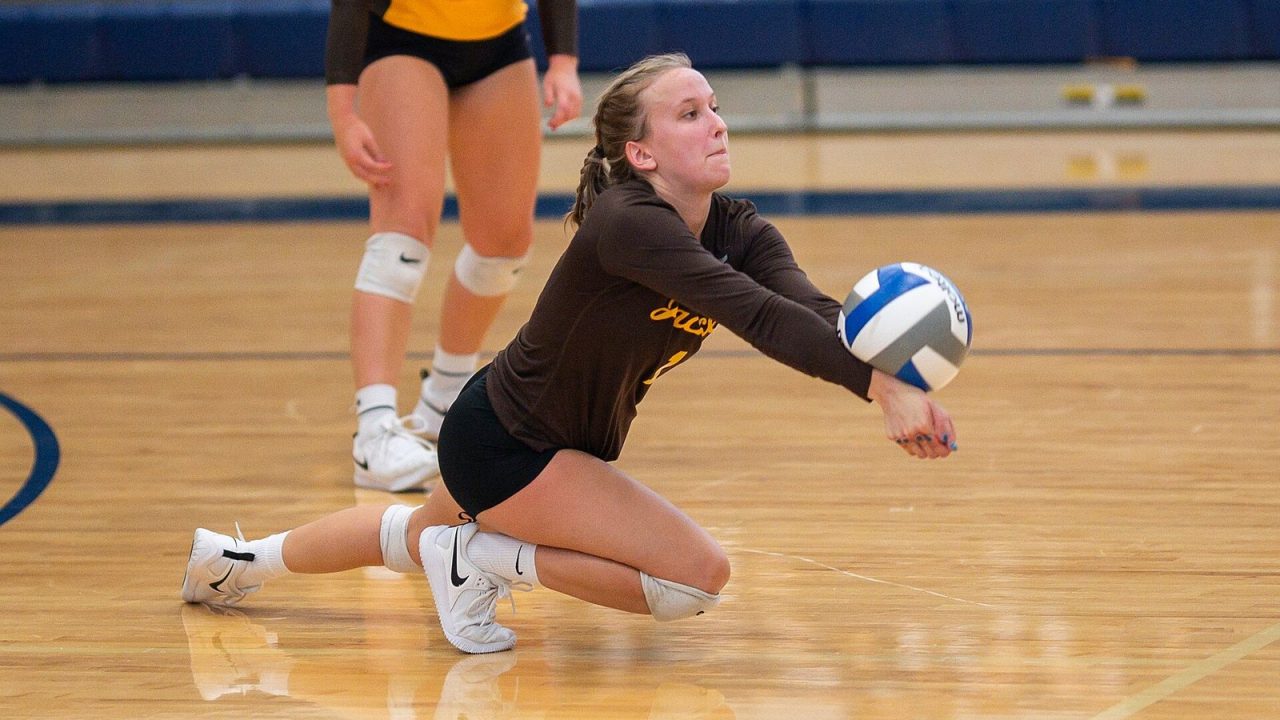
The player in the different-coloured shirt is the easiest one to spot on a volleyball court, and the one whose rules are least understood. The libero comes on and off without the scorer seeming to record a substitution, never blocks, never jumps to spike at the net, and yet often touches the ball more than anyone else. This guide explains why the role exists, what the libero can and cannot do under the FIVB Official Volleyball Rules 2025–2028, and how the role differs in some other rule codes.
Why the libero was introduced
The libero was introduced into international volleyball in 1998. The name comes from the Italian word for “free”, a nod to the freedom to replace back-row players without using up substitutions.
The aim was to improve ball control and defence at a time when the men’s game in particular was increasingly dominated by big serves and powerful attacks. A designated specialist passer and digger lengthens rallies, rewards reading and technique, and gives smaller players a route to the top level of a sport where height usually matters enormously.
The role spread to other codes afterwards. US college volleyball, for example, introduced the libero in NCAA competition in 2002.
Designation and the contrasting jersey
Under the FIVB rules, each team may designate up to two liberos from the players on its score sheet. They are recorded on special lines reserved for them. In senior FIVB, world and official competitions, a team that records more than 12 players must include two liberos.
The libero on court is called the acting libero; the other is the second libero. Only one libero may be on court at any time.
The libero’s uniform must have a different dominant colour from any colour worn by the rest of the team and must contrast clearly with it. The two liberos may wear different uniforms from each other as well as from the rest of the team, and they are numbered like everyone else. The contrasting kit exists so referees and the scorer can follow the libero’s movements at a glance. A libero may also be the team captain or game captain.
How libero replacements work
A libero does not enter the game through a normal substitution. Instead, the rules use the term libero replacement:
- The libero may replace any back-row player. Most teams use the libero for the middle blockers when they rotate to the back row, but any back-row player can be replaced.
- Libero replacements are not counted as substitutions and are unlimited.
- There must be a completed rally between two libero replacements, with limited exceptions such as a penalty that rotates the libero to position 4 or an acting libero who becomes unable to play.
- The player who was replaced, called the regular replacement player, is the only player (apart from the second libero) who can replace the acting libero.
- Replacements happen only while the ball is out of play and before the whistle for service, and the libero and the replaced player enter and leave through the libero replacement zone, the part of the free zone on the bench side between the attack line and the end line.
- At the start of each set, the libero may not enter until the second referee has checked the line-up.
Because the libero may play only in the back row, they must leave the court when the rotation would take them to position 4 in the front row. That is why you see the libero jog off when a team rotates and the middle blocker comes back on.
A replacement made after the whistle but before the serve is not rejected the first time; the team is told it is not allowed, and repeated late replacements lead to delay sanctions. An illegal libero replacement, for example one made without a completed rally in between, is treated like an illegal substitution.
What the libero may not do
The libero’s restrictions all flow from the idea that this is a back-row defensive player. Under the FIVB rules, the libero:
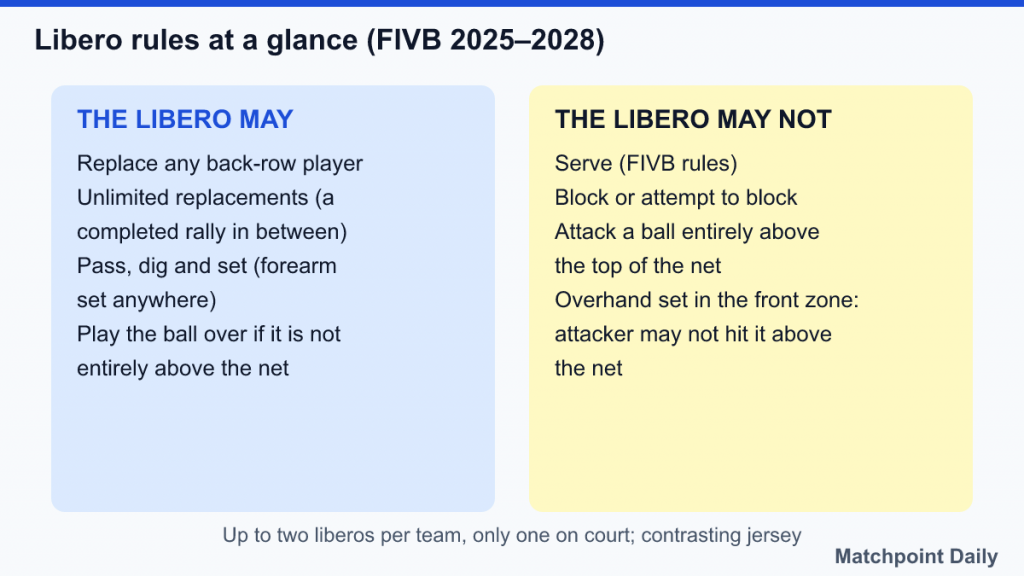
- May not attack above net height. The libero may not complete an attack hit from anywhere, on court or in the free zone, if the ball is entirely higher than the top of the net at contact. A libero can still send the ball over with a hit from below the top of the net, which is why liberos sometimes play a free ball or a controlled shot back.
- May not block or attempt to block. Even an unsuccessful block attempt is a fault.
- May not serve under FIVB rules.
The overhand set in the front zone
The most subtle restriction concerns setting. The libero may set the ball, but if the libero makes an overhand finger pass while in the front zone (or its extension beyond the side lines), a teammate may not complete an attack hit on that ball while it is entirely above the top of the net. The attacker can still play it, but only with the ball below net height, or with a contact that is not an attack hit.
The restriction disappears if:
- the libero takes off or stands behind the attack line and sets with the fingers; or
- the libero sets with a forearm (bump) pass, even inside the front zone.
This is why you will see liberos jump-set from behind the 3 m line or use a bump set when they have to take the second contact near the net.
When the libero cannot continue: re-designation
A libero becomes unable to play if injured, ill, expelled or disqualified, and the coach (or, without a coach, the assistant coach or game captain) may also declare the libero unable to play for any reason.
- Team with two liberos: the team carries on with the remaining libero. No re-designation is allowed unless that remaining libero also cannot continue.
- Team with one libero: the coach may re-designate any other player who is not on court at that moment (except the regular replacement player) as the new libero for the rest of the match. The original libero may not return to play in that match.
A re-designated libero wears a different-coloured jersey or bib, ideally matching the original libero’s style, but keeps their own number. Further re-designations are allowed if needed, and the team captain may be re-designated as libero.
Two-libero rosters in practice
Having two liberos does not mean two can play at once. Instead, teams use them in a few common ways:
- Specialisation: one libero comes on for serve receive, the other for defence when the team is serving. Because the acting libero can be replaced by the second libero, teams can make this switch between rallies.
- Freshness and form: a coach may change libero between sets or within a set if the first libero is struggling.
- Insurance: a second libero means a team does not have to re-designate a non-specialist if the first is injured.
How the libero is used tactically
The libero’s job is to make the team’s passing and defence as good as possible.
- Serve receive: the libero usually covers the largest area of the court, often the middle, letting outside hitters focus on smaller zones.
- Defence: the libero commonly plays in position 5 or 6 in the back row, reading the opposing hitter and covering the deep zones or tips.
- Second contact: when the setter has to dig the first ball, the libero is often the emergency setter, using a bump set or a set from behind the attack line.
- Organisation: because the libero sees the whole court from behind, many act as the on-court voice for the back-row defence.
For how the libero fits around the setter, hitters and middles, see our guide to volleyball positions.
How other codes differ
The FIVB rules are the reference for international play, and most national rulebooks build on them. Some codes, however, give the libero more freedom. The best-known example is US college volleyball, where NCAA rules have since 2004 allowed the libero to serve, but only in one rotation position, for the player they are replacing. School, club and national league rules elsewhere may also differ in details such as libero serving or how many liberos a team may use. If you play outside FIVB competition, check your league’s rulebook.
Quick answers to common questions
Can the libero play the first ball over the net?
Yes, as long as the ball is not entirely above the top of the net at contact. A libero digging a ball that floats over is perfectly legal.
Can the libero replace a different player each time?
Yes. The libero can replace any back-row player, but once on court can only be replaced by the player they came in for or by the second libero.
Does the libero count towards the six substitutions?
No. Libero replacements are recorded separately and are unlimited.
Libero rules at a glance
| Question | FIVB answer |
|---|---|
| How many liberos? | Up to two per team; only one on court |
| Jersey | Different dominant colour from the team |
| Which players can the libero replace? | Any back-row player |
| Do replacements count as substitutions? | No; unlimited, with a completed rally between them |
| Can the libero serve? | No |
| Can the libero block? | No, not even attempt |
| Can the libero attack? | Only if the ball is not entirely above the net |
| Libero sets with fingers in the front zone | Attacker may not hit that ball above net height |
For the wider context of how timeouts, substitutions and rotation fit together, our rotation and overlap guide explains why the libero always leaves before rotating to the front row.