Badminton Doubles Tactics: Attacking and Defensive Formations
How front-and-back attack, side-by-side defence and smooth rotation work in badminton doubles, plus serve patterns, mixed doubles roles and common club mistakes.
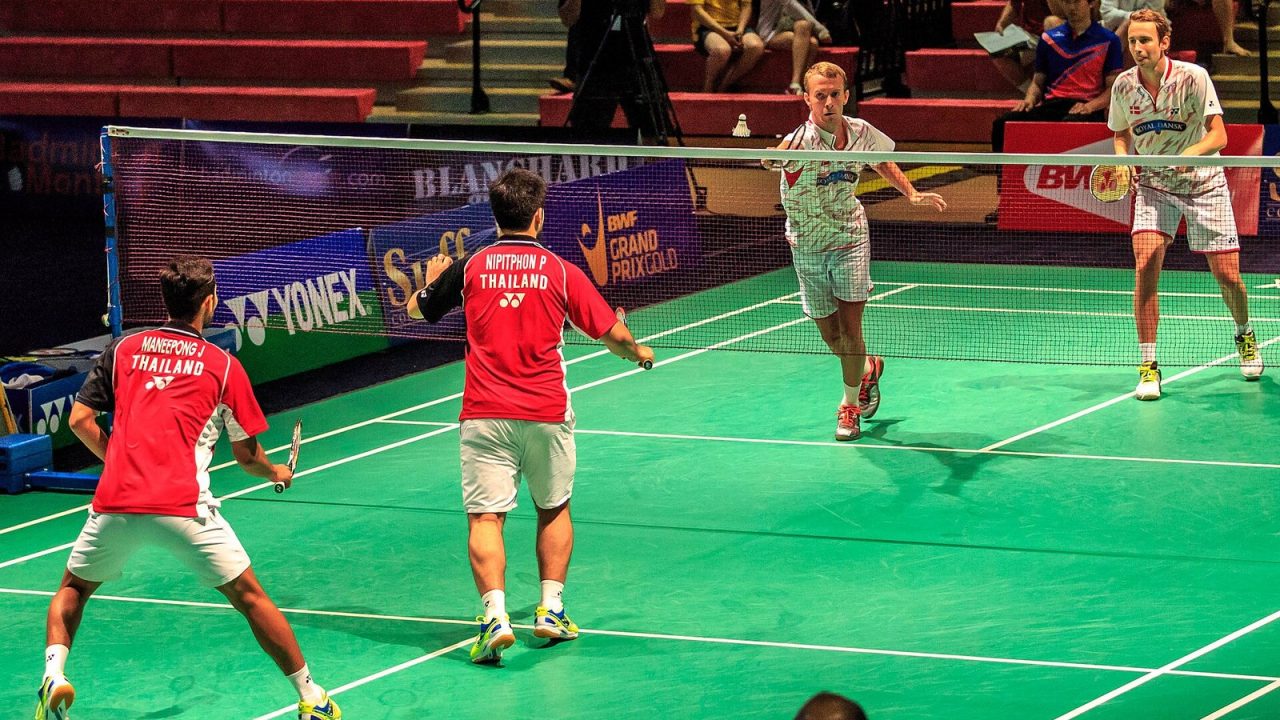
Doubles badminton is a different sport from singles in many of the ways that matter. The court is wider but the service area is shorter, rallies are faster and flatter, and the key question in almost every exchange is not “where is the open space?” but “which pair is attacking?” Pairs that understand formations and rotation can beat individually stronger players, while pairs who simply stand in place and hit whatever comes to them usually lose the battle for the attack.
This guide explains the two basic formations, how and when to rotate between them, how serve and return patterns shape the opening of each rally, the special features of mixed doubles, and the mistakes most club players make.
The core idea: win and keep the attack
In doubles, the shuttle is usually travelling either downward (the attacking side is hitting down) or upward (the defending side is lifting). The pair hitting down has the advantage, because a downward shuttle is hard to counter-attack. The pair forced to lift has to defend until they can get the shuttle flat or downward again.
So the whole tactical structure of doubles revolves around two goals:
- Get the attack by forcing the opponents to lift, usually with good serves, tight net play and flat, fast exchanges.
- Keep the attack once you have it, by smashing and dropping in ways that force further lifts.
When neither side can hit downward, pairs play flat drives and pushes, trying to be the first to get a shuttle they can hit down. Our guide to badminton shots explains the drives, drops, smashes and lifts that make up these exchanges.
Attacking formation: front and back
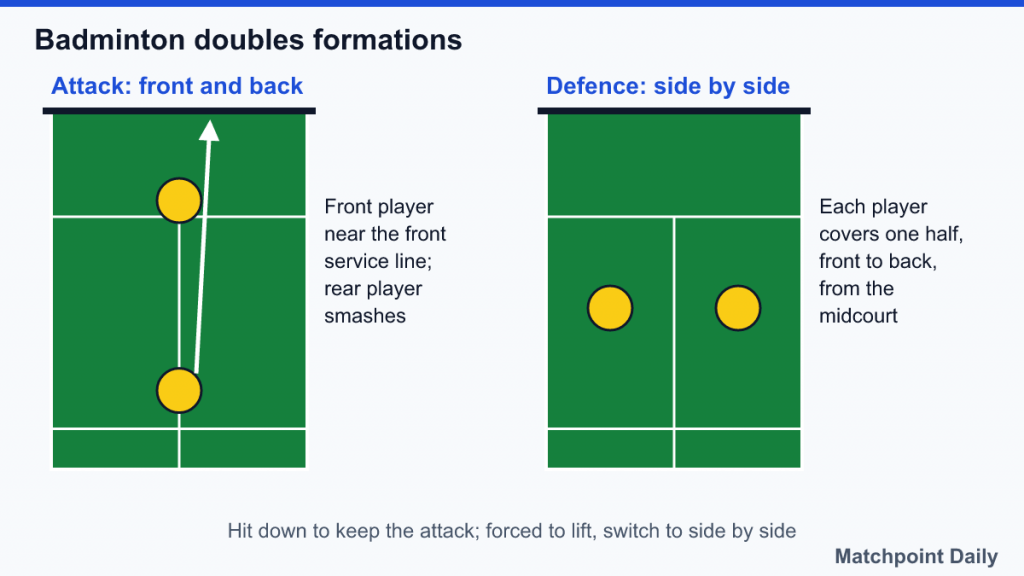
When a pair is attacking, the ideal formation is front and back. One player attacks from the rear court, smashing or dropping, while the partner covers the forecourt and midcourt in front, ready to intercept returns and kill anything left high near the net.
The rear player’s job
- Hit downward whenever possible: full smashes, half smashes and drops.
- Vary pace and direction so the defenders cannot settle; a mix of steep smashes and well-placed drops is harder to defend than repeated full power.
- Recover quickly after each shot to be ready for the next lift.
The front player’s job
- Stand roughly around the front service line area, racket up, ready to intercept.
- Cut off straight and cross-court blocks and drives before they can escape past.
- Pounce on any weak return near the net and push or kill it downward.
- Avoid drifting too far back, which leaves the net open, or standing so close to the net that fast drives fly past.
The front player is not just a spectator. Many points in high-level doubles are finished by the front player intercepting a defensive return that the opponents hoped would ease the pressure.
Defensive formation: side by side
When a pair has to lift or clear, it moves into a side-by-side formation. Each player covers one half of the court from front to back, standing roughly in the midcourt of their half. This gives the widest possible coverage against smashes, which can be aimed anywhere across the width of the court.
Key defensive principles
- Stand slightly further back than feels natural. A steep smash arrives quickly, so defenders need time to react.
- Racket in front, ready on the backhand side. Many players defend smashes aimed at the body with a backhand grip because it covers more of the body.
- Communicate about the middle. Attackers often aim at the gap between the two defenders. Pairs need a clear habit, for example the player on the forehand side or the player the smash is closer to, so both do not leave it for the other.
- Look for the counter-attack. A good defence does not just survive; it tries to return the shuttle flat or to the net so the opponents cannot keep hitting down.
Rotation: switching between attack and defence
The formations only work if both players move between them smoothly. Rotation is the term for this continuous switching.
From defence to attack
When the defending pair manages to get the shuttle low or force the opponents to lift, the player who hit the shot that won the attack usually moves forward or backward to create the front-and-back shape. If the pair’s last shot was a block to the net, the player who played it often follows it in to take the front position, and the partner drops back to cover the rear.
From attack to defence
When the attacking pair is forced to lift, both players drop into side-by-side. The front player usually moves back to the side where they were already standing, and the rear player moves across to the opposite half.
Rotation during an attack
If the rear attacker plays a drop shot, the shuttle will usually come back towards the net, so the attacker often follows the drop forward while the front player moves back to take over the rear. This is one of the most common rotation patterns in doubles: the players effectively swap roles while keeping the front-and-back shape.
Smooth rotation relies on a simple habit: the player who can see the partner is the one who adjusts. The front player cannot see the partner behind them, so the rear player usually reads the situation and moves to fill the gap.
Serve and return patterns
Because the doubles service court is short and wide (the doubles long service line is 0.76 m inside the back boundary), serving long is risky: a high serve gives the receiver an easy smash. That is why most doubles serves are low.
The serve
- Low serve: the standard serve, played softly to just over the net, usually aimed at the front service line near the T. At high levels, the backhand low serve is most common.
- Flick serve: a deceptive serve that looks like a low serve but flicks over the receiver’s head. Used occasionally to stop the receiver from rushing every low serve.
- Under the BWF Laws, the whole shuttle must be below 1.15 metres from the court surface at the moment the server hits it, which limits steep, attacking serves.
The return
The receiver in doubles usually stands close to the front service line, ready to attack any serve that rises. Good returns include pushes to the midcourt, net kills on loose serves and tight net replies. The aim is to make the server’s side lift.
Third shot
After the serve, the server’s partner (usually behind the server) covers the rear court, and the server stays at the front. The serving pair therefore starts in a front-and-back shape, and the third shot of the rally often decides who gains the attack.
The order of serving in doubles is governed by the Laws: a pair serves from the right service court when its score is even and from the left when it is odd, and the receiving pair only changes service courts when it wins a point on its own serve. Our article on badminton rules and scoring covers this in more detail.
Mixed doubles: different roles
Mixed doubles uses the same formations, but the standard attacking shape assigns the woman to the front and the man to the back. The reasoning is that the man’s smash is usually more powerful, while a skilful female net player can dominate the forecourt with interceptions and tight net shots.
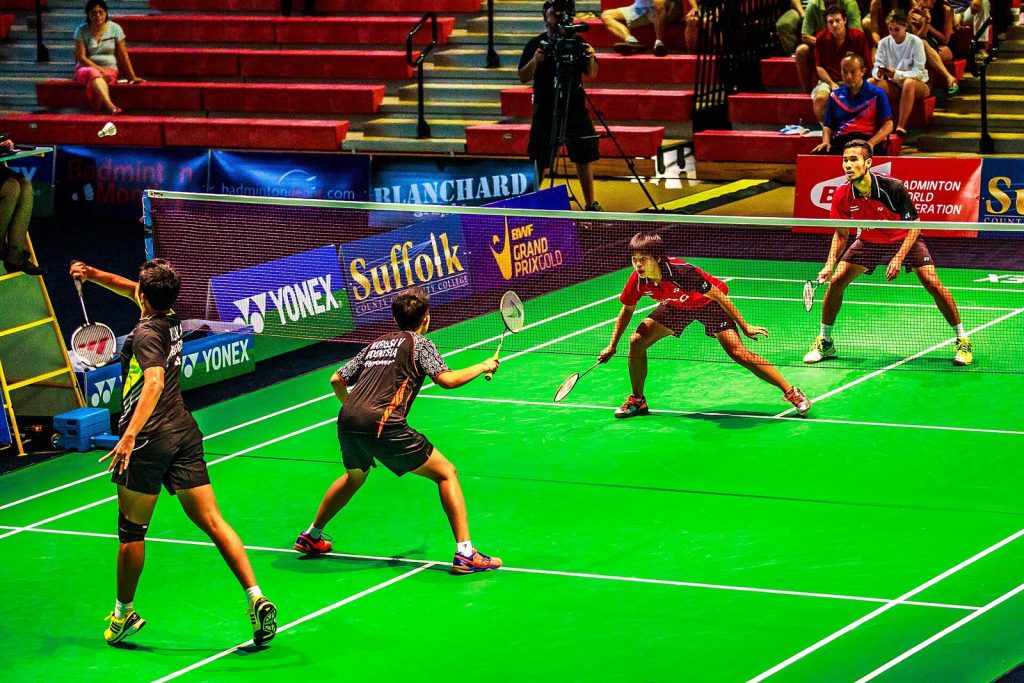
Opponents therefore try to break this structure, for example by lifting to the woman’s side of the rear court or by pulling the man forward to the net, so that the pair is forced into an unfamiliar shape. At high levels, formations are more flexible: top female players can attack effectively from the back, but pairs generally return to the standard shape when they can.
For club pairs, the practical lesson is to agree in advance what happens when the shape is broken. If the woman is forced to the back, does she play a clear and reset, or attack? If the man is drawn to the net, who covers the rear? Pairs that have discussed these situations recover faster than pairs who improvise.
Common mistakes at club level
- Both players standing in the same line. Two players at the back leave the net open; two at the net leave the back open. Formations exist to avoid this.
- Lifting too often. Every lift hands the attack to the opponents. Look for pushes, drives and net shots first.
- Front player retreating after every smash. The front player should hold position and be ready to intercept, not back away.
- Rear player smashing from poor positions. A weak smash from deep in the court gives the defence time to counter. A drop or half smash can be the better choice.
- Silent partnerships. Simple calls such as “yours,” “mine” or “out” prevent clashes and missed shuttles.
- Serving high by habit. High serves in doubles invite attacks. Develop a reliable low serve first.
- Not recovering after a shot. Hitting and then admiring the shot leaves gaps in the formation.
Simple drills to improve doubles play
- Two-versus-one attack and defence: one player feeds lifts while a pair practises front-and-back attack with rotation after drops.
- Drive exchanges: pairs practise flat drives across the net to get comfortable with fast midcourt exchanges.
- Serve and third-shot practice: repeat low serves, returns and the third shot to train the opening of rallies.
Doubles rewards teamwork more than any other format in badminton. Learn the two formations, practise moving between them, and agree on simple rules with your partner. You will be surprised how often good positioning beats raw power.