Volleyball Systems Explained: 5-1 vs 6-2 vs 4-2
What 5-1, 6-2 and 4-2 mean, how each system uses setters and hitters through six rotations, and which one suits beginners, clubs and elite teams.
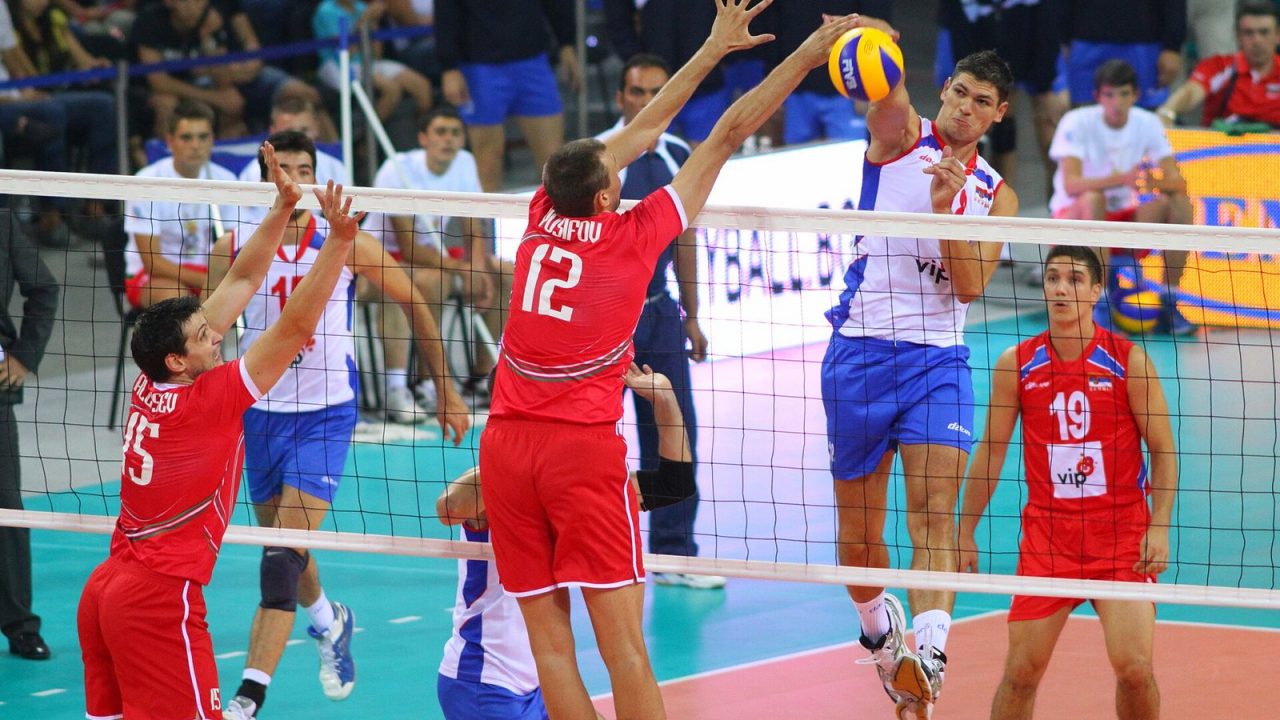
Listen to volleyball coaches for a few minutes and you will hear numbers that sound like football formations: “We run a 5-1,” “Our juniors play a 6-2,” “Start them in a 4-2.” These are offensive systems, and they answer one basic question: who sets the ball, and from where? Because every team has to rotate through all six court positions during a set, that question has a different answer in every rotation, and the system a team chooses shapes its line-up, its substitutions and the kind of attack it can run.
This guide explains what the numbers mean, walks through the three main systems rotation by rotation, compares their pros and cons, and explains why the 5-1 is the standard at the top level of the indoor game.
What the numbers mean
Each system name has two numbers. The first is the number of players who are primarily hitters (attackers); the second is the number of setters. They always add up to six, the number of players on court.
- 5-1: five hitters, one setter.
- 6-2: six hitters, two setters (the setters also hit when they are in the front row, which is why the first number is six).
- 4-2: four hitters, two setters (the setters set when they are in the front row and are not counted as hitters).
To understand why the details matter, you need two rules from the FIVB Official Volleyball Rules. First, players occupy six numbered positions: 4, 3 and 2 across the front row (left to right) and 5, 6 and 1 across the back row, and the team rotates one position clockwise each time it wins back the serve. Second, a back-row player may not complete an attack hit from the front zone (in front of the attack line, 3 m from the centre line) when the ball is entirely above the top of the net. A back-row player can still attack from behind the attack line.
So the key question in each rotation is: how many front-row attackers are available? Our guides to rotation and overlap rules and volleyball positions cover the underlying rules in depth.
The 5-1: one setter does everything
In a 5-1, a single setter takes the second contact in all six rotations. The line-up usually places the setter opposite the opposite hitter (three positions apart in the rotation), with the two outside hitters opposite each other and the two middle blockers opposite each other.
How the rotations work
- Setter in the back row (three rotations): the setter comes forward from the back row to set, and all three front-row players are available to attack: typically an outside hitter, a middle and the opposite. This is the strongest offensive situation.
- Setter in the front row (three rotations): only two front-row attackers are available, because the setter occupies the third front-row spot. To compensate, the setter can attack or “dump” the second ball over the net, and teams use back-row attacks from players behind the attack line.
Strengths
- One playmaker gives total consistency: hitters learn one set of tempos, one ball trajectory and one decision-maker.
- The team can field its best six attackers and blockers without being forced into constant substitutions.
- A front-row setter is also a blocker and a dumping threat, which keeps opponents honest.
Weaknesses
- In three rotations there are only two front-row attackers, so the team relies on back-row attacks and the setter’s dump to stretch the block.
- The setter must be fit and versatile, because he or she plays every ball in every rotation, blocks at the net and defends in the back row.
The 6-2: two setters, always three front-row hitters
In a 6-2, there are two setters placed opposite each other in the rotation. Whichever setter is in the back row sets; the setter in the front row becomes an attacker. The result is that three front-row hitters are available in every rotation.
How the rotations work
In practice, many teams combine the 6-2 with substitutions: when a setter rotates from the back row to the front row, a stronger hitter or blocker may come on in their place, and the setter comes back on when the rotation returns to the back row. Under FIVB rules, each team can make six substitutions per set, and a starting player can leave and re-enter only once per set, only to the same position in the line-up. Those limits make substitution-heavy 6-2 patterns something a coach must plan carefully.
Strengths
- Three front-row attackers in every rotation gives a more balanced offence.
- It creates playing time for two setters, which is helpful for developing teams and squads with two good setters but no outstanding one.
- Setters who can also hit stay engaged in both roles.
Weaknesses
- Hitters must adapt to two different setters with different set heights and tempos, which can reduce consistency.
- If the setters are not strong hitters, the “three attackers” advantage is partly theoretical.
- Substitution limits can constrain how freely a coach makes other changes.
The 4-2: the simplest system
In a 4-2, there are again two setters opposite each other, but this time the setter in the front row sets. Usually the setter moves to position 2 (front right) or position 3 (middle front) to set, leaving two front-row attackers: typically one on the left and one in the middle or right, depending on the team.
Strengths
- It is easy to learn. The setter is already at the net and does not need to run in from the back row after every serve.
- Serve receive is simpler, because the setter does not have to hide or release from the back row.
- It suits beginners, school teams and recreational players who are still mastering passing.
Weaknesses
- Only two front-row attackers are available in every rotation, so the offence is easier to read and block.
- Teams that progress usually outgrow it as their passing and hitting improve.
Side-by-side comparison
| System | Setters | Who sets | Front-row attackers | Best suited to |
|---|---|---|---|---|
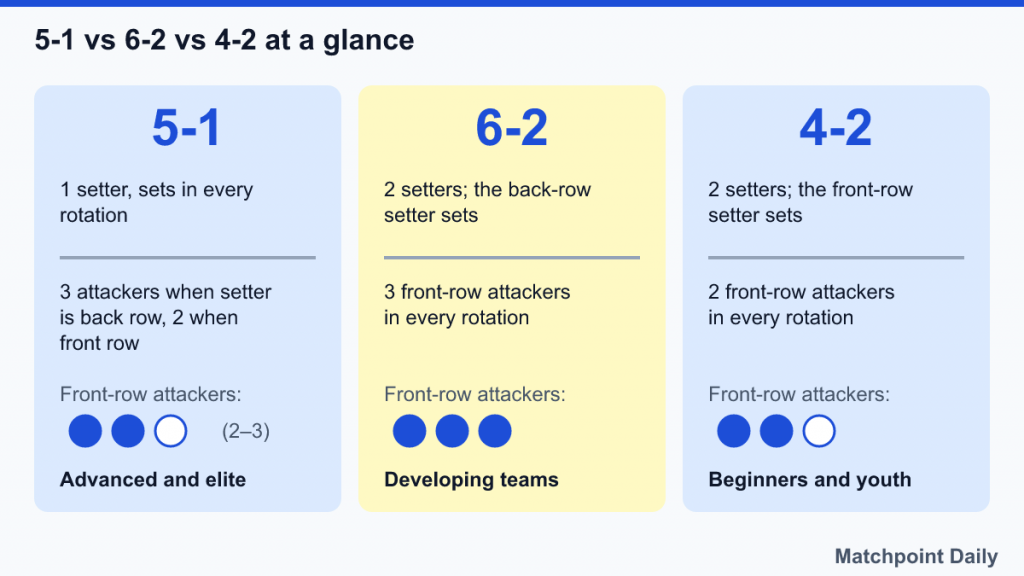
| 5-1 | 1 | The one setter, in every rotation | 3 when the setter is back row, 2 when front row | Advanced club, college, professional and national teams |
| 6-2 | 2 | Whichever setter is in the back row | 3 in every rotation | Developing and intermediate teams; squads with two capable setters |
| 4-2 | 2 | Whichever setter is in the front row | 2 in every rotation | Beginners, youth and recreational teams |
Some coaches also use hybrid systems, for example running a 5-1 for most of the set and switching to a 6-2 pattern for two or three rotations where the line-up is weakest. There are also beginner formats in which every player takes turns setting, but those are teaching tools rather than competitive systems.
Why elite teams use the 5-1
At high level, the 5-1 is overwhelmingly the standard choice. Several reasons combine:
- Specialisation pays. Elite setters are specialists whose timing, decision-making and ball placement are central to the offence. A team with one exceptional setter wants that player touching the second ball every time.
- Back-row attacks fill the gap. At elite level, outside hitters and opposites attack powerfully from behind the attack line (the “pipe” from the middle back is a common example), so a front-row setter rotation no longer means only two attacking options.
- The libero solves passing. With a libero handling much of serve receive and defence, the team can field hitters and blockers selected for their attacking value. Our article on the libero explains how the role works.
- Consistency in tempo. Fast combination plays (quick sets to the middle, slides, back-row combinations) rely on a fine-tuned connection between setter and hitters. One setter makes that connection much easier to build.
Choosing a system for your team
If you coach or organise a team, these questions usually point to the right answer:
- How reliable is your passing? If first contacts often go wild, a setter coming from the back row will struggle. A 4-2 keeps things simple.
- How many players can set well? One standout setter suggests a 5-1; two decent setters suggests a 6-2.
- Can your hitters attack from the back row? A 5-1 depends on it in three rotations.
- What is the team for? Youth development programmes often favour systems that give more players experience of setting and hitting, while results-focused teams lean towards the 5-1.
Common mistakes
- Moving to a 5-1 too early. A team whose passing cannot reliably get the ball to the setter will see the “extra hitter” advantage disappear.
- Forgetting overlap rules. Systems that require the setter to release from the back row need legal serve-receive formations; illegal positioning at the moment of serve costs points.
- Ignoring blocking match-ups. A small setter in the front row in a 5-1 may face the opponent’s best hitter; coaches often plan the starting rotation with this in mind.
- Not training both setters equally in a 6-2. Hitters need repetitions with both setters, or the offence will look like two different teams.
No system is “best” in the abstract. The 4-2 is the easiest to learn, the 6-2 gives balanced front-row firepower, and the 5-1 rewards a team with an outstanding setter and strong back-row hitters. As players improve, many teams naturally progress through all three.