Table Tennis Strokes for Beginners: Push, Drive, Loop, Block and Flick
The five core table tennis strokes explained for beginners: what the push, drive, loop, block and flick do, when to use them, common errors and a learning order.
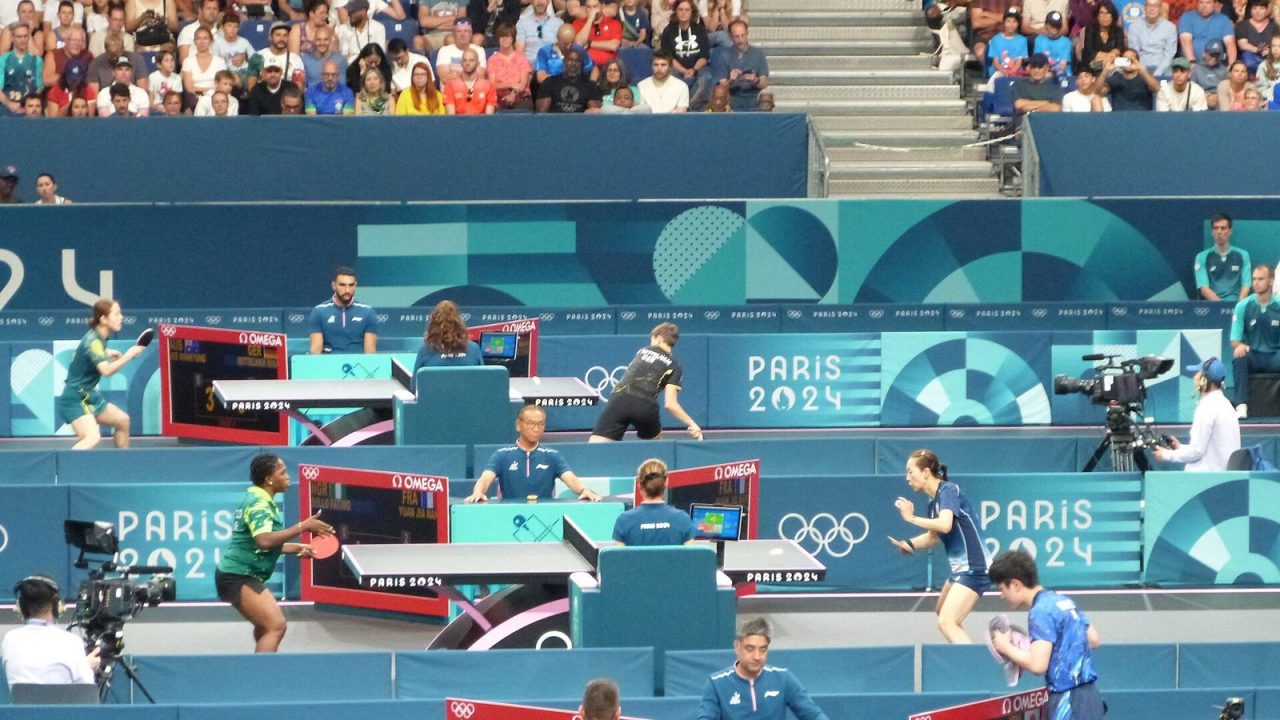
Watch two good table tennis players and the ball seems to move too fast to follow. Underneath, though, most rallies are built from a handful of fundamental strokes played on the forehand and backhand. This guide explains five of them, the push, drive, loop, block and flick, what each one does with spin and pace, when to use it, and the mistakes beginners most often make. Spin theory is kept short here, as it has its own article on this site.
Before the strokes: grip, stance and the ready position
Every stroke starts from the same base. Most players today use the shakehand grip, holding the racket as if shaking hands, with the thumb and index finger resting lightly on either side of the blade. Penhold grips are also used, particularly by some Asian players, and both are legal.
The ready position is roughly an arm’s length from the table, feet a little wider than shoulder width, knees bent, weight on the balls of the feet, and the racket in front of the body at around table height. Right-handers often stand with the right foot slightly back so the forehand has room to swing.
Two habits make every stroke easier:
- A relaxed grip. Squeezing the racket kills feel and slows the wrist.
- Returning to ready. After every shot, recover to the neutral position before the opponent hits.
A thirty-second guide to spin
The strokes in this guide either create spin or deal with it:
- Topspin makes the ball dip and kick forward off the table. A topspin ball tends to fly off your racket upward if you do not close the racket face (tilt it forward).
- Backspin (underspin) makes the ball float and check. A backspin ball tends to drop into the net if you do not open the racket face (tilt it back) or lift it.
Most beginner errors against spin come from using the wrong racket angle. The strokes below each have a typical angle that matches the spin they face.
The push
What it is: a short, controlled stroke against backspin, played close to the table, that sends the ball back with backspin of its own.
When to use it: to return short or low backspin serves and pushes when you cannot attack. It is the most common stroke in the early part of rallies at club level.
How to play it: open the racket face so it points slightly upward, move the racket forward and slightly down under the ball, and contact the ball near the top of the bounce or just after. Keep the stroke compact, mostly from the forearm and wrist. Both forehand and backhand pushes are used, though beginners usually find the backhand push easier.
Common errors: pushing too high, which gives the opponent an easy attack; pushing long without purpose; and swinging so hard that the ball goes off the end.
The drive (counter-hit)
What it is: a flat-to-slightly-topspin attacking stroke against topspin or a ball without much spin. It is often the first stroke beginners learn because it teaches timing and consistency.
When to use it: in rallies where both players are hitting with topspin close to the table, and to put away a high ball.
How to play it: close the racket face slightly, rotate the waist, and brush forward and slightly upward through the ball, finishing with the racket in front of the forehead (forehand) or pointing towards the target (backhand). Contact the ball at the top of the bounce.
Common errors: using only the arm, hitting late after the ball has dropped, and an open racket face that sends the ball long.
The loop
What it is: the defining attacking stroke of modern table tennis. A loop brushes the ball to produce heavy topspin, making it dip onto the table and jump forward off the bounce.
When to use it: against backspin to start an attack (the loop is the main way to turn a push into an attack), and against topspin as a stronger, spinnier alternative to the drive. Loops can be slow and heavy with spin or fast and powerful.
How to play it:
- Against backspin: drop the racket below the ball, keep the face a little more open, and swing upward and forward, brushing the back of the ball. Use your legs and waist to lift.
- Against topspin: start the racket at about the height of the ball, close the face more, and swing forward rather than up.
- Both: brush the ball rather than hitting it flat. The thinner the contact, the more spin.
Common errors: trying to loop with only the arm, failing to adjust the angle to the incoming spin, and standing too close or too far for the ball.
The backhand loop has become common among modern players, but most beginners develop the forehand loop first.
The block
What it is: a short, defensive stroke that redirects an attacking topspin ball using the opponent’s own pace.
When to use it: against loops and drives when you are close to the table and do not have time to attack.
How to play it: close the racket face, position it in the path of the ball just after it bounces, and let the ball rebound with a small forward motion. Absorb pace against a powerful loop (a “soft” block) or push forward slightly to return it faster (an “active” block). The backhand block is more common than the forehand block for most players.
Common errors: swinging at the ball instead of letting it rebound, an open racket face that pops the ball up, and blocking too late after the ball has risen high.
The flick (flip)
What it is: an attacking stroke over the table against a short ball, using a quick wrist and forearm action. It is called a flick or a flip.
When to use it: against short serves and short pushes that bounce twice on your side if left, when you want to attack rather than push. The backhand flick, sometimes played with sidespin and known in that form as a “banana flick”, is now a major weapon at the top level.
How to play it: step in with the foot nearest the ball under the table, bring the racket close to the ball, and use a short, fast wrist action, brushing the ball forward and up. Contact at the top of the bounce.
Common errors: not stepping in, which forces a reach; flicking backspin balls without enough lift; and flicking predictably to the same spot.
Stroke summary
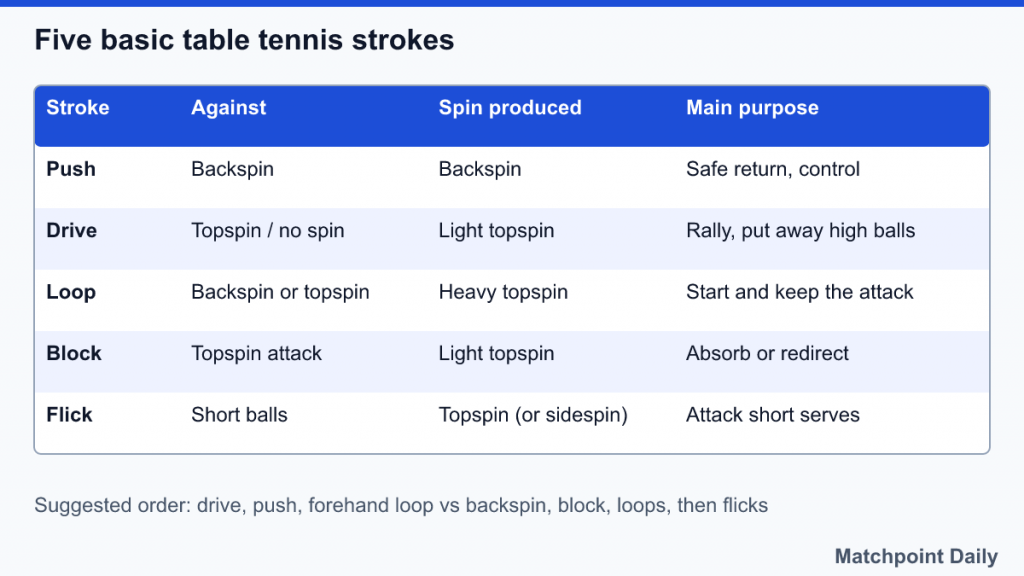
| Stroke | Against | Spin produced | Distance from table | Main purpose |
|---|---|---|---|---|
| Push | Backspin | Backspin | Close | Safe return, control |
| Drive | Topspin / no spin | Light topspin | Close to mid | Rally, put away high balls |
| Loop | Backspin or topspin | Heavy topspin | Close to mid-distance | Start and maintain attack |
| Block | Topspin attack | Light topspin | Close | Absorb or redirect attack |
| Flick | Short balls | Topspin, sometimes sidespin | Over the table | Attack short serves and pushes |
A suggested order for learning
- Forehand and backhand drive against a coach or partner feeding topspin. This builds timing, footwork and consistency.
- Backhand and forehand push so you can return backspin safely.
- Forehand loop against backspin, the stroke that turns defence into attack.
- Backhand block to handle opponents’ loops.
- Forehand loop against topspin and the backhand loop.
- Flicks once you can read short serves and push reliably.
Alongside strokes, practise serving and receiving from the start. Serve legality has a detailed set of requirements, and our table tennis rules guide covers the basics of scoring, lets and what counts as a legal return.
Practising effectively
- Use regular drills. Simple patterns, such as forehand to forehand, backhand to backhand, or one forehand and one backhand alternately, build consistency quickly.
- Use multiball. A coach or partner feeding many balls quickly lets you repeat a stroke dozens of times in a few minutes.
- Focus on footwork. Many “stroke” errors are really positioning errors. Small adjustment steps put you in the right place to swing.
- Get coaching early. Bad habits, especially with grip and racket angle, are much easier to fix in the first months. A qualified coach at a local club or a national association programme can spot faults you cannot see yourself.
- Warm up. Table tennis involves fast rotation and lunges. Build up gradually and seek advice from a professional if you have joint or back problems.
Common beginner questions
Should I learn to loop straight away?
Learn the drive and push first. The loop is easier once your timing and racket angle are reliable.
Do I need an expensive racket?
No. A pre-assembled all-round racket is ideal while learning strokes; very fast or very spinny rubbers make control harder.
Forehand or backhand first?
Most coaches teach both from the first sessions, usually starting with a forehand drive and a backhand push or block. Players often favour one side naturally, but a weak backhand is quickly exploited, so balance both.
How do I know if my stroke is correct?
Consistency is the best early test. If you can hit 20 or 30 controlled balls in a row with a stroke against a steady feed, the basic mechanics are working. Filming yourself from the side also helps you spot a cramped elbow or a late contact.
Is it a fault if the ball hits my finger?
Not if it is the hand holding the racket, below the wrist. The rules treat that hand as part of the racket.