How the Volleyball Nations League Works
How the VNL works as of 2026: 18 teams per gender, three preliminary weeks, an eight-team Finals, relegation and why every match counts for the world ranking.

Every summer, the world’s leading national volleyball teams spend weeks crisscrossing the globe in the Volleyball Nations League (VNL). For fans it is the most regular chance to see national teams in action outside the Olympics and World Championships; for coaches it is a long testing ground for players and tactics; and since every match counts towards the FIVB World Ranking, it matters for seeding and qualification too.
This guide explains where the VNL came from, how many teams take part, how the preliminary round and the Finals work, how teams enter and leave the competition, and how it connects to the world ranking. It describes the format as of the 2026 edition.
Origins: replacing the World League and Grand Prix
Before 2018, international volleyball’s annual summer competitions were split by gender and branded differently. Men played the FIVB World League, which ran from 1990 to 2017, and women played the FIVB World Grand Prix, which ran from 1993 to 2017.
In October 2017, the FIVB announced a new competition as a joint project with the sports marketing company IMG and 21 national federations. The Volleyball Nations League launched in 2018 for both men and women, with a common format, shared branding and a schedule designed for television. The men’s Finals of the first edition were held in Lille, France, and the women’s Finals in Nanjing, China.
The idea was to give national-team volleyball a reliable annual product, similar to a league season, with the strongest nations guaranteed to take part and enough matches for teams to build momentum and audiences to follow storylines.
Teams: from core and challengers to 18 per gender
The original VNL had 16 teams per gender, divided into two groups:
- 12 core teams, which were guaranteed a place every year;
- 4 challenger teams, which could be relegated.
The lowest-placed challenger team was relegated each year and replaced by the winner of a separate competition, the Challenger Cup, which ran alongside the VNL from 2018 to 2024 and gave other ambitious nations a pathway in.
That system changed for 2025. The field expanded to 18 teams per gender, the distinction between core and challenger teams was abolished, and the Challenger Cup was discontinued. In the men’s competition, for example, China (the 2024 Challenger Cup winner) and Ukraine (the highest-ranked non-qualified team) were added to make up the 18.
The preliminary round
The VNL starts with a preliminary round spread over three weeks of competition in different host cities. Using the 2025 men’s edition as the template:
- The 18 teams are split into pools of six each week, with three pools playing simultaneously in different venues.
- Each team plays four matches per week, giving 12 preliminary matches per team in total.
- All results go into a single combined standings table.
The preliminary round is long and physically demanding, with significant travel between weeks. Coaches frequently rotate their squads, give younger players international experience and manage the workload of key players, especially in years with an Olympic Games or World Championship later in the season. That is one reason VNL line-ups can look different from the line-ups those same nations use at the Olympics.
The Finals
The top eight teams from the preliminary standings qualify for the Finals. The host nation of the Finals is guaranteed a place: if it does not finish in the top eight, it takes the eighth spot.
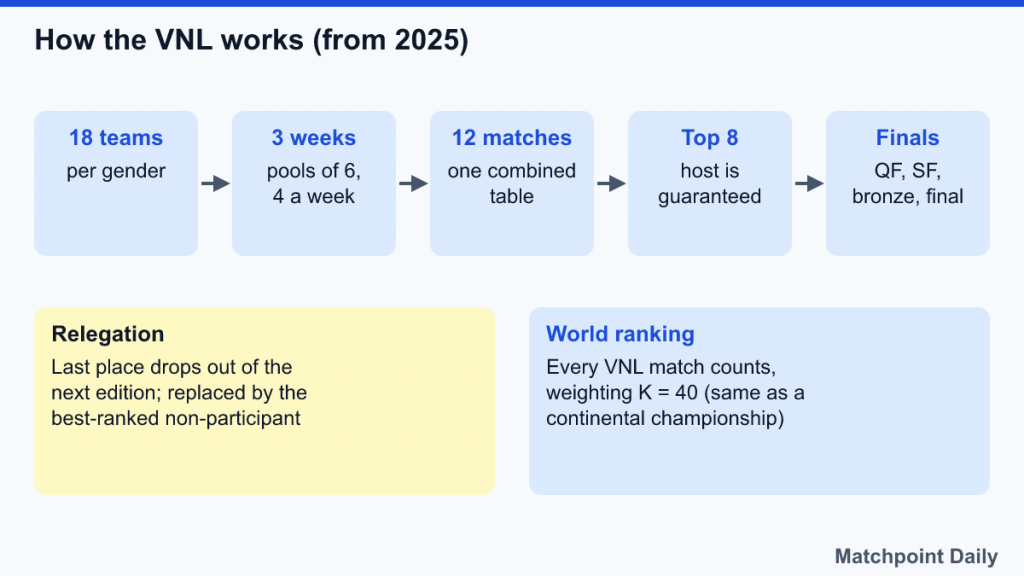
Since 2022, the Finals have been a straight knockout:
- four quarter-finals (seeded by preliminary ranking);
- two semi-finals;
- a bronze-medal match and a final.
Before 2022, the format was different: the original editions used a final round with pools (six teams in two pools of three in the men’s competition) followed by semi-finals. The knockout format makes every Finals match decisive and fits neatly into a few days of television.
Recent men’s Finals hosts have included Poland (Gdańsk in 2023, Łódź in 2024) and China (Ningbo in 2025 and 2026).
Relegation and promotion
From 2025 onward, the rule is simple. The team that finishes last in the overall standings is relegated from the next edition. Its place goes to the highest-ranked team in the FIVB World Ranking that did not take part in that year’s VNL. A relegated team cannot be the team that is promoted.
The first application of the new rule in the men’s competition saw the Netherlands finish 18th in 2025 and drop out of the 2026 edition. The ranking-based promotion means that nations outside the VNL have a clear incentive to keep winning matches in continental competitions, because ranking position is now their route in.
Why the VNL matters for the world ranking
Since February 2020, the FIVB World Ranking has used a match-based system. After every counting match, points move between the two teams according to a formula that considers the result (including the set score: a 3–0 win is worth more than a 3–2 win) and the expected result based on the teams’ relative strength. Upsets move more points than expected results.
Each competition carries a weighting factor. From 2026 the weights are:
| Competition | Weighting (K) |
|---|---|
| Olympic Games | 50 |
| FIVB World Championship | 50 |
| Volleyball Nations League | 40 |
| Continental championships | 40 |
| Annual official continental events | 30 |
| Annual official zonal events | 20 |
With at least 12 matches per team each summer, all weighted at the same level as a continental championship, the VNL gives participating teams many opportunities to gain or lose ranking points. That matters because the ranking is used to allocate places at the World Championships and the Olympic Games, as well as to decide seeding and VNL promotion. A strong VNL can therefore improve a team’s draw at the next major tournament, and a poor one can hurt it. For how ranking-based qualification shapes the Olympic tournaments, see our guide to volleyball at the Olympics.
Champions so far
Through the 2026 edition (there was no tournament in 2020 because of the COVID-19 pandemic), the VNL champions have been:
| Year | Men | Women |
|---|---|---|
| 2018 | Russia | United States |
| 2019 | Russia | United States |
| 2021 | Brazil | United States |
| 2022 | France | Italy |
| 2023 | Poland | Turkey |
| 2024 | France | Italy |
| 2025 | Poland | Italy |
| 2026 | Poland | Turkey |
Poland leads the men’s roll of honour with three titles, after beating the United States in a five-set final in Ningbo in 2026. On the women’s side, Italy and the United States have three titles each, and Turkey has two. Brazil’s women have been runners-up several times, including in 2025 and 2026, without yet winning the title.
Does VNL form predict the big titles?
Sometimes, but not reliably. The 2025 season is a good illustration. Italy’s women won the 2025 VNL and then went on to win the 2025 World Championship in Thailand, so their summer form carried straight through. Italy’s men lost the 2025 VNL final to Poland, yet a few weeks later they won the 2025 World Championship in the Philippines, beating Bulgaria in the final, while Poland took bronze.
Several factors explain why VNL results and major-title results can diverge:
- Timing. The VNL comes earlier in the summer, and teams aim to peak for the main event that follows.
- Squad rotation. A team may not use its strongest line-up in every VNL week.
- Format. A knockout Finals rewards form over a few days, while the preliminary round rewards consistency over three weeks. Both differ from a World Championship or Olympic tournament.
The best use of VNL results is as one piece of evidence among several, alongside world ranking, continental results and head-to-head records.
Frequently asked questions
Is the VNL an Olympic qualifier?
Not directly. There are no Olympic places awarded for winning the VNL. Its influence is indirect, through the world ranking points every match carries.
What happened during the pandemic?
The 2020 edition was cancelled. The competition returned in 2021, with the men’s Finals played in Rimini, Italy.
Can a nation that is relegated come back?
Yes. A relegated team cannot be promoted straight back for the following edition, but in later years it can return as the highest-ranked non-participating nation if its ranking is strong enough.
Is the format the same for men and women?
The structure is shared: 18 teams, a three-week preliminary round, an eight-team knockout Finals and the same relegation rule. Host cities and dates differ between the two competitions.
How to follow the VNL
- Watch the standings, not just the results. With 12 matches each and only eight Finals places, the race for the top eight and the fight to avoid last place both matter.
- Look at squad selection. Many coaches use the early weeks for experimentation, so a weaker result does not always mean a weaker team.
- Follow ranking changes. Because VNL matches are weighted heavily, the world ranking can shift noticeably during the summer.
- Use the Finals as a preview. In years with an Olympic Games or World Championship, the VNL Finals are a useful but imperfect guide to who is peaking.
- Learn the tactics. The VNL is a showcase for elite systems; our explainer on 5-1, 6-2 and 4-2 systems explains what you are watching.
In short, the VNL is international volleyball’s regular season: 18 teams per gender, three weeks of pool play, an eight-team knockout Finals, one relegation spot and ranking points on every match. It may not carry the prestige of an Olympic medal, but it shapes the path to one.