Volleyball at the Olympics: Indoor and Beach Formats Explained
How Olympic indoor and beach volleyball tournaments work: team numbers, qualification routes, pools and knockouts, plus debut years and the most successful nations.
Volleyball is one of the few sports with two separate Olympic disciplines, indoor and beach, each with a men’s and a women’s tournament. Together they brought 72 teams and 384 athletes to Paris 2024. This guide explains how the two tournaments are structured, how teams qualify, how the pool and knockout stages work, and a little of the history behind them. Formats are described as used at Paris 2024, the most recent Games, because the details can change from one Olympics to the next.
A short history: from demonstration to medal sports
Indoor volleyball appeared at the 1924 Paris Games as a demonstration event and joined the official Olympic programme at Tokyo 1964, with both men’s and women’s tournaments. Japan’s women won gold on home soil in that first tournament.
Beach volleyball was a demonstration sport at Barcelona 1992 and became an official Olympic medal sport at Atlanta 1996.
The number of indoor teams has varied over the years, from ten teams in some early men’s tournaments to twelve. Both indoor tournaments have had 12 teams since 1996. In beach volleyball, the men’s tournament has had 24 teams at every edition since 1996, while the women’s tournament has had 24 teams since 2000.
Indoor volleyball: 12 teams per gender
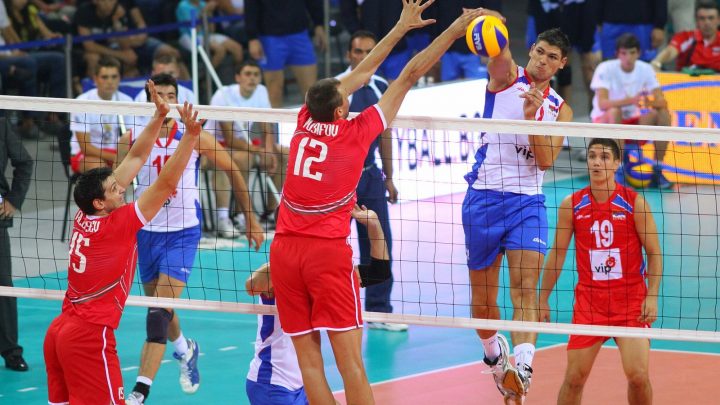
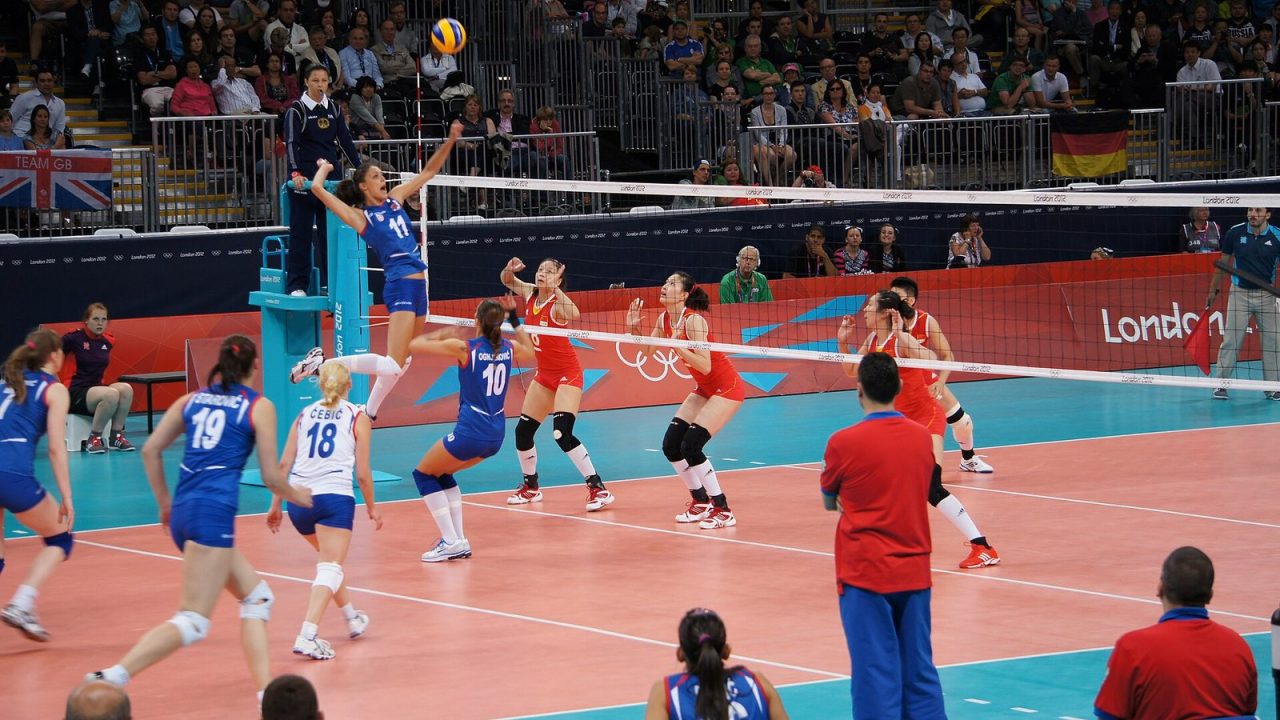
At Paris 2024, each indoor tournament had 12 teams. The rules of play are the standard FIVB indoor rules: six players per side, best-of-five-set matches, sets to 25 and a fifth set to 15. For a rules refresher, see our guide to volleyball rules. Olympic squads are small: each team has 12 players, and Paris 2024 was the first Olympic volleyball competition in which teams could also bring one non-competing alternate who could replace an athlete for medical reasons.
How indoor teams qualified for Paris 2024
- Host: France had a guaranteed place in both the men’s and women’s tournaments.
- Olympic qualification tournaments: three tournaments in 2023, with the winners and runners-up of each qualifying, six teams per gender in total.
- World ranking: the remaining five places went to the best-placed eligible teams in the FIVB world ranking as of June 2024, with priority given to continents that did not yet have a qualified team (the “universality principle”).
The indoor competition format
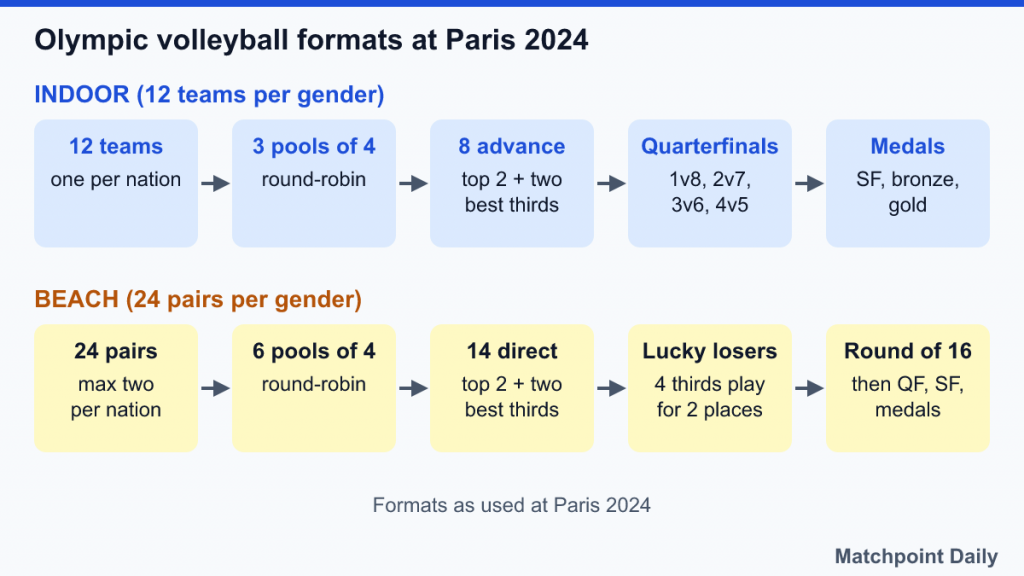
At Paris 2024, the 12 teams were drawn into three pools of four, each playing a single round-robin. This was a change from the previous nine Olympic tournaments, which had used two pools.
- The top two in each pool plus the two best third-placed teams advanced to the quarterfinals, making eight.
- Quarterfinal pairings were set by a combined ranking of all qualified teams based on pool position, matches won, match points, set ratio, points ratio and other tiebreakers: 1st played 8th, 2nd played 7th, 3rd played 6th and 4th played 5th.
- Single-elimination knockout rounds followed: quarterfinals, semifinals, the bronze medal match and the gold medal match.
Beach volleyball: 24 teams per gender
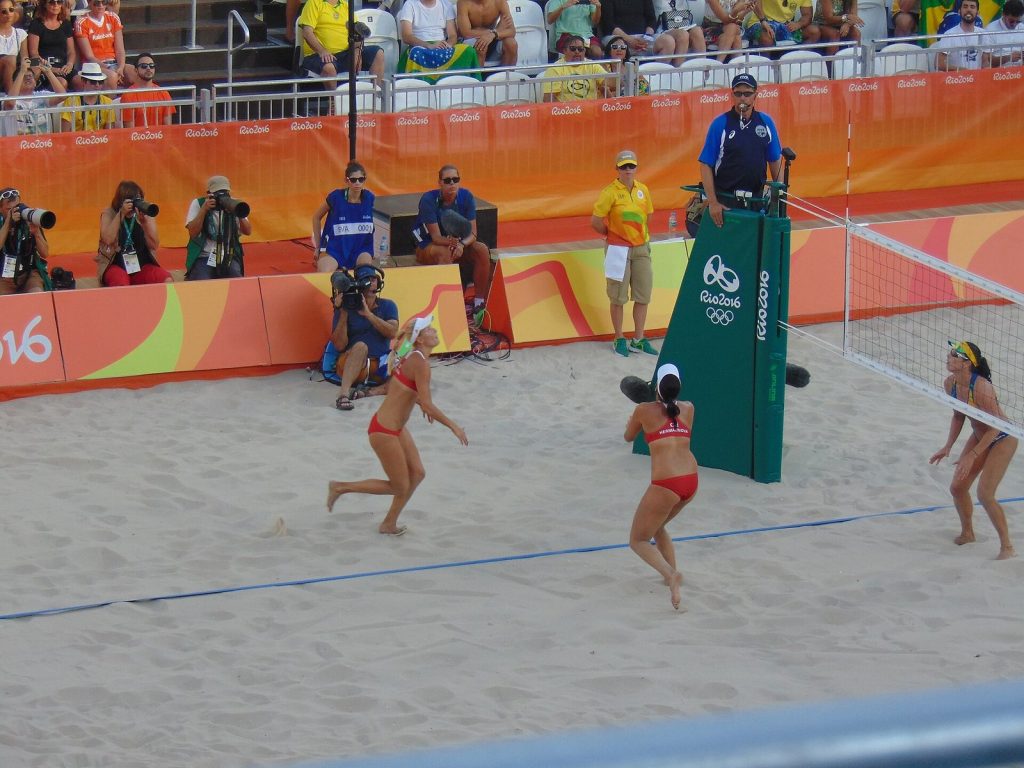
Each beach tournament has 24 pairs, with a maximum of two pairs per National Olympic Committee per gender. Matches use the FIVB beach rules: two players per team, best of three sets, sets to 21 and a deciding set to 15. Our article comparing beach and indoor volleyball explains the main differences.
How beach pairs qualified for Paris 2024
- Host: one place per gender for France.
- World Championships: the winners of the 2023 Beach Volleyball World Championships in each gender qualified directly.
- Olympic ranking: 17 places per gender went to the highest-ranked eligible pairs on the FIVB Olympic ranking list, based on each pair’s twelve best results between 1 January 2023 and 10 June 2024.
- Continental qualification: the final five places per gender went to the winners of continental qualification tournaments, one per continental confederation.
Because beach qualification is based on pairs rather than nations, a country’s strongest teams must compete against each other in the ranking race, and only two from each nation can make the field.
The beach competition format
At Paris 2024 the format for each gender was:
- Pool stage: six pools of four pairs, each playing a round-robin.
- Direct qualification for the round of 16: the top two in each pool (12 pairs) plus the two best third-placed pairs.
- Lucky loser round: the remaining four third-placed pairs played off, with the two winners taking the last two places in the round of 16.
- Knockout rounds: round of 16, quarterfinals, semifinals, bronze medal match and gold medal match, all single elimination.
Indoor vs beach at the Olympics: side by side
| Indoor | Beach | |
|---|---|---|
| Official debut | Tokyo 1964 | Atlanta 1996 |
| Teams per gender (Paris 2024) | 12 | 24 |
| Players per team | 12-player squads, 6 on court | 2 |
| Max teams per nation | 1 | 2 |
| Preliminary round | 3 pools of 4 | 6 pools of 4 |
| Knockout starts at | Quarterfinals (8 teams) | Round of 16 (after a lucky loser round) |
| Main qualification routes | Host, Olympic qualification tournaments, world ranking | Host, World Championship winners, Olympic ranking, continental qualification |
Paris 2024 medallists
| Event | Gold | Silver | Bronze |
|---|---|---|---|
| Indoor men | France | Poland | United States |
| Indoor women | Italy | United States | Brazil |
| Beach men | Sweden | Germany | Norway |
| Beach women | Brazil | Canada | Switzerland |
France’s win made them back-to-back Olympic men’s champions after their Tokyo 2020 title, and Italy’s women won their first Olympic gold. Indoor events were held at the Paris Expo Porte de Versailles, while beach volleyball was played in a temporary stadium at the foot of the Eiffel Tower.
The most successful nations
Indoor, through Paris 2024
- Men: the Soviet Union, the United States and Brazil have three gold medals each, and France two. Japan, Poland, the Netherlands, Russia and Yugoslavia have one each.
- Women: China (1984, 2004, 2016) and Cuba (1992, 1996, 2000) have three golds each, with Cuba’s coming in three consecutive Games. Japan won in 1964 and 1976, Brazil in 2008 and 2012, the United States in 2020 and Italy in 2024, while the Soviet Union won several titles from 1968 onwards.
Beach, through Paris 2024
The United States has been the most successful beach volleyball nation, with seven of the sixteen Olympic gold medals awarded across both genders, followed by Brazil with four. The best-known partnership in Olympic beach history is Misty May-Treanor and Kerri Walsh Jennings of the United States, who won three consecutive gold medals in 2004, 2008 and 2012.
Why the formats look the way they do
Both Olympic formats are a compromise between fairness and time. An Olympic volleyball tournament has to fit into roughly two and a half weeks, share venues and broadcast slots with other sports, and give every team meaningful matches.
- Pools first: a round-robin guarantees every team at least three matches, so a single bad day does not end a team’s Games. With 12 indoor teams, three pools of four keep the preliminary round short while producing eight quarterfinalists.
- Best third-placed teams: with three pools, taking only the top two would give six quarterfinalists, an awkward number for a bracket. Adding the two best third-placed teams makes a clean eight.
- Lucky losers on the beach: six pools of four produce 12 automatic qualifiers plus six third-placed pairs. Two go straight through and the other four play off for the final two places, giving a 16-team knockout bracket.
- Seeding by ranking: pairing the best-ranked qualifiers with the lowest in the quarterfinals rewards strong pool performance and keeps the strongest teams apart in the early knockout rounds.
The physical demands of the two disciplines also shape scheduling. Beach pairs have no substitutes and play outdoors in summer conditions, while indoor teams play longer matches but can rotate their squads.
Common questions
Can a country have two indoor teams?
No. Each nation can enter one men’s and one women’s indoor team. On the beach, a nation can have up to two pairs per gender.
Do the libero rules apply at the Olympics?
Yes. Olympic indoor matches use the standard FIVB rules, so teams use liberos in the normal way; see our article on the libero’s role and restrictions.
Is there a bronze medal match?
Yes, in both disciplines. The losing semifinalists play for bronze, so every medal is decided on court.
Looking ahead to Los Angeles 2028
Volleyball is on the programme for the Los Angeles 2028 Games, where the United States will be host nation. It is a fitting setting: indoor volleyball was invented in Holyoke, Massachusetts, in 1895, and the United States is the most successful nation in Olympic beach volleyball. Qualification systems and competition formats are set for each Games by the FIVB and the International Olympic Committee and published ahead of the qualification period, so the details may differ from those used in Paris. Check the official FIVB and Olympic channels as qualification approaches.
How to follow Olympic volleyball
- Know the qualification calendar. For indoor, results in the world ranking events and qualification tournaments in the year before the Games are decisive. For beach, the Olympic ranking period runs across most of the preceding season and a half.
- Watch the pool standings closely. In both disciplines, finishing third does not end a team’s Games; the best third-placed teams advance, and on the beach the others get a second chance in the lucky loser round.
- Remember the tiebreakers. In the indoor combined ranking used at Paris 2024, teams were ordered by pool position, then matches won, match points, set ratio and points ratio, so a dropped set can matter for quarterfinal pairings.