How the Volleyball World Beach Pro Tour Works
A clear guide to the Beach Pro Tour: Elite16, Challenge and Futures events, qualification, pool formats, the season Finals and how it links to the Worlds.
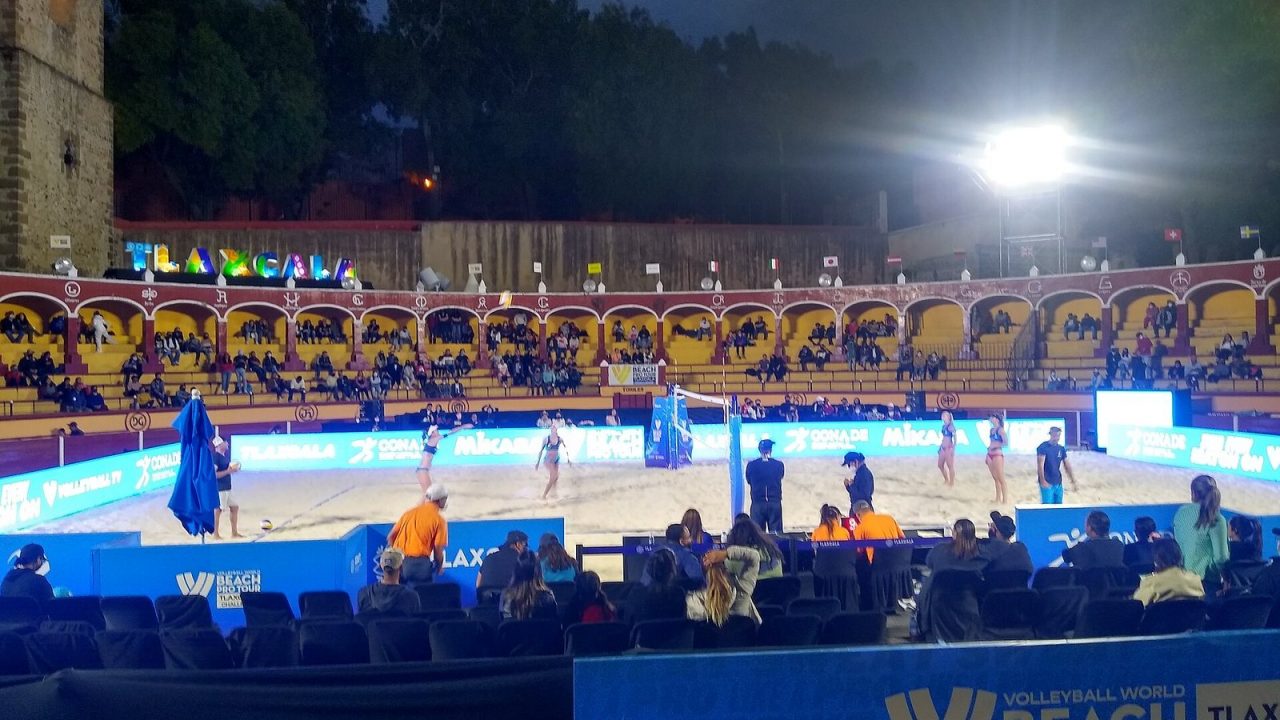
Professional beach volleyball runs on a global circuit. Through most of the year, the world’s best teams travel from beach to beach, collecting results that decide their ranking, their entry into the biggest events and, in Olympic cycles, their chances of reaching the Games. Since 2022, that circuit has been the Volleyball World Beach Pro Tour, which replaced the long-running FIVB Beach Volleyball World Tour.
This guide explains how the tour is structured as of 2026: the three levels of events, how each tournament is played, how teams progress up the ladder, the season-ending Finals and how the tour connects to the Beach Volleyball World Championships and the Olympics.
From the World Tour to the Beach Pro Tour
The FIVB had run an international beach circuit since 1989 for men and 1992 for women. Over three decades, the World Tour grew from a handful of events into a sprawling calendar of tournaments with different star ratings and prize levels.
In October 2021, Volleyball World announced a rebrand and restructuring. The new Beach Pro Tour started in 2022 with a clearer ladder of three event levels, standard formats for each level and a season-ending Finals for the best teams. The aim was to make the circuit easier for fans to understand and more attractive to broadcasters and sponsors, while giving developing teams a defined route to the top.
The three levels: Elite16, Challenge and Futures
| Level | Main draw (per gender) | Qualification | Role |
|---|---|---|---|
| Elite16 | 16 teams | Up to 16 teams | Top tier; the world’s leading teams |
| Challenge | 24 teams | Up to 32 teams | Feeder to Elite16; awards ranking points |
| Futures | 16 teams | Up to 16 teams | Entry level; feeder to Challenge; awards ranking points |
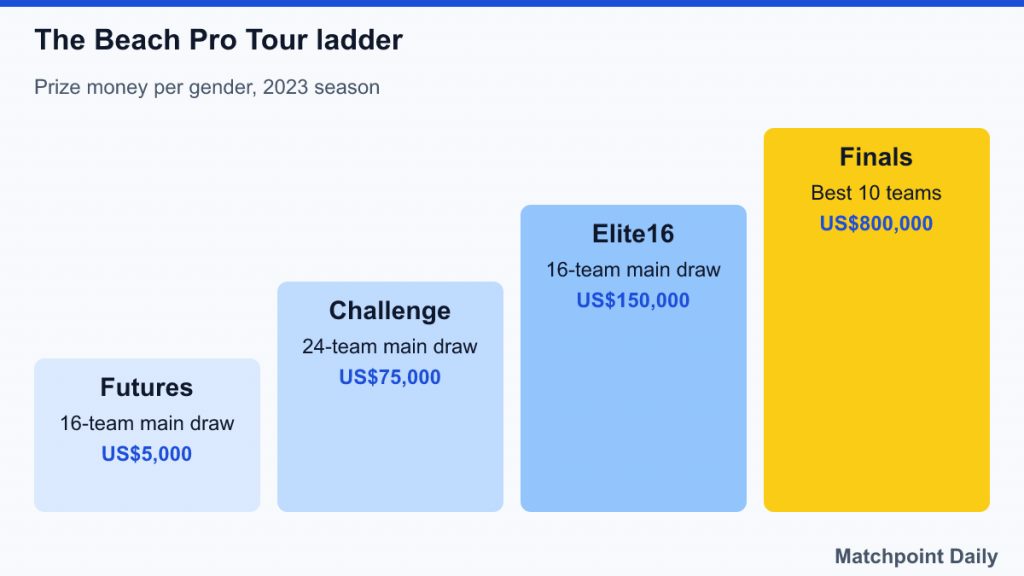
Above these sit two special events: the Beach Pro Tour Finals, which close the season, and the Beach Volleyball World Championships. In the 2023 season, published prize money per gender was US$150,000 for an Elite16, US$75,000 for a Challenge, US$5,000 for a Futures event, US$500,000 for the World Championships and US$800,000 for the Finals, which gives a sense of the gap between the tiers.
How each level is played
Elite16
An Elite16 event runs for about five days including qualification. The qualification tournament, with up to 16 teams, sends a small number of teams into the 16-team main draw. The main draw then works in two phases:

- Pool phase: four pools of four teams. The pool winners go straight to the quarter-finals; the second- and third-placed teams go into a round of 12.
- Knockout phase: round of 12, quarter-finals, semi-finals, a bronze-medal match and the final.
Winning a pool is valuable because it saves a match and gives a team a direct route to the last eight.
Challenge
Challenge events have a larger main draw of 24 teams, drawn into six pools of four, played with a modified pool-play format, followed by a single-elimination bracket. That adds up to 40 main-draw matches per gender over four or five days. Qualification can involve up to 32 teams, so Challenge events are often fiercely contested by teams trying to break into the elite.
Futures
Futures events use a 16-team main draw in four pools of four, again with modified pool play followed by single elimination, for a total of 28 matches per gender. They are the most accessible level of the tour, used by young teams, newly formed partnerships and players from developing beach volleyball nations to earn their first international ranking points.
Every match follows the FIVB beach rules: best of three sets to 21, a deciding set to 15, and side switches every seven points (five in the deciding set). Our guide to beach volleyball rules explains the details.
Entry, ranking points and moving up the ladder
Ranking is the currency of the Beach Pro Tour. Teams earn points based on the level of the event and how far they advance, and a team’s entry into future events depends largely on its ranking.
In practice, the ladder works like this:
- A new team starts at Futures events, sometimes through qualification, to earn initial points.
- Good results at Futures events give access to Challenge qualification and then to Challenge main draws.
- Strong Challenge results lift a team high enough to enter Elite16 qualification and eventually Elite16 main draws.
- Consistent Elite16 results bring qualification for the Finals and strengthen the team’s standing for the World Championships and, in Olympic cycles, the Olympic Games.
Because entry depends on ranking, scheduling is strategic. A team on the edge of the Elite16 main draw may choose to play a Challenge event where it can realistically go deep, rather than an Elite16 where it would have to come through qualification. Teams also have to balance points against travel, recovery and the cost of a long season.
The Beach Pro Tour Finals
The season ends with the Finals, an exclusive event for the best ten qualified teams of the season per gender. It carries the tour’s largest prize fund and is the closest thing beach volleyball has to a season championship outside the Worlds and the Olympics.
Doha, Qatar, has been a regular host. Recent Finals champions include:
| Season | Men | Women |
|---|---|---|
| 2022 (played January 2023, Doha) | Anders Mol / Christian Sørum (Norway) | Sara Hughes / Kelly Cheng (USA) |
| 2023 (Doha) | David Åhman / Jonatan Hellvig (Sweden) | Kristen Nuss / Taryn Kloth (USA) |
| 2024 (Doha) | Anders Mol / Christian Sørum (Norway) | Kristen Nuss / Taryn Kloth (USA) |
The Norwegian pair Mol and Sørum, who also won the last World Tour Finals in 2021, have been the defining men’s team of the tour’s early years.
How the tour relates to the World Championships and Olympics
Beach Volleyball World Championships
The World Championships, first held in 1997, are a separate FIVB event rather than a tour stop, but they sit inside the same season and draw the same teams. A strong tour season is the natural preparation for the Worlds, which offer a large prize fund and the prestige of a world title.
The Olympic Games
Beach volleyball has been an Olympic sport since 1996. In Olympic cycles, results on the Beach Pro Tour feed into the rankings used for Olympic qualification, alongside continental routes. That makes the tour especially intense in the year or two before a Games, as teams chase every point. For how the Olympic tournament itself is organised, see our guide to volleyball at the Olympics.
Why the formats are designed this way
The combination of pools and knockouts is a deliberate compromise. Pure single elimination is fast, but it means a team that travelled across the world could be out after one match, often against a top seed. Pure round-robin is fair but takes too long for a five-day event. Pools of four guarantee every main-draw team several matches, and then the knockout rounds deliver the decisive drama that television needs.
The Elite16 twist, in which pool winners go straight to the quarter-finals while second- and third-placed teams play an extra round, rewards topping the pool. It gives the best-performing teams a little more rest, which matters in hot conditions and tight schedules.
The modified pool play used at Challenge and Futures events serves a similar purpose with larger fields: it reduces the number of matches compared with a full round-robin, while still giving teams more than one chance to show what they can do.
Frequently asked questions
What does “Elite16” mean?
The name refers to the 16-team main draw per gender. It is the top regular level of the tour.
Is the Beach Pro Tour the same as the AVP?
No. The AVP is a professional beach volleyball organisation in the United States, founded in the 1980s after a players’ strike. The Beach Pro Tour is the international circuit run under the FIVB umbrella, and American teams can appear on both circuits.
Are the Finals the same as the World Championships?
No. The Finals are an invitation event for the season’s best ten teams per gender, while the World Championships are a separate FIVB championship with a much larger field and the official world title at stake.
Do men and women play at the same events?
The formats are defined per gender, and many tour stops stage both men’s and women’s draws, although the calendars do not always match exactly.
How to follow a Beach Pro Tour season
- Anchor on the Elite16 events. They feature the leading teams and are the most widely broadcast.
- Use the pool phase to spot form. In an Elite16, pool winners skip the round of 12, so pool results tell you who is in form.
- Watch Challenge events for breakthroughs. This is where rising teams earn the results that carry them to the top level.
- Follow partnerships, not just players. Beach teams split and re-form between seasons, and new pairings often take time to click.
- Remember the conditions. Wind, heat and sand vary widely between venues, which is part of what makes beach results less predictable than indoor ones. Our comparison of beach and indoor volleyball explains why.
The structure is easy to remember: Futures at the bottom, Challenge in the middle, Elite16 at the top, then the Finals for the best ten teams, with the World Championships and, every four years, the Olympics as the biggest prizes of all.