Beach Volleyball vs Indoor Volleyball: The Key Differences
Beach and indoor volleyball share a net height and a basic idea, but team size, court, ball, scoring, positions and physical demands differ. Here is how.
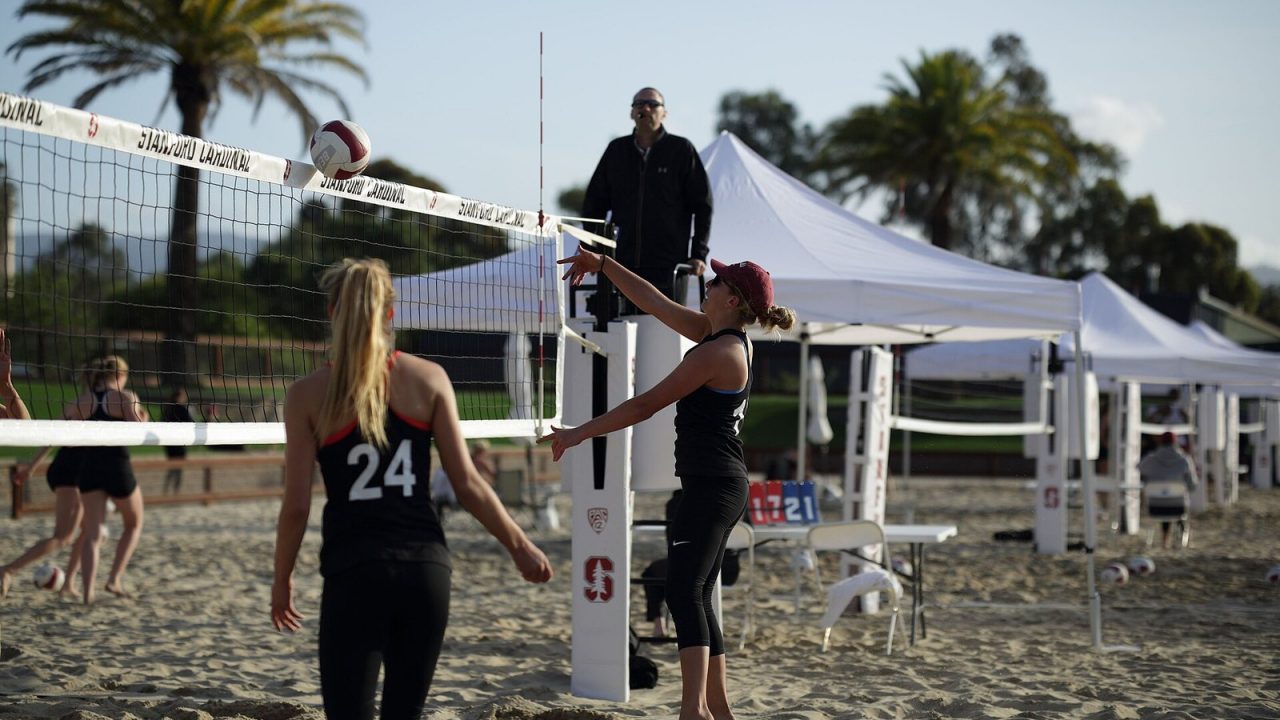
Beach and indoor volleyball share a name, a net height and an Olympic programme, yet players who switch between them often say it feels like learning a new sport. Two players instead of six, a smaller court, a softer ball, shorter sets and sand underfoot all change what wins points. This guide compares the two disciplines side by side, using the FIVB Official Volleyball Rules 2025–2028 and the FIVB Official Beach Volleyball Rules 2025–2028. Beach-specific faults, such as the restrictions on open-hand tips and hand sets over the net, are covered in more depth in our separate beach rules article.
Side-by-side comparison
| Element | Indoor (FIVB) | Beach (FIVB) |
|---|---|---|
| Players per team | 6 on court, plus substitutes and up to 2 liberos | 2, with no substitutes |
| Court | 18 x 9 m | 16 x 8 m |
| Attack line | Yes, 3 m from the centre line | None |
| Net height | 2.43 m men, 2.24 m women | 2.43 m men, 2.24 m women |
| Ball circumference | 65–67 cm | 66–68 cm |
| Ball weight | 260–280 g | 260–280 g |
| Ball pressure | 0.30–0.325 kg/cm² | 0.175–0.225 kg/cm² |
| Match | Best of five sets | Best of three sets |
| Set length | 25 points; 5th set to 15 | 21 points; 3rd set to 15 |
| Fixed positions / rotation | Yes, rotational order enforced for the receiving team at the serve | No positions; only a service order |
| Block counts as a hit? | No | Yes |
| Time to serve | 8 seconds after the whistle | 5 seconds after the whistle |
| Timeouts | 2 per set, 30 seconds | 1 per set, 30 seconds (plus a technical timeout in sets 1 and 2 at FIVB events) |
| Changing sides | After each set; at 8 points in the 5th | Every 7 points in sets 1 and 2, every 5 in set 3 |
| Interval between sets | 3 minutes | 1 minute |
| Coaching during play | Coach on the bench calls timeouts and substitutions | Only the captain may request timeouts |
Team size and the absence of specialists
The biggest difference is also the simplest: beach teams have two players and no substitutes. Indoors, a team may list up to 12 players for a match (up to 14 in senior FIVB competitions), and each set allows six substitutions plus unlimited libero replacements. On the beach, the two players who start the match must finish it.
That has huge consequences for skill sets. Indoor players specialise: setters set, middles block, liberos pass and dig. Our guide to indoor volleyball positions explains how each role works. A beach player has to pass, set, attack, serve and defend on every rally. Partnerships usually divide into a “blocker” and a “defender” based on height and skill, but even the blocker digs and the defender attacks. There is no libero on the beach, and nobody can be hidden.
Court size and the ball
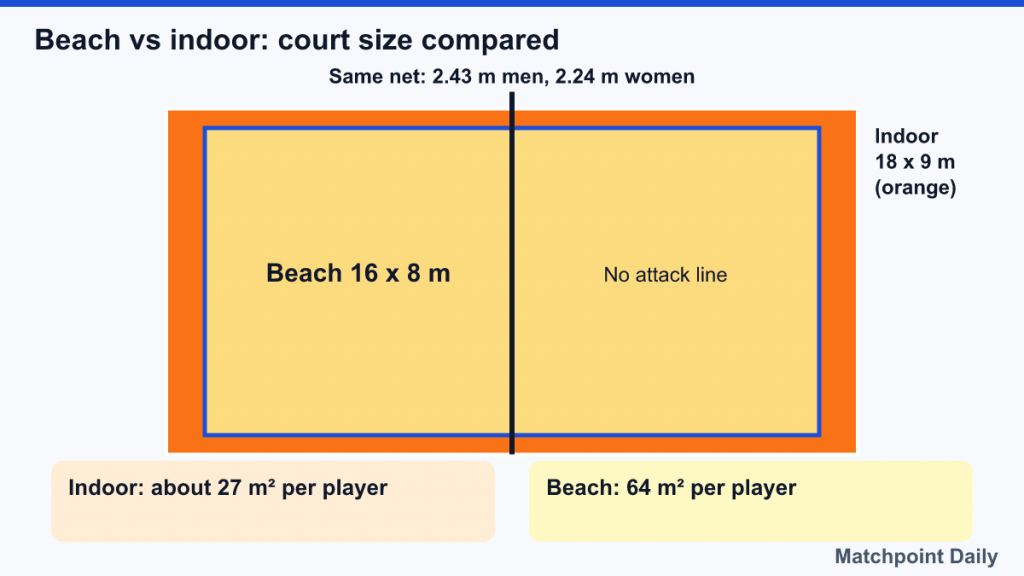
The beach court is 16 x 8 m, two metres shorter and one metre narrower than the 18 x 9 m indoor court. With only two players covering it, though, each player is responsible for 64 square metres of sand compared with about 27 square metres per player indoors. There is no attack line on the beach, so the front-row/back-row distinction disappears entirely: either player can attack from anywhere.
The beach ball is slightly larger in circumference and inflated to a much lower pressure. In practice it feels softer and floats more, and it is more affected by wind. That is one reason why float serves and high, looping sets behave so differently outdoors.
Net heights are identical, 2.43 m for men and 2.24 m for women in both disciplines. On sand, though, players cannot jump as high as on a hard floor, so the net effectively plays higher on the beach.
Scoring and match format
Both disciplines use rally-point scoring with a two-point margin, but the targets differ:
- Indoor: best of five sets. Sets 1–4 go to 25; a deciding fifth set goes to 15.
- Beach: best of three sets. Sets 1 and 2 go to 21; a deciding third set goes to 15.
Beach teams switch sides frequently to share sun and wind conditions fairly: after every 7 points played in sets 1 and 2, and every 5 points in set 3. Indoors, teams swap ends between sets and once in the deciding set when the leading team reaches 8 points.
Timeouts are scarcer on the beach. Each team gets one 30-second timeout per set, requested by the captain since there is no coach on the bench in the indoor sense. At FIVB, world and official competitions, an additional 30-second technical timeout is applied automatically in sets 1 and 2 when the combined score reaches 21. Indoor teams get two 30-second timeouts per set, called by the coach.
Positions, rotation and serving order
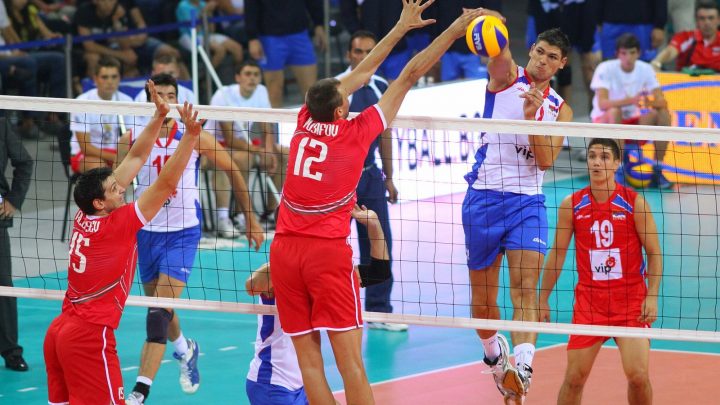
Indoor volleyball enforces a rotational order. When the ball is served, the receiving team’s players must be correctly positioned relative to each other, and teams rotate clockwise each time they win back the serve. The rotation dictates who is in the front row and who may block or attack at the net.
On the beach, the rules state plainly that there are no determined positions on the court and no positional faults. Players may stand anywhere on their side when the ball is served. What is kept is a service order: the two players must alternate serving in the order set at the start of each set, and serving out of turn is a fault that gives the opponents a point and the serve.
The block counts as a touch on the beach
This single rule difference reshapes tactics. Indoors, a block contact does not count as one of the team’s three hits, so after a touch on the block the team still has three contacts to organise a counter-attack.
On the beach, the block does count as a team hit. If the blocker touches the ball, the team has only two contacts left. In practice, the defender usually digs a ball deflected by the block and the blocker either sets or attacks it straight back. Beach players also often prefer not to block every attack at all; instead, the blocker may drop off the net and both players defend, which is rare at elite indoor level.
Shot restrictions and ball handling
Ball handling is judged differently in the two disciplines. On the beach, an attack hit made with an open-handed finger action, or with fingertips that are not rigid and together, is a fault. That is why beach players use the “cut shot”, “pokey” (knuckles) and “cobra” (rigid fingertips) instead of the soft open-hand tip used indoors. Hand-setting is also stricter on sand. An overhand pass sent over the net as an attack must travel perpendicular to the line of the shoulders, unless the player was trying to set a teammate, and on the team’s first contact a player who uses overhand fingers may not touch the ball with the fingers or hands consecutively, even within one action. These finer points are explained in our dedicated beach rules article.
Environment, conditioning and injury profile
Indoor volleyball is played on a flat, hard surface in controlled conditions, with a minimum temperature set in the rules and strict lighting requirements for top events. Beach volleyball is played outdoors on sand, and conditions change constantly:
- Wind moves the light, low-pressure ball and rewards players who adjust their serves and sets.
- Sun makes high balls hard to track, which is one reason for the frequent side switches.
- Sand absorbs energy, so every approach and jump costs more effort. Movement is slower and players rely more on reading the opponent early.
- Heat adds to fatigue in matches where only two players share all the work.
Conditioning differs accordingly. Indoor players need explosive jumping and short repeated efforts, with frequent substitutions for some roles. Beach players need endurance on top of power, since they are involved in every rally. Sand is softer to land on than a hard court, though it brings its own demands on ankles and calves. Anyone moving between the two surfaces, especially in heat, should build up training volume gradually and seek advice from a coach or medical professional about load and recovery.
Common mistakes when switching surfaces
- Indoor players on sand often tip with soft open fingers out of habit, which is a fault on the beach, and forget that touching the ball on the block uses up one of the team’s three contacts.
- Indoor players also tend to set too tight to the net. With wind and a softer ball, beach sets are usually played a little further off the net to give the hitter room.
- Beach players indoors sometimes lose track of the rotation and get called for an overlap when receiving serve, because they are used to standing anywhere.
- Beach players may also attack from inside the 3 m line while in the back row, which is a fault indoors if the ball is entirely above the net.
For a refresher on the indoor fundamentals, including the attack line and overlap rules, see our complete guide to volleyball rules.
Which one should you start with?
Both offer a path into the sport, and many players do both.
- Start indoors if you want structured coaching, a team environment and the chance to specialise in a role.
- Start on the beach if you prefer an all-round game, outdoor play and only needing one partner to get a game going.
Skills transfer in both directions. Indoor players bring passing technique and attacking power to the beach; beach players bring ball control, reading and shot variety indoors. The adjustments are mostly about how many contacts you have after a block, how you can tip, and whether you have five teammates or one.