Beach Volleyball Rules Explained: Sets, Side Switches and Banned Shots
The FIVB beach volleyball rules in plain English: 21-point sets, side switches every 7 points, time-outs, the block as a touch and the shots that are banned.
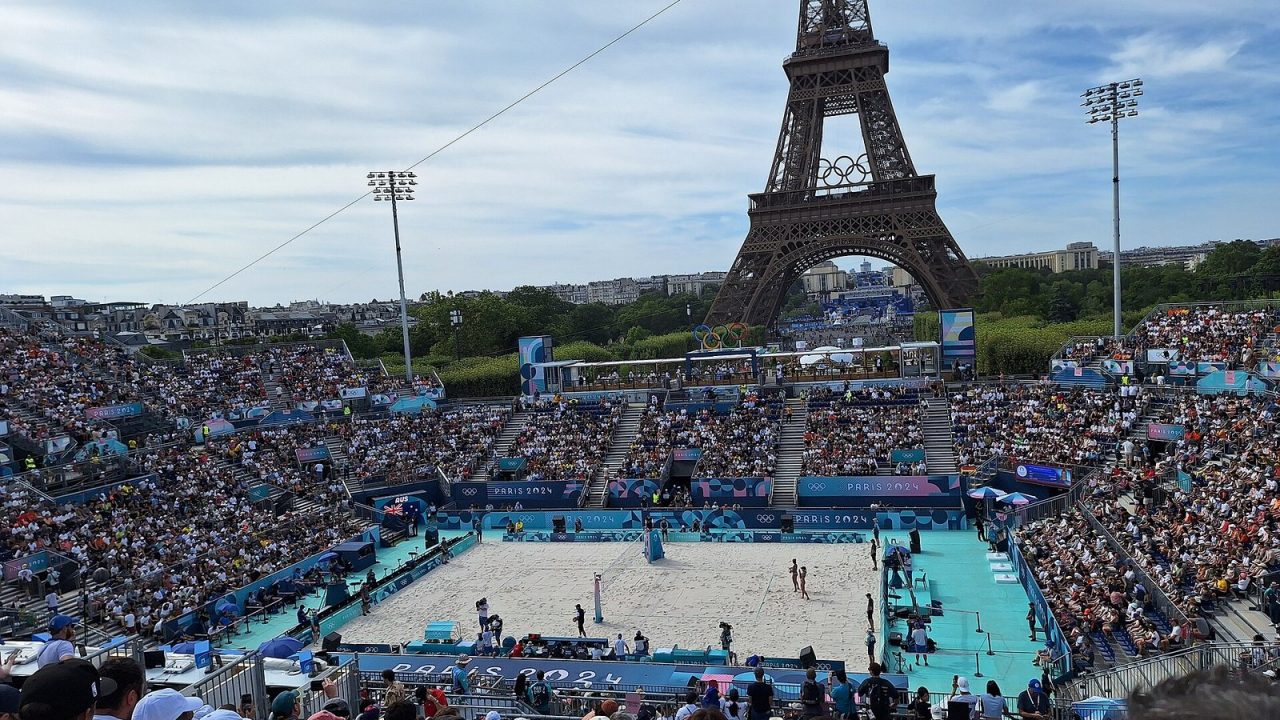
Beach volleyball looks like a relaxed version of the indoor game, but its rulebook is distinct and in some ways stricter. Two players cover the whole court, the block counts as a touch, setting the ball over the net is tightly policed and the open-hand tip that indoor players use all the time is simply illegal. On top of that, the scoring, time-outs and side switches all differ from indoor volleyball.
This guide explains the rules as written in the FIVB Official Beach Volleyball Rules 2025–2028, which govern international competition, including the Olympic Games and the Beach Pro Tour. Domestic and recreational competitions sometimes adapt them, but the FIVB rules are the reference. For a side-by-side overview of the two disciplines, see beach volleyball vs indoor volleyball.
Court, net, ball and team
- Court: a rectangle of 16 m by 8 m, surrounded by a free zone at least 3 m wide on all sides. Lines are 5 cm wide and the lines are part of the court, so a ball touching a line is in.
- Net: 2.43 m high for men and 2.24 m for women. There is no attack line on a beach court.
- Ball: circumference 66–68 cm, weight 260–280 g and internal pressure of 0.175–0.225 kg/cm². The beach ball is softer than an indoor ball, which helps it float in the air.
- Team: two players. Both must always be in play, and there are no substitutions. If a player cannot continue, the team is declared incomplete and loses the match.
- Coaching: at FIVB, World and Official senior competitions, players may not receive coaching during the match. They have to solve problems themselves, which is one of the defining features of the discipline.
Scoring: best of three to 21
Beach volleyball uses rally scoring: a point is scored on every rally, whichever team served.
- A match is won by the first team to win two sets.
- Sets one and two are played to 21 points with a minimum two-point lead. There is no cap; at 20–20, play continues until one team leads by two (22–20, 23–21 and so on).
- If the sets are tied 1–1, a deciding third set is played to 15 points, again with a two-point lead required.
- The interval between sets lasts one minute.
Before the match, the first referee conducts a toss. The winner chooses either to serve or receive, or which side of the court to start on; the loser takes the other choice. In the second set, the loser of the first toss gets first choice, and a new toss is held before a deciding set.
Side switches, time-outs and other interruptions
Side switches every 7 (and 5) points
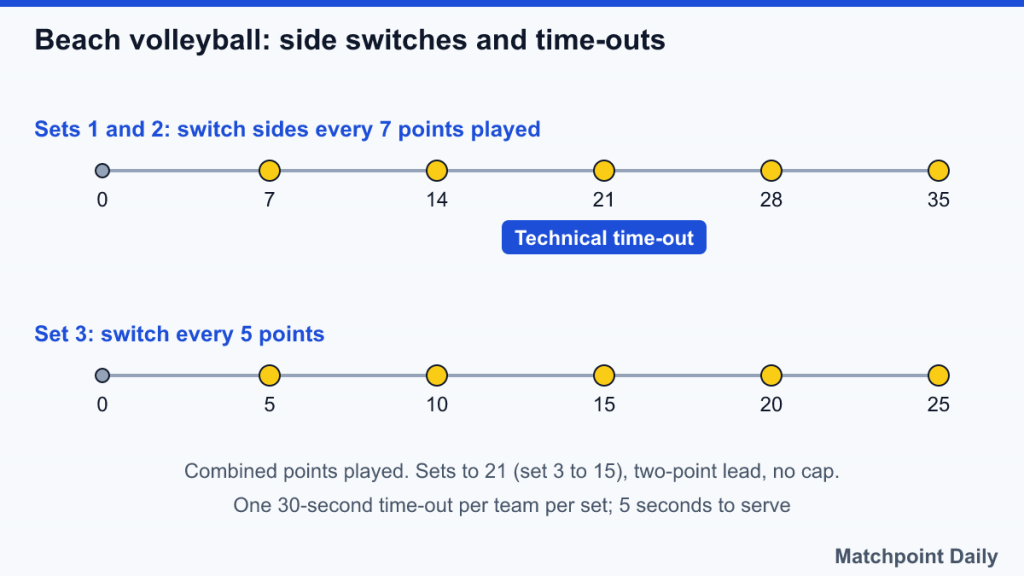
Because sun and wind can favour one side of an outdoor court, teams switch ends regularly: after every 7 points played in sets one and two (for example at 4–3, 7–7 or 10–4) and after every 5 points in the deciding set. The switch must be made immediately, without delay. If it is missed, it is made as soon as the error is noticed, and the score stands.
Time-outs
- Each team may request one time-out per set, lasting 30 seconds.
- At FIVB, World and Official competitions, in sets one and two an additional 30-second technical time-out is applied automatically when the combined score reaches 21 points.
- In the deciding set there is no technical time-out; each team may still request its single 30-second time-out.
- Only the captain may request a time-out, using the official hand signal while the ball is out of play and before the whistle for service.
Delays and injuries
The maximum time from the end of a rally to the whistle for the next service is 12 seconds under normal conditions. A first delay is punished with a warning; further delays in the match cost a point and service. An injured or ill player receives a maximum of five minutes of recovery time; if they cannot continue, the team is declared incomplete.
Serving: order, time limit and screening
There are no fixed court positions in beach volleyball and no positional faults: the two players can stand wherever they like when the ball is served (except that each must be within their own court, apart from the server). What does matter is the serving order.
- The order is decided by the captain after the toss and must be maintained throughout the set.
- When the serving team wins a rally, the same player serves again. When the receiving team wins, it gains the serve, and the player who did not serve last time serves next.
- Serving out of order is a fault, punished by a point and service to the opponent.
- The server has 5 seconds after the first referee’s whistle to hit the ball.
- The server may move freely in the service zone behind the end line, but at the moment of the hit (or the take-off for a jump serve) must not touch the court or the ground outside the service zone, and may not have a foot under the end line. If the line moves because of sand pushed by the server, that is not a fault.
- Only one toss or release of the ball is allowed.
- Screening is forbidden. The server’s partner may not block the receivers’ view of the server or the flight of the ball, and players of the serving team may not raise their hands above their heads during the serve until the ball has passed the net.
Touches, the block and contact rules
Each team has a maximum of three hits to return the ball, and a player may not hit the ball twice in a row (with exceptions explained below).
The block counts as a touch
This is one of the biggest differences from indoor volleyball. On the beach, a blocking contact counts as one of the team’s three hits, so after a block the team has only two more hits. The first hit after the block can be made by either player, including the one who blocked. Blocking the opponent’s serve is forbidden.
Double contacts
- On the team’s first hit, consecutive contacts during a single action are allowed, provided the ball is not played overhand with the fingers.
- If the first hit is played overhand with the fingers, the ball may not contact the fingers or hands consecutively, even within one action.
- In defence of a hard-driven ball, the contact can be momentarily extended, even with an overhand finger action.
- Otherwise, a player who hits the ball twice in succession commits a double-contact fault. Catching or throwing the ball is also a fault.
Two players at the net
If players from both teams contact the ball simultaneously above the net (a “joust”) and the ball stays in play, the team receiving the ball gets a fresh three hits. Players may penetrate into the opponent’s court and space provided they do not interfere with the opponent’s play.
The banned and restricted shots
No open-hand tips
Indoors, a soft, open-handed tip over the block is an everyday shot. On the beach, an attack hit completed with an open-handed finger action, or with fingertips that are not rigid and together, is a fault. That is why beach players use alternatives such as the “pokey” (knuckles), the “cobra” (rigid fingertips) and well-placed cut shots and roll shots.
Setting the ball over the net
A player may not complete an attack hit using an overhand pass (a set) whose trajectory is not perpendicular to the line of the shoulders. In other words, if you set the ball over the net, it must travel straight ahead in the direction you are facing (or straight backwards). The exception is when the player is genuinely trying to set to a teammate and the ball happens to go over.
Attacking the serve
Completing an attack hit on the opponent’s serve when the ball is entirely above the top of the net is a fault, as is blocking the serve.
Net contact
Touching the net between the antennae during the action of playing the ball is a fault. The action of playing the ball includes take-off, the hit (or attempt) and landing. Touching the net outside the antennae is not a fault unless it is used as support.
Quick reference: beach vs indoor rules
| Rule | Beach (FIVB) | Indoor (FIVB) |
|---|---|---|
| Players per team | 2, no substitutions | 6 on court, substitutions allowed |
| Court | 16 x 8 m | 18 x 9 m |
| Set length | 21 (deciding set 15), best of 3 | 25 (deciding set 15), best of 5 |
| Block | Counts as a team hit | Does not count as a team hit |
| Open-hand tip | Fault | Legal if not caught or thrown |
| Positions | No fixed positions; serving order only | Rotation order and overlap rules |
| Time-outs | 1 per set + technical time-out at 21 points (sets 1–2) | 2 per set |
| Service time limit | 5 seconds | 8 seconds |
For more of the language you will hear in beach commentary, from “skyball” to “block signals,” see our volleyball glossary.
Common rule misunderstandings
- “You can tip as long as it’s soft.” Softness is irrelevant; the issue is the open-handed finger action. Use knuckles or rigid fingertips.
- “The block is a free touch.” Not on the beach. After a block you have two hits left.
- “Any set over the net is illegal.” Only sets that are not perpendicular to the shoulders when used as an attack; a straight-ahead set over the net is legal.
- “We can change who serves next.” The serving order set at the start of each set must be kept.
- “A ball on the line is out because the line moved.” If any part of the ball touches the line, it is in; lines shifting slightly in the sand is part of the game.