The History of Badminton: From Battledore and Shuttlecock to Olympic Sport
From an old shuttlecock pastime and British India to the All England, the IBF, Olympic status in 1992 and the scoring reforms of 2006 and 2027.
Badminton has a split identity. In much of the world it is a relaxed backyard game played with a cheap racket and a plastic shuttle. At elite level it is one of the fastest racket sports on earth, a game of explosive lunges and smashes that dominates sporting television in parts of Asia and northern Europe. Both versions share a long history that runs from ancient shuttlecock games through British India and an English country house to the Olympic Games.
This article follows that story: the game’s roots, how it got its name and first rules, the founding of the All England Championships and the international federation, the road to the Olympics, and the scoring reforms that shaped the modern sport.
Ancient roots: shuttlecock games across Eurasia
Games involving a feathered shuttlecock are far older than badminton. Versions in which players keep a shuttlecock in the air with the feet, hands or bats were played for centuries across Eurasia. In England, the children’s and family pastime known as battledore and shuttlecock involved two players hitting a shuttlecock back and forth with small paddles called battledores, usually with the aim of keeping it in the air for as long as possible rather than winning points.
What turned this cooperative pastime into a competitive sport was the addition of a net and a court, with the goal reversed: instead of keeping the shuttle going with your partner, you try to make it land on your opponent’s side. That shift happened in the mid-19th century.
British India and the name “Badminton”
The modern game developed in the mid-1800s among British officers and expatriates in British India, as a competitive variant of battledore and shuttlecock. It was popular enough in India by the 1870s that it was widely known there as “Poona,” after the garrison town (today’s Pune).
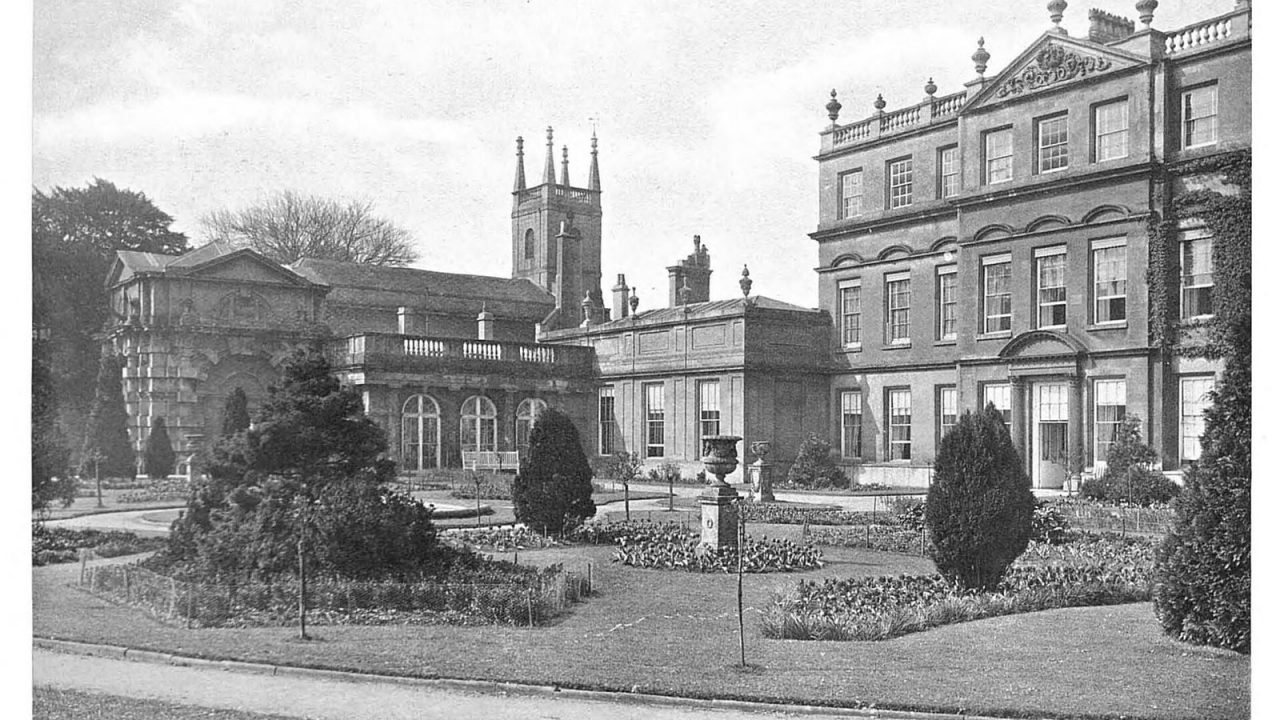
The name we use today most likely comes from Badminton House in Gloucestershire, England, the seat of the Dukes of Beaufort. Exactly why and when the game became associated with the house is unclear, and the popular story of a single famous party that launched the sport is not well documented. What is reliably recorded is that the game was being described in print in England in the 1860s: a booklet on the game by Isaac Spratt is said to have been published around 1860, though no copy survives, and an 1863 article in The Cornhill Magazine described it.
The first rules
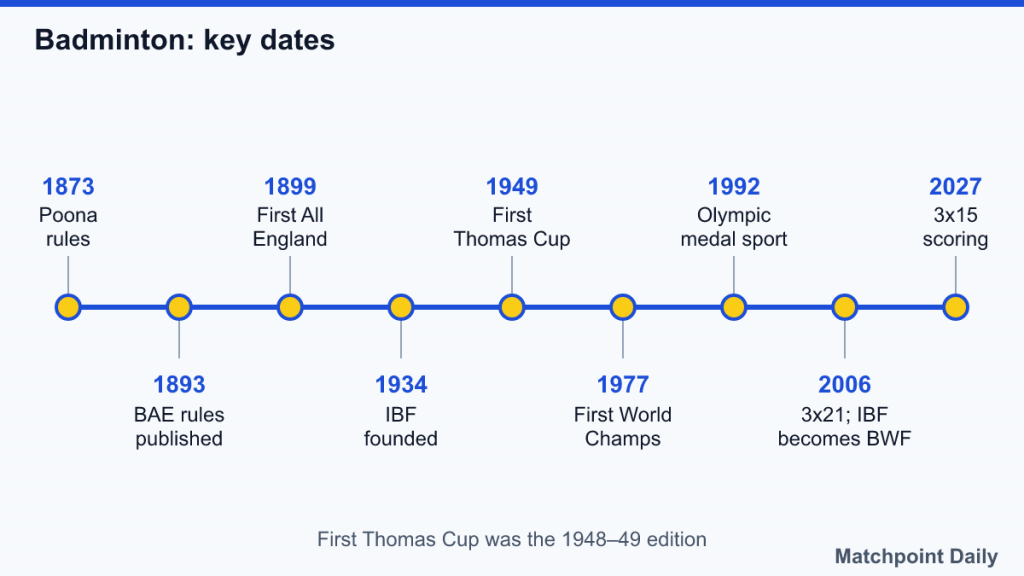
Like many sports, badminton first had to agree on what the game actually was. The standard account is that the first written rules were drawn up in Poona in 1873, although at least one historian has argued they were drawn up in Karachi in 1877. Either way, the early rules came from British India.
Those rules were refined back in England over the following decades:
- 1887: J. H. E. Hart of the Bath Badminton Club revised the Poona rules.
- 1890: Hart and Bagnel Wild revised them again.
- 1893: the newly formed Badminton Association of England published a set of rules and officially launched the sport in Portsmouth that September.
Early badminton was scored only on serve, with games to 15 points for men’s singles and doubles and to 11 for women’s singles. Players could “set” the game at certain tied scores to extend it. This serve-scoring system lasted for more than a century.
The All England Championships (1899)
The Badminton Association of England staged the first All England Championships in 1899, initially with doubles events only; singles events were added in 1900. For decades, the All England was effectively the world championship of badminton, since there was no official world title until much later.
The tournament’s prestige has survived the arrival of world championships and the Olympics. Today it is one of the four Super 1000 events on the BWF World Tour, as explained in our guide to how the BWF World Tour works, and it remains one of the most coveted titles on the circuit.
Going international: the IBF and the great team events
As national associations multiplied, the sport needed a global body. The International Badminton Federation (IBF) was founded on 5 July 1934 in Cheltenham, England, by nine member nations: Canada, Denmark, England, France, Ireland, the Netherlands, New Zealand, Scotland and Wales. India joined as an affiliate in 1936.
The IBF’s first great showpiece was a team event. The Thomas Cup, proposed and donated by English player Sir George Alan Thomas in 1939, was intended to start in 1941–42, but the Second World War delayed it until 1948–49. A women’s equivalent, the Uber Cup, named after English player Betty Uber, followed in 1956–57. A mixed team championship, the Sudirman Cup, began in 1989.
Individual world titles came surprisingly late. The first BWF World Championships (then IBF) were held in 1977, almost eight decades after the first All England.
Governance also went through a split and reunion. A rival body, the World Badminton Federation, existed for a time, before merging with the IBF in 1981. The IBF moved its headquarters from Cheltenham to Kuala Lumpur in 2005, reflecting the sport’s centre of gravity in Asia, and in 2006 changed its name to the Badminton World Federation (BWF). Today the BWF has around 200 member associations across five continental confederations.
The road to the Olympics
Badminton’s Olympic journey took two decades. It appeared as a demonstration sport at the 1972 Munich Games and again at the 1988 Seoul Games, before becoming a full medal sport at the 1992 Barcelona Olympics with four events: men’s and women’s singles and men’s and women’s doubles. Mixed doubles was added four years later, in 1996, completing the five-event programme used today.
Olympic status changed the sport’s economics, especially in Asia, where national federations invested heavily in training centres and professional squads. It also raised the profile of the world rankings and international circuits that decide who qualifies.
Shifting centres of power
For much of the 20th century, badminton’s strongest nations were in northern Europe and Asia. Denmark long dominated European badminton and remains Europe’s leading power, while England had strong periods. In Asia, Malaysia and Indonesia built powerful traditions, especially in the Thomas Cup, and China rose to become the dominant force in international competition from the 1980s onwards, with Japan, South Korea and others also producing world and Olympic champions.
Team event records tell the story well. Through the 2026 edition, Indonesia had won the Thomas Cup 14 times and China 12 times, with Malaysia on five. In the Uber Cup, China had 16 titles through 2026. These events remain among the most passionately followed in the sport.
Scoring reforms: from serve scoring to 3×21 and beyond
The biggest modern change to how badminton is played came in the 2000s. The old system, in which only the server could score, produced long and unpredictable matches. The federation experimented first with a 5×7 format (best of five games to seven) in 2002, the same year the traditional “setting” rules were dropped, but abandoned it because matches still ran long.
In December 2005, the federation trialled rally-point scoring: best of three games to 21, with a point on every rally, women’s singles scored the same way as men’s, a two-point margin required and a cap at 30. The system was formally adopted in August 2006 and has been the international standard ever since. Our guide to badminton rules and scoring explains how it works in practice.
The next change is already scheduled. After endorsing a best-of-three-games-to-15 format in November 2024 and testing it in 2025, the BWF approved 3×15 scoring at its annual general meeting on 25 April 2026, effective from 4 January 2027. Through the 2026 season, the 21-point system remains in use.
Three myths about badminton’s past
“Badminton was invented at Badminton House”
The house almost certainly gave the game its name, but the competitive game itself grew out of battledore and shuttlecock and took shape largely in British India. The country house was a stop on the journey, not its starting point.
“It was always a gentle garden game”
Garden badminton and competitive badminton have coexisted since the 19th century. The All England Championships were already a serious tournament in 1899, decades before most people had heard of the sport as anything but a pastime.
“The scoring has never really changed”
In fact, badminton has changed its scoring more often than most racket sports: serve scoring to 15 and 11, the dropping of setting, the abandoned 5×7 trial, 3×21 rally scoring from 2006, and 3×15 from 2027.
A timeline of badminton history
| Year | Milestone |
|---|---|
| Mid-1800s | Competitive game develops among British officers in India |
| 1873 | First rules drawn up in Poona (by the standard account) |
| 1893 | Badminton Association of England publishes its rules |
| 1899 | First All England Championships (doubles; singles from 1900) |
| 1934 | International Badminton Federation founded in Cheltenham |
| 1948–49 | First Thomas Cup |
| 1956–57 | First Uber Cup |
| 1977 | First World Championships |
| 1992 | Full Olympic sport in Barcelona |
| 2006 | 3×21 rally scoring adopted; IBF renamed BWF |
| 2027 | 3×15 scoring scheduled to take effect (4 January) |
From a pastime played with battledores to a fiercely competitive Olympic sport, badminton’s history is one of steady formalisation: first rules, then national associations, then an international federation, then world titles and Olympic medals. The 2027 scoring change shows that the process of reshaping the game for modern audiences is still going on.