How the BWF World Tour Works: Super 1000 to Super 100 and the Finals
A plain guide to badminton's elite circuit: the Super 1000 to Super 100 tiers, ranking points, player commitments and the season-ending Finals.
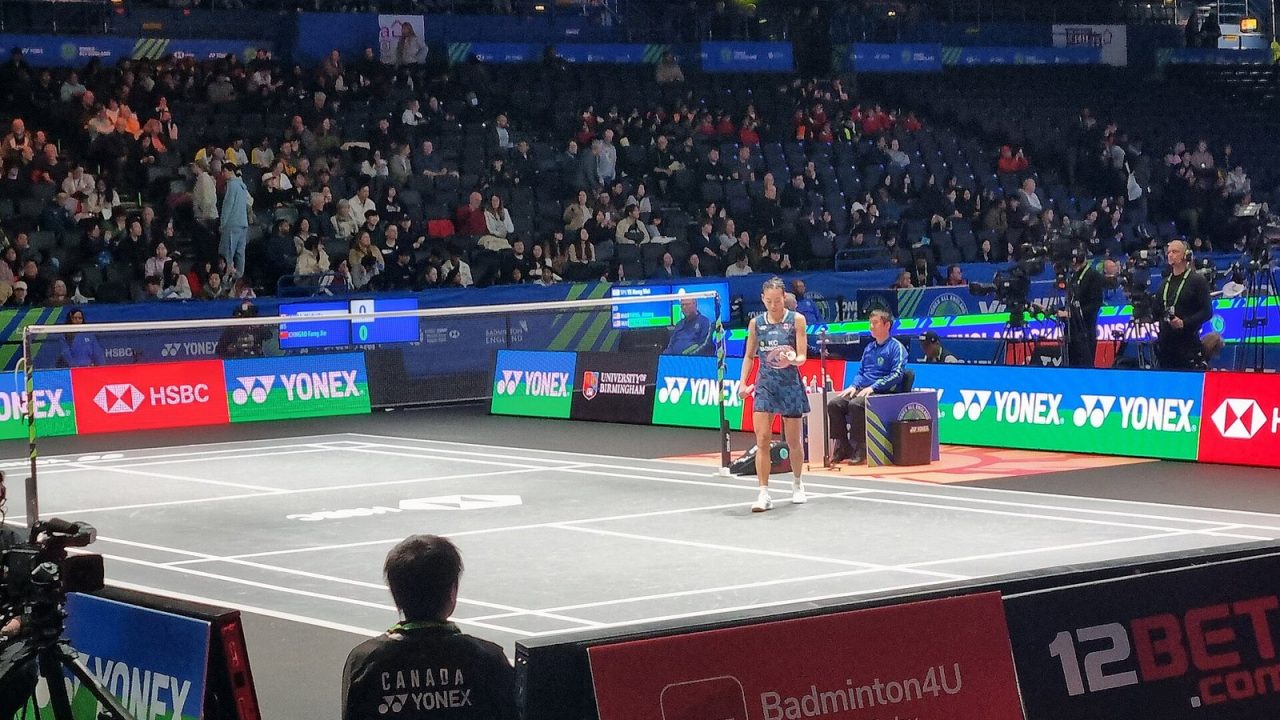
If you follow badminton for more than a few weeks, you notice that the same names keep turning up in different cities: Kuala Lumpur in January, Birmingham in March, Jakarta in June, Odense in October. That rhythm is the BWF World Tour, the professional circuit run by the Badminton World Federation. It decides where the best players spend their year, how they earn ranking points and prize money, and who gets into the season-ending World Tour Finals.
This guide explains the structure as it stands for the 2026 season: what the “Super” numbers mean, which events sit at the top, how points are distributed, which tournaments top players are obliged to enter, and how the Finals work. It also notes the changes already approved for the 2027–2030 cycle.
Where the World Tour came from
The World Tour began in 2018. Before that, the top tier of international badminton was the BWF Super Series, which ran from 2007 to 2017 and had its own season-ending event (the Super Series Masters Finals in 2008 and 2009, then the Super Series Finals from 2010 to 2017). The World Tour replaced that system with a more clearly graded ladder of tournaments, each labelled by level.
The idea is simple: the bigger the tournament’s level, the more prize money it must offer and the more ranking points it awards.
The World Tour is separate from the sport’s championship events. The BWF World Championships, the Olympic Games and the team competitions (Thomas Cup, Uber Cup and Sudirman Cup) are not World Tour events, although the individual championships still feed the world rankings.
The tiers: what Super 1000, 750, 500, 300 and 100 mean
The BWF treats the World Tour as six levels. Level 1 is the World Tour Finals; levels 2 to 6 are, in order, Super 1000, Super 750, Super 500, Super 300 and Super 100. The numbers are labels for a tournament’s status rather than a literal count of anything, but they line up with prize money: when the tour launched in 2018, the minimum prize money was set at US$1,000,000 for Super 1000, US$700,000 for Super 750, US$350,000 for Super 500, US$150,000 for Super 300 and US$75,000 for Super 100. Prize funds at many events have risen since then, so treat those as the original floors rather than current figures.
For the 2023–2026 cycle, the calendar consists of the Finals plus 30 regular tournaments:
| Level | Number of events (2023–2026) | Examples |
|---|---|---|
| Super 1000 | 4 | All England Open, China Open, Indonesia Open, Malaysia Open |
| Super 750 | 6 | China Masters, Denmark Open, French Open, India Open, Japan Open, Singapore Open |
| Super 500 | 9 | A mix of established national opens in Asia, Europe and Oceania |
| Super 300 | 11 | Smaller national opens, often a first step up for emerging players |
| Super 100 | Separately branded | Entry-level World Tour events |
The Super 1000 group is the closest thing badminton has to tennis’s majors in terms of prestige on the circuit. The All England is the oldest of them by a long way, dating back to 1899, and still carries a special aura with players. The Malaysia Open usually opens the season in January, while the Indonesia Open in Jakarta is famous for one of the loudest crowds in the sport. The China Open completes the quartet.
Below those, the Super 750 events form a second “premium” layer, and the Super 500s fill out the core of the elite calendar. Super 300 and Super 100 events matter enormously for players outside the top 30 or so: they are where rising juniors and players from developing badminton nations collect the points they need to qualify for bigger draws.
How ranking points are awarded
Every World Tour event feeds the BWF World Ranking. Points depend on the tournament’s level and the round a player or pair reaches. Under the ranking system in force since 23 April 2024, the winner of each level receives:
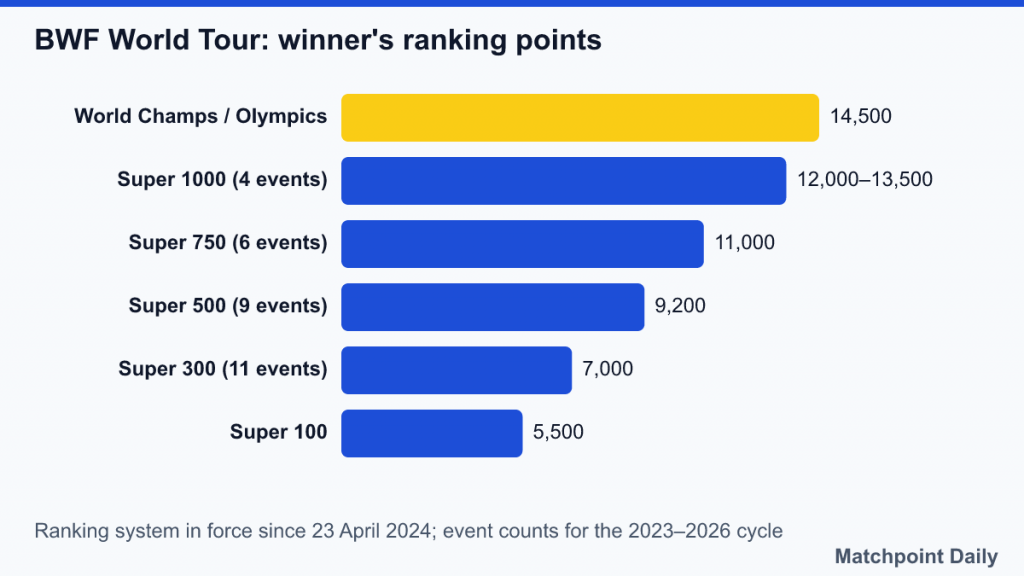
| Event level | Winner’s ranking points |
|---|---|
| World Championships / Olympic Games | 14,500 |
| Super 1000 (with at least US$500,000 additional prize money) | 13,500 |
| Super 1000 (US$250,000–499,999 additional prize money) | 12,700 |
| Super 1000 (base) | 12,000 |
| Super 750 | 11,000 |
| Super 500 | 9,200 |
| Super 300 | 7,000 |
| Super 100 | 5,500 |
| International Challenge | 4,000 |
| International Series | 2,500 |
| Future Series | 1,700 |
Two things stand out. First, the gaps between tiers are deliberately large: a Super 1000 title is worth more than twice a Super 100 title. Second, the Super 1000 level itself is split by extra prize money, which rewards organisers who invest beyond the minimum and rewards players who win those richer events.
The world ranking itself is a rolling 52-week list. If a player has played ten or fewer ranking tournaments in that window, all their points count; if they have played eleven or more, only their ten best results count. That “best ten” rule is why you will sometimes see a player enter a small event late in the season: a good result there can replace a weaker one in their top ten.
Rankings decide entry into tournaments and seeding within draws, so a player’s position directly shapes which events they can enter and whom they meet in the early rounds. Our guide to badminton rules and scoring covers what happens on court; the ranking is what decides who gets there.
Commitment rules: which events the top players must play
A tour only works if the stars show up. The BWF therefore requires its leading players to commit to a minimum schedule. Under the regulations that took effect on 8 November 2025, the “Top Committed Players” are the top 15 singles players and the top 10 doubles pairs in the world ranking as of the third week of November of the previous year. For the following season they must:
- play all four Super 1000 tournaments;
- play all six Super 750 tournaments;
- play at least two of the nine Super 500 tournaments;
- play the World Tour Finals if they qualify.
Players who climb into those ranking bands by early July take on a slightly lighter version of the same commitment for the rest of the season: the remaining Super 1000 and Super 750 events, the Finals if qualified, and at least one Super 500.
Missing a committed event has a cost. On top of the normal withdrawal fees, non-compliance carries an additional penalty of US$5,000, which the BWF can waive for documented injury or certain exceptional circumstances. The rule protects organisers who sell tickets and broadcast rights on the promise of the world’s best players, but it is also a frequent talking point when players discuss the physical toll of a long season.
The World Tour Finals
The season ends with the World Tour Finals, the only event at Level 1. It is a small, invitation-style tournament: only the top eight players or pairs in each of the five disciplines (men’s singles, women’s singles, men’s doubles, women’s doubles and mixed doubles) qualify, based on a separate World Tour standings table rather than the world ranking.
How qualification works
- Only a player’s best 14 World Tour results count towards the Finals standings, and no more than three of those can come from Super 100 events.
- Each member association can have at most two entries per discipline, which stops one dominant nation from filling a draw.
- The reigning world champion (or Olympic champion in an Olympic year) can be invited if ranked inside the top 20 and not otherwise qualified.
- Ties in the standings are broken first by tournaments played, then by points earned from 1 July onwards, then by drawing lots.
Format and prize money
Unlike regular tour events, which are straight knockouts, the Finals begin with a group stage before moving into knockout rounds, so every qualifier is guaranteed several matches against elite opposition. The event carries the largest prize fund on the tour: the 2025 edition in Hangzhou offered US$3,000,000, with winners receiving US$240,000 in singles and US$252,000 per pair in doubles.
Hosts and records
The first edition was held in Guangzhou in 2018. Pandemic disruption moved later editions to Bangkok (2020 and 2022) and Bali (2021), before the event settled in Hangzhou, which hosted in 2023 and 2025. As of the end of 2025, the most decorated Finals players were the mixed doubles pair Huang Yaqiong and Zheng Siwei with four titles, while Viktor Axelsen held the men’s singles record with three.
How a typical season flows
Understanding the structure makes the calendar easier to read. The season traditionally opens in Asia in January with the Malaysia Open and India Open, moves to Europe for the All England in March, and then swings back and forth between Asia and Europe through the summer and autumn. The big Asian Super 1000 and 750 events cluster around the middle of the year, and the European autumn swing (including the Denmark and French Opens) comes shortly before the Finals.
The championship events slot in between. In years with a World Championships or Olympic Games, the tour calendar bends around them, and players often skip smaller events to protect their form and fitness. Team competitions such as the Thomas and Uber Cup take up their own windows as well.
For fans, a practical approach is to treat the four Super 1000s and the Finals as anchor points and follow the Super 750 and 500 events for continuity.
Common misunderstandings
“Super 1000 means 1,000 points”
It does not. The tier name is a label. A Super 1000 winner earns 12,000 to 13,500 ranking points depending on the extra prize money on offer.
“The World Tour Finals uses the world ranking”
Not directly. Qualification uses the World Tour standings, which count only World Tour results (best 14, with a Super 100 cap). A player can be very high in the world ranking thanks to a World Championships result and still miss the Finals if their tour results are thin.
“Every top player enters every big event”
The commitment rules push in that direction, but withdrawals still happen, mainly through injury. That is why draws sometimes look different from the ranking list. And whatever the tier, the Laws of Badminton are the same; only the stakes change. For the kit side, see our guide on choosing a badminton racket.
What changes from 2027
The BWF has already set the shape of the next cycle. For 2027–2030 the World Tour will comprise 36 tournaments including the Finals: five Super 1000s, five Super 750s, nine Super 500s, eight Super 300s and eight Super 100s. In other words, one more event joins the very top tier, the Super 750 group shrinks by one, the Super 300 group gets smaller and the Super 100s are brought formally into the tour count.
The 2027 season will also be the first played under the new 3×15 scoring system approved by the BWF in April 2026, which takes effect on 4 January 2027. That will not change the tier structure, but it will change the feel of matches and possibly how players manage a dense calendar. Until then, the 21-point system remains in use for the 2026 season.
The essentials, then, are easy to keep in mind: four Super 1000s at the top, a ladder of smaller events beneath them, ranking points that rise steeply with each level, a minimum schedule for the stars, and an eight-player Finals to close the year.