How to Choose a Badminton Racket: Weight, Balance, Stiffness and Grip
How to read a badminton racket's spec label: U weight codes, G grip sizes, head-heavy vs head-light balance, shaft flex and string tension, by player type.
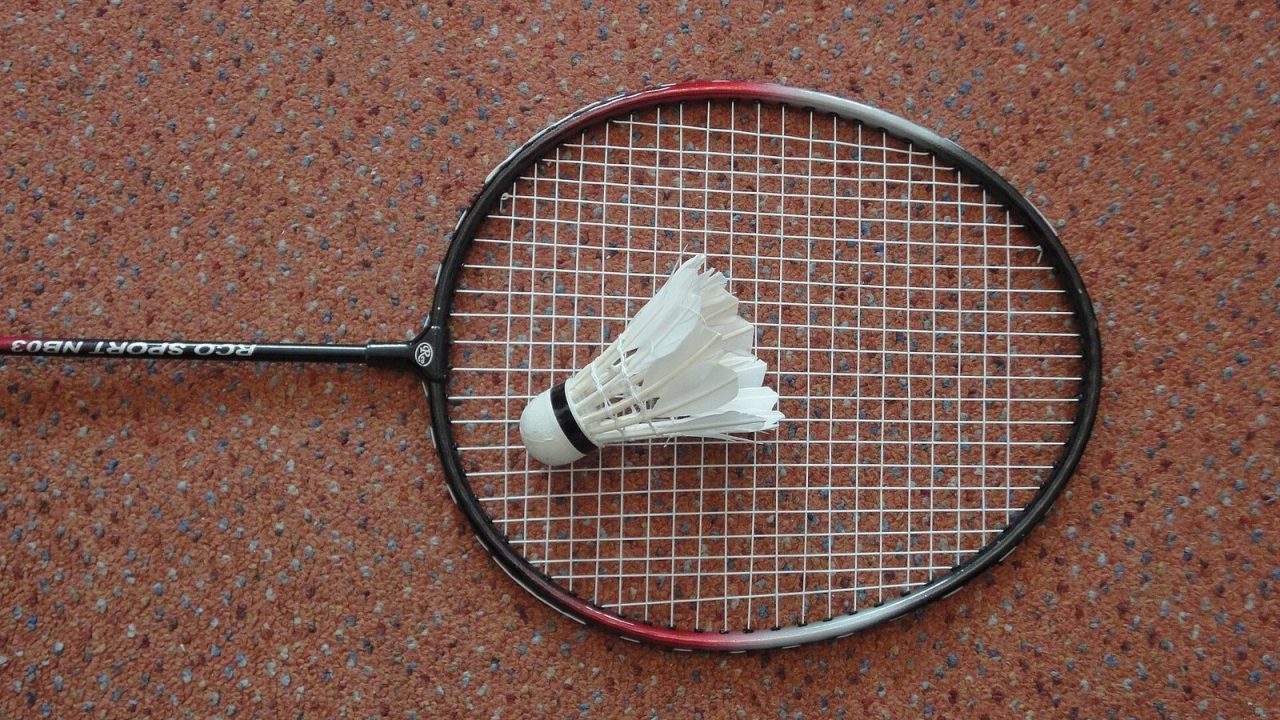
Walk into a badminton shop and every racket looks similar: a slim frame, a long shaft, a small head. The differences are in the numbers and words printed on the shaft and the packaging, such as “4U G5”, “head heavy” or “stiff”. Those labels tell you a great deal about how the racket will feel, if you know how to read them. This guide explains each specification, what it changes on court and which combinations tend to suit beginners, defensive players and big hitters. It does not rank brands or quote prices; the aim is to help you understand any spec sheet.
What the Laws allow
Before the specs, a quick note on legality. Under the Laws of Badminton, a racket frame may not exceed 680 mm in overall length and 230 mm in overall width. The stringed area must be flat, with crossed strings, and may not exceed 280 mm by 220 mm overall. The racket must be free of attached objects and protrusions, except small items used only to limit wear or vibration, to distribute weight, or to secure the handle to the hand, and it must not have any device that lets the player change its shape during play.
In practice, every racket sold by a mainstream manufacturer for adult play sits within these limits. The differences that matter for choosing are weight, balance, flex, grip size and string set-up.
Weight: the “U” code
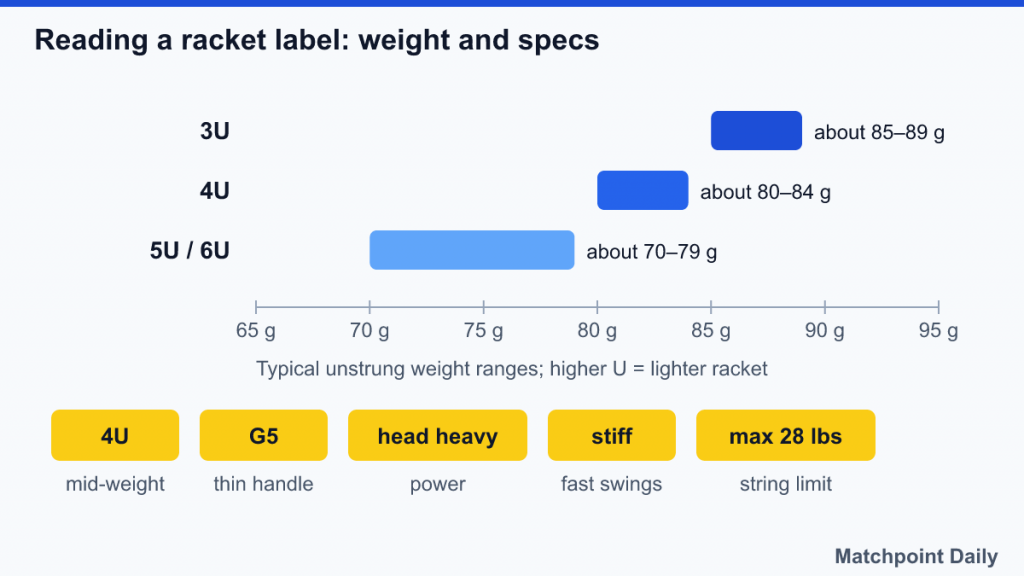
Many major manufacturers mark weight with a number followed by “U”. The higher the number, the lighter the racket. Each step is a band of roughly 5 grams. Typical published ranges for unstrung frames are:
| Code | Typical unstrung weight range | General feel |
|---|---|---|
| 3U | About 85–89 g | Heavier; more stable and powerful, slower to manoeuvre |
| 4U | About 80–84 g | The most common adult weight; balanced all-round choice |
| 5U and 6U | Roughly 70–79 g (6U the lighter) | Light to very light; fast handling, less mass behind the shuttle, can feel less stable on off-centre hits |
The exact bands differ slightly between manufacturers, and some publish an average weight instead of a range, so always check the label or the maker’s own specification. Weights are almost always quoted unstrung; strings and grip add more.
Rule of thumb: lighter rackets are easier to swing quickly and kinder to the arm; heavier rackets feel more solid and can add power, provided you have the technique and strength to swing them fast.
Grip size: the “G” code
Grip size is usually marked with “G” and a number. On the labels of several major makers, a higher G number means a thinner handle, so G5 is slimmer than G4, and G6 slimmer still. Conventions vary by manufacturer and market, though, so compare the actual handle rather than relying on the code alone.
- A thinner grip allows more finger control and quicker grip changes, which suits fast doubles exchanges and deceptive net play.
- A thicker grip can feel more stable and reduce the need to squeeze.
If you are unsure, choose the thinner option. A thin handle can be built up with an overgrip or a second grip layer, but a thick handle cannot easily be made thinner.
Balance: head-heavy, even or head-light
Balance describes where the racket’s weight is concentrated along its length. It is often given as a balance point in millimetres measured from the butt of the handle, and as a descriptive label.
- Head-heavy: more mass towards the head. The racket swings with more momentum, adding power to smashes and clears. The trade-off is slower handling at the net and in fast defence.
- Even balance: a middle ground that suits players who want both attack and defence, and players who have not yet settled on a style.
- Head-light: more mass towards the handle. The racket is quick to manoeuvre for blocks, drives and net exchanges, but delivers less power on overhead shots without good technique.
Two rackets of the same weight can feel completely different because of balance. A 4U head-heavy racket may feel heavier in the swing than a 3U head-light racket.
Shaft flex: stiff, medium or flexible
The shaft bends during the swing and then springs back as you hit the shuttle. How much it bends is the flex, usually labelled from “flexible” through “medium” to “stiff” and “extra stiff”.
- Flexible shafts store and release energy with slower swings, helping beginners and players with less racket-head speed get the shuttle deep. They feel more forgiving but can be less precise.
- Medium shafts suit most improving club players.
- Stiff shafts respond best to fast, well-timed swings. They give more control and a more direct feel for strong players but feel harsh and underpowered if your swing is slow.
Rule of thumb: slow swing, flexible shaft; fast swing, stiff shaft. Many beginners choose a stiff racket because elite players use them and then find it hard to clear the shuttle to the back of the court.
Strings and tension basics
Strings and tension affect feel as much as the frame. Tension is usually expressed in pounds (lbs), and each racket has a maximum recommended tension printed on the frame or in the specification. Stringing above it puts extra stress on the frame.
- Lower tension creates a larger “sweet spot” and more trampoline effect, which helps beginners get depth with less effort.
- Higher tension gives more control and a crisper feel for players who hit cleanly and fast, but punishes off-centre hits and can be harder on the arm.
- String thickness: thinner strings tend to feel more responsive; thicker strings usually last longer.
A stringer at a club or shop can advise on tension for your level. Raise tension gradually as your technique improves rather than jumping straight to the levels used by professionals.
Head shape and frame profile
Two further details appear on many spec sheets:
- Head shape. Most modern rackets have an isometric (squarer) head, which spreads the strings to widen the sweet spot and make off-centre hits more forgiving. A traditional oval head concentrates the sweet spot in a smaller area, which some experienced players prefer for precision. For beginners, an isometric head is the easier choice.
- Frame profile. Some frames are thin and aerodynamic for fast swings; others are thicker and box-shaped for stability. Thin profiles usually suit attacking players with fast swings, while box frames can feel more solid on blocks and drives.
How to test a racket before buying
If you can borrow or demo a racket, a short test tells you more than any label:
- Swing it in defence. Play a few minutes of fast drives and blocks. If the racket feels slow to bring back into position, it may be too head-heavy or too heavy overall for you.
- Clear from the back. If you struggle to reach the opponent’s back line with relaxed technique, the shaft may be too stiff for your swing speed.
- Smash a few times. Notice whether the racket feels stable or twists on contact. Very light frames can feel unstable for some players.
- Hold it for a while. The grip should be comfortable without squeezing, and your forearm should not tire unusually quickly.
Compare at the same string tension where possible, since tension can change the feel as much as the frame does.
Matching the racket to the player
| Player type | Weight | Balance | Flex | Notes |
|---|---|---|---|---|
| Beginner | 4U or 5U | Even or slightly head-light | Flexible to medium | Forgiving, easy to swing; moderate string tension |
| Defensive / doubles front-court player | 4U or 5U | Head-light | Medium to stiff | Fast handling for drives, blocks and net play |
| Attacking singles player / smasher | 3U or 4U | Head-heavy | Medium to stiff | Power on overhead shots; needs good technique |
| All-rounder | 4U | Even | Medium | Versatile for singles and doubles |
| Junior | Junior or very light frames | Even or head-light | Flexible | Shorter or lighter junior rackets exist for younger children |
These are starting points, not rules. Personal preference matters a great deal, and many strong players use specs outside the “typical” range for their style.
How to read a spec label: an example
Suppose a label reads: “4U G5, head heavy, stiff, max 28 lbs”. Reading left to right:
- 4U: a mid-weight racket, about 80–84 g unstrung on the common scale.
- G5: a relatively thin handle on most major makers’ scales.
- Head heavy: weight concentrated towards the head for power.
- Stiff: best suited to fast, confident swings.
- Max 28 lbs: do not string above this tension.
That combination suits an attacking intermediate or advanced player. A beginner would usually find a more flexible, evenly balanced racket easier to learn with.
Common buying mistakes
- Copying a professional’s racket. Elite players have swing speeds and technique that suit stiff, head-heavy frames. Most club players do not.
- Ignoring the grip. A grip that is too thick leads to squeezing and tired forearms.
- Over-stringing. Very high tension reduces power and comfort for most players.
- Judging by weight alone. Balance and flex change the feel as much as the number on the label.
- Not trying before buying. If possible, borrow a club racket or use a demo racket to feel the difference.
Your racket choice ties directly to the shots you want to play. Our guide to badminton shots explains which strokes reward power and which reward speed of handling, and the rules and scoring guide covers the game the racket will be used in.