Volleyball Serves Explained: Underhand, Float, Topspin and Jump Serves
How underhand, float, topspin, jump float and jump spin serves work, basic technique cues, the serving rules, and how teams use serving as a tactical weapon.
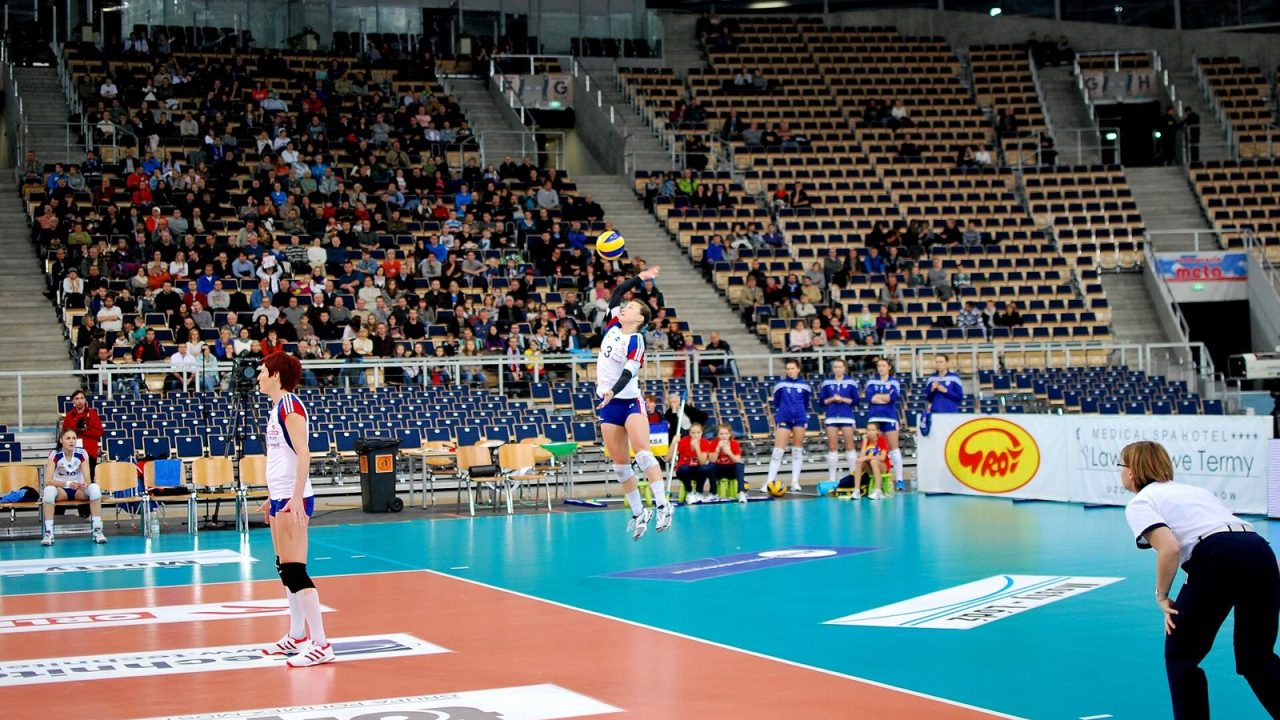
The serve is the only skill in volleyball that a player performs entirely alone, with nobody else touching the ball first. It starts every rally, and at higher levels it is one of the main ways to score directly or to break the opponent’s offence before it begins. This guide covers the main serve types, how the ball behaves with each, simple technique cues, the rules that govern serving, and the tactical thinking behind where and how hard to serve.
The serving rules you need to know
Under the FIVB Official Volleyball Rules 2025–2028:
- The serve is made by the player in the back-right position (position 1), in the order set by the line-up.
- The server stands in the service zone, a 9 m wide area behind the end line that extends back to the end of the free zone.
- At the moment of contact, or at take-off for a jump serve, the server must not touch the court, including the end line, or the floor outside the service zone. Landing inside the court after the hit is allowed.
- The ball must be hit with one hand or any part of the arm after being tossed or released.
- Only one toss or release is allowed. Bouncing or moving the ball in the hands beforehand is fine.
- The server must hit the ball within 8 seconds of the first referee’s whistle. A serve made before the whistle is cancelled and repeated.
- The serving team must not screen: players may not wave arms, jump, move sideways or stand grouped to hide the server and the ball’s flight from the receivers, and they may not raise their hands above their heads during the serve.
After a correct contact, the serve is a fault if it touches a teammate, fails to cross the net through the crossing space, lands out, or passes over a screen. A serve that touches the net and continues over is legal. For more on who serves and when, see our guide to rotation and overlap rules.
Float serves vs spin serves: the physics in plain terms
Every overhand serve falls somewhere on a spectrum between “no spin” and “lots of spin”, and the ball behaves very differently at each end.
- A float serve is struck so that the ball has almost no rotation. Without spin to stabilise it, small changes in airflow around the ball’s panels make it wobble, dip or drift unpredictably, rather like a knuckleball in baseball. Passers find it hard to judge exactly where it will arrive.
- A topspin serve rotates forwards. The spin makes it dive downwards as it travels, so it can be hit hard yet still drop into the court. Its path is predictable, but it arrives fast.
Most serving decisions come down to this trade-off: movement and unpredictability on one side, speed and power on the other.
The main serve types
Underhand serve
The ball is held at waist height in the non-hitting hand and struck from below with the heel of the hand or a fist, swinging the arm like a pendulum. It is easy to learn and consistent, which makes it the usual starting point for children and beginners. Its weakness is that it travels slowly on a high arc, giving receivers plenty of time.
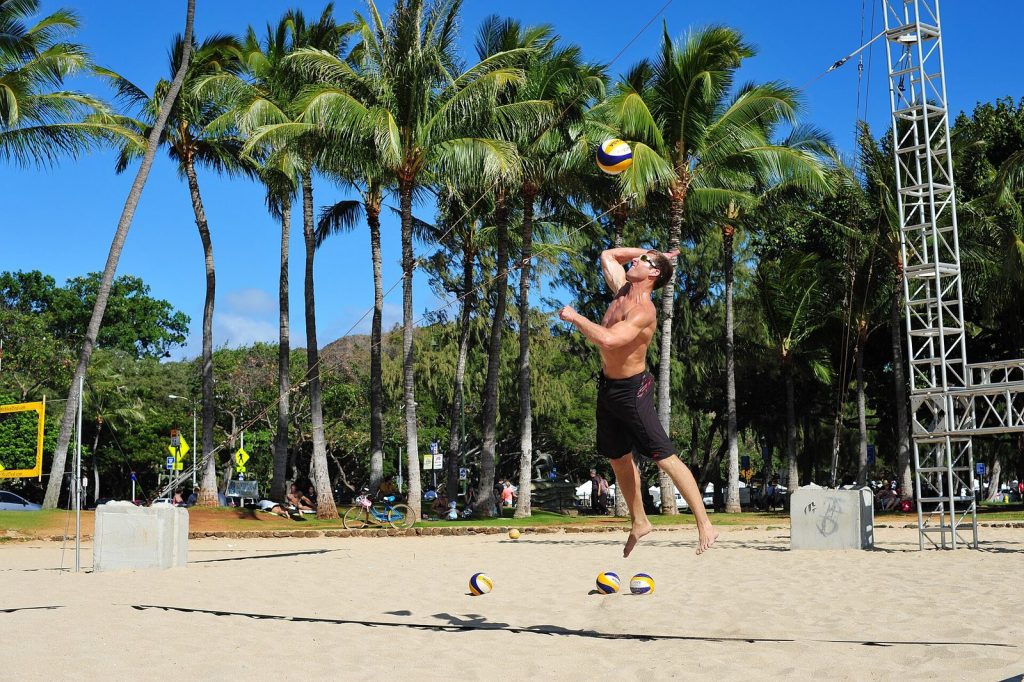
Cues: step forward with the opposite foot, keep the arm straight, contact the lower back of the ball, and follow through towards the target.
Standing float serve
The workhorse of recreational and club volleyball, and still common at elite level. The server tosses the ball low in front of the hitting shoulder and strikes the centre of the ball with a firm, flat hand, stopping the follow-through short to avoid putting spin on it.
Cues: a low, spin-free toss; a firm wrist; contact through the middle of the ball with the heel of the hand; a short, punching follow-through.
Topspin serve (standing)
Here the server tosses higher and slightly in front, reaches up and snaps the wrist over the top of the ball, brushing it forward to create rotation. It is a stepping stone to the jump spin serve.
Cues: toss above and in front of the hitting shoulder; contact the lower-back of the ball and roll the hand up and over; full follow-through.
Jump float serve
The server takes a short approach, usually two or three steps, jumps and hits a float serve at the top of the jump. The extra height lets the ball travel on a flatter path over the net while still floating. It is widely used at every level from club to international, by women and men alike, often as a lower-risk alternative to the jump spin.
Cues: a consistent low toss, often with one hand; a rhythmic approach; contact in front of the body at the top of the jump with a firm, flat hand.
Jump spin serve (jump serve)
The most powerful serve in the game. The server throws the ball high and in front, takes a full spike-style approach, and attacks it with topspin from the top of the jump. It is a major weapon at elite level, especially in the men’s game, and it can produce aces, but it also carries the highest risk of errors.
Cues: a consistent, high, forward toss (often with topspin applied by the tossing hand); an approach timed like a spike; contact high and in front with a fast arm swing and wrist snap.
Other variations
- Sidearm or roundhouse serves appear in older or recreational play.
- Hybrid serves, struck with a little topspin but at moderate pace, are used by some players to combine control with dip.
Comparing the serve types
| Serve | Ball behaviour | Typical level | Main strength | Main risk |
|---|---|---|---|---|
| Underhand | High, slow arc | Beginners, young children | Very consistent | Easy to pass |
| Standing float | Wobbles, dips | All levels | Unpredictable movement | Can float long or into the net |
| Standing topspin | Dives downward | Developing players | Pace with control | Less movement than a float |
| Jump float | Flat trajectory, wobbles | Club to elite | Movement plus a lower path | Timing of toss and approach |
| Jump spin | Very fast, dipping | Advanced and elite | Aces and broken passes | Highest error rate |
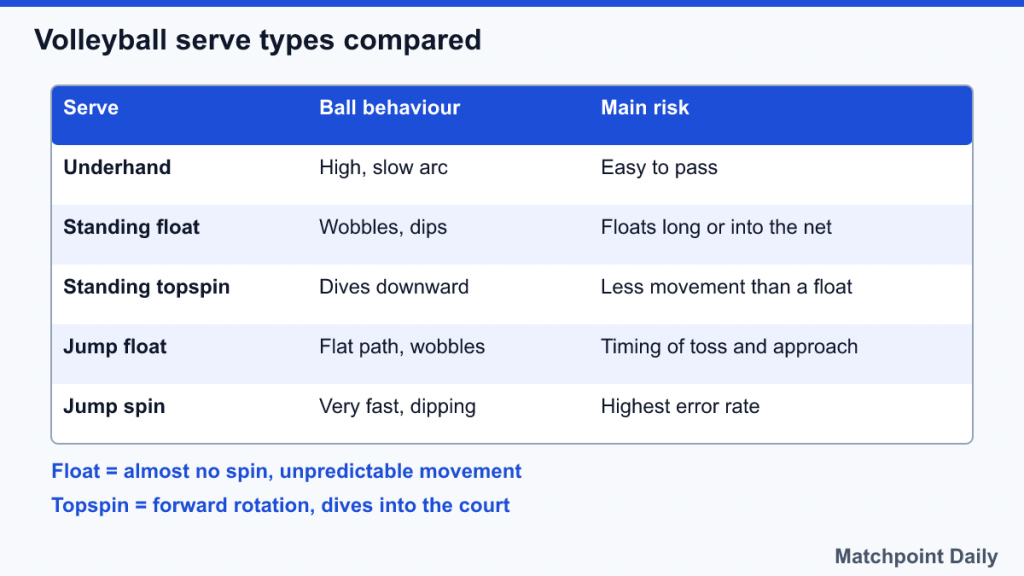
Serving tactics: what is the serve trying to do?
A serve is not only about aces. Its broader job is to make the opponent’s first contact as bad as possible, so that their setter cannot run the full offence and their attack becomes predictable.
Aggression vs error rate
Every team balances risk. A harder serve creates more aces and more poor passes, but it also produces more missed serves, which give the opponent a free point and the serve. Coaches set targets for each server and each situation. Late in a tight set, many teams lower the risk; when well ahead or facing a strong receiving team, they may serve harder.
Targeting passers
Teams scout the opponent’s passers and aim at the weakest or most tired one. Serving a hitter who has just attacked, or who must pass and then run to attack, can also disrupt the opponent’s offence.
Targeting seams and zones
- Seams: serving between two passers forces them to decide who takes it. Hesitation causes shanked passes.
- Short serves: dropping the ball in front of the passers, especially to a hitter who wants to approach, disrupts their attack timing.
- Deep corners: serves to positions 1 and 5 push passers back and make the pass travel further to the setter.
- The setter’s path: serving into the zone the setter must run through from the back row can slow their arrival at the net.
Serving to set up the block and defence
Elite teams link serving to the next phase. If a serve forces the pass to drift off the net, the opponent’s setter has fewer options and the blockers can predict the attack. Some teams therefore choose a serve target based on which attacker they want the opponent to use.
Common serving mistakes
- Inconsistent toss: the cause of most serving errors. Practise the toss on its own until it lands in the same spot every time.
- Dropping the elbow: on overhand serves, a low elbow sends the ball into the net.
- Following through on a float: a long follow-through adds spin and kills the float.
- Rushing: taking a breath and using a routine within the 8 seconds helps under pressure.
- Foot faults: stepping onto the end line before contact, particularly on jump serves where the take-off point drifts forward.
- Trying the jump serve too early: without a reliable standing serve, a jump serve usually adds errors rather than points.
Building a serve: a sensible progression
- Learn the underhand serve for consistency and confidence.
- Move to the standing float, focusing on a clean, spin-free contact.
- Develop a standing topspin serve to learn wrist action.
- Add a jump float once the standing float is reliable.
- Try the jump spin serve when you can spike with good timing and have the strength to repeat it safely.
Jump serving repeatedly loads the shoulder, knees and ankles. Build volume gradually and ask a qualified coach or medical professional for guidance if you are increasing training load or returning from injury. For the basic rules that frame every serve, our volleyball rules guide is a good companion to this article.