Badminton Shots Explained: Clear, Drop, Smash, Net Shot, Drive and Lift
The core badminton strokes explained: clear, drop, smash, net shot, drive and lift, with forehand and backhand variants, when to use each and beginner cues.
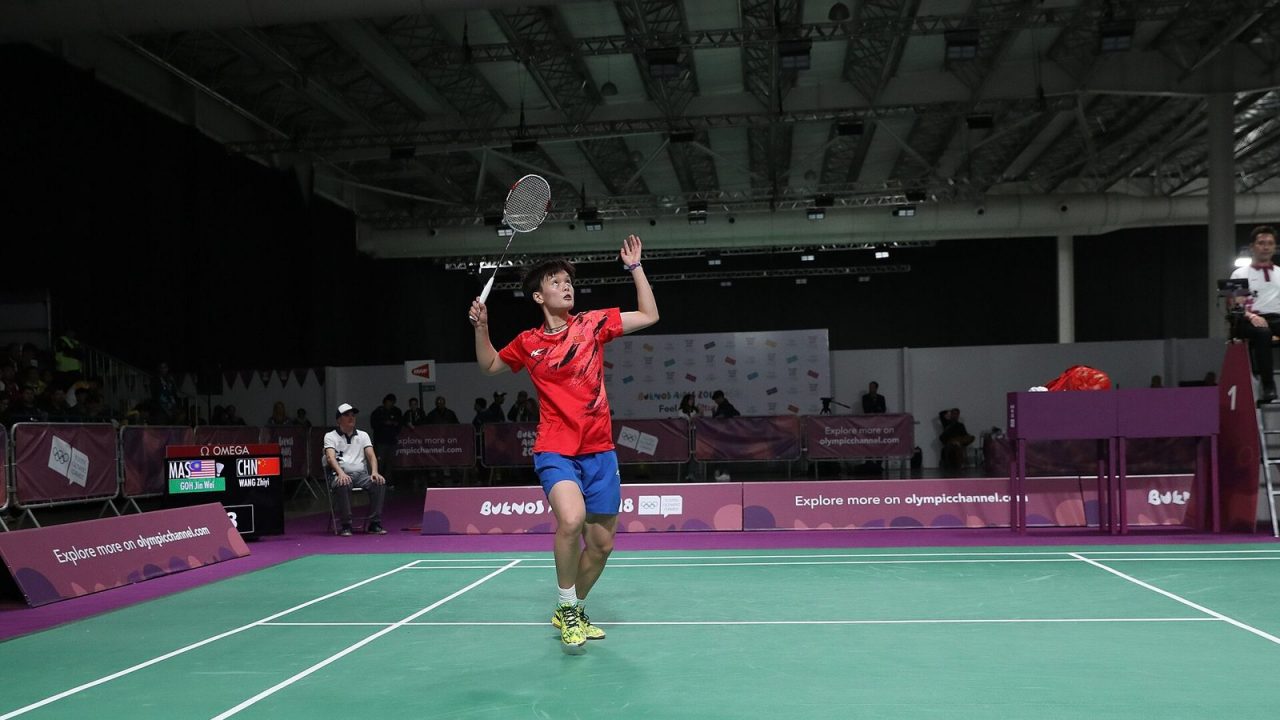
Badminton rallies can look chaotic, but nearly every shot in them belongs to a small family of strokes. Learn to recognise the clear, drop, smash, net shot, drive and lift, and you can follow what elite players are trying to do on almost every exchange. Learn to play them, and you have the building blocks of the whole game. This guide explains each shot, its forehand and backhand versions, when it is used and the basic technique cues for beginners.
How badminton shots are classified
Three questions describe any badminton stroke:
- Which side? Forehand (racket side of the body) or backhand (non-racket side).
- Where is the contact? Overhead (above the head), side-arm (around shoulder to waist height), or underarm (below the waist, typically near the net or in defence).
- Where is it going? Up and deep, down and steep, short to the net, or flat and fast.
A forehand overhead clear, a backhand underarm lift and a forehand side-arm drive are all combinations of those three choices. The names below describe the destination and trajectory; the variants describe how you get there.
The clear
A clear is hit from the back of your court high and deep to the back of your opponent’s court. It buys time to recover your position and pushes your opponent away from the net.
- Defensive (high) clear: very high and very deep, giving you maximum recovery time when you are under pressure.
- Attacking clear: a flatter, faster trajectory, just high enough to pass over the opponent’s reach. It tries to get behind an opponent who is standing too far forward.
- Backhand clear: played from the rear backhand corner. It is one of the hardest shots for beginners, which is why many players learn to move round the shuttle and play a forehand “round-the-head” shot instead.
Beginner cues: turn side-on, get behind the shuttle, lead with the elbow, and hit at the highest comfortable point slightly in front of you with a relaxed grip that tightens at impact.
The drop shot
A drop is played from the back of your court to land just over the net in your opponent’s forecourt. It forces them to move forward and lift the shuttle, often giving you the chance to attack.
- Slow drop: falls close to the net, but gives the opponent more time.
- Fast (or attacking) drop: travels more steeply and quickly, landing a little further from the net, around the front service line. It is harder to reach in time.
- Slice or reverse-slice drop: the racket face cuts across the shuttle to change its direction and speed, adding deception.
Beginner cues: use the same preparation as your clear and smash so the opponent cannot read it early, then slow the racket head just before contact or slice across the base.
The smash
The smash is a powerful, steep downward shot from an overhead position, aimed to end the rally or force a weak reply. It is the most spectacular shot in badminton and the one that produces its headline speed figures.
As of 2026, Guinness World Records recognises India’s Satwiksairaj Rankireddy as holding the record for the fastest badminton hit by a male player, measured at 565 km/h on 14 April 2023 at a Yonex facility in Soka, Saitama, Japan, using an ultrahigh-speed camera. Shuttles slow down very quickly because of their feathered skirt, so the speed when the shuttle reaches the opponent is far lower than the speed off the racket.
- Full smash: maximum power, usually from mid to rear court.
- Half (or slice) smash: less power but steeper and more accurate, often used to wrong-foot or to keep the attack going.
- Jump smash: a smash from a jump, steepening the angle.
- Backhand smash: rare and difficult; used by advanced players in the rear backhand corner.
Beginner cues: contact the shuttle in front of the body, not above or behind your head; use forearm rotation rather than just a stiff arm; aim at the body, the hip or the sidelines rather than straight down the middle.
The net shot
A net shot is played from your forecourt to land as close as possible to the net in your opponent’s forecourt. The best net shots “tumble” (spin over themselves) as they cross the net, making them very hard to play cleanly.
- Spinning or tumbling net shot: slicing under or across the base makes the shuttle rotate.
- Net kill: if the shuttle is above the net when you reach it, push or tap it sharply down instead of playing another net shot.
- Cross-court net shot: played across the net to the opposite side, forcing a long movement.
Beginner cues: take the shuttle as high and as early as you can, lunge with the racket leg forward, keep the racket head up, and use gentle control rather than a swing.
The drive
A drive is a flat, fast shot played at roughly net height from the side of the body. It travels parallel to the floor and is designed to rush the opponent.
- Forehand and backhand drives: used heavily in doubles, where rallies often become flat exchanges in the mid-court.
- Push: a softer, controlled cousin of the drive, used to place the shuttle into the mid-court gaps.
Beginner cues: keep a short backswing, contact in front of the body at around shoulder height, and recover the racket quickly for the next shot.
The lift
A lift is an underarm shot from your forecourt that sends the shuttle high and deep to the back of the opponent’s court. It is the forecourt equivalent of the clear: usually defensive, giving you time to recover.
- Defensive lift: high and deep to escape pressure.
- Attacking lift: lower and faster, aimed over an opponent who has moved forward.
- Forehand and backhand lifts: both are essential, as net shots can come to either side.
Beginner cues: lunge to the shuttle, keep your weight balanced over the front leg, and use the wrist and forearm for a compact flick rather than a long swing.
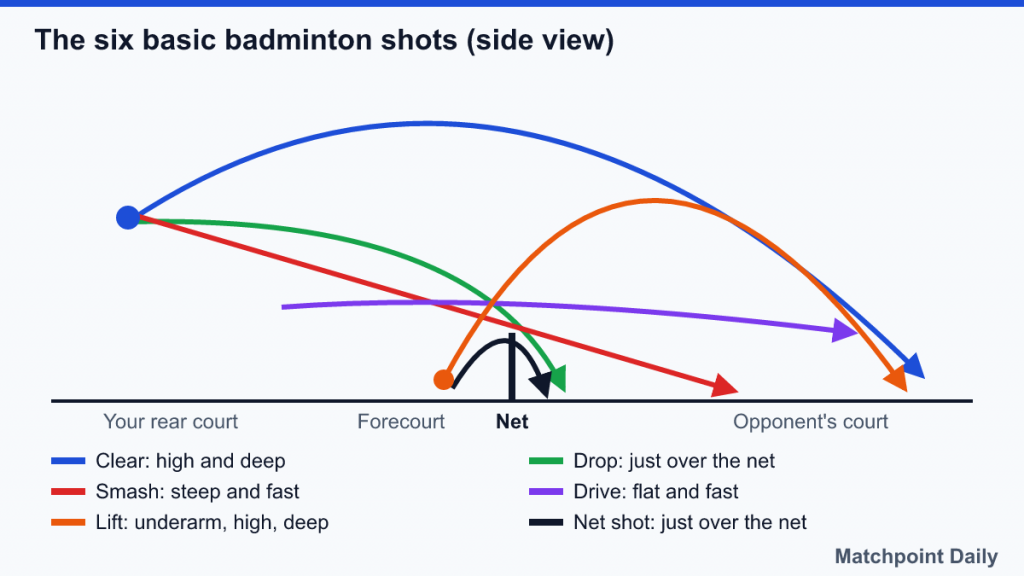
Shot summary table
| Shot | Played from | Trajectory | Main purpose |
|---|---|---|---|
| Clear | Rear court, overhead | High and deep | Buy time, push opponent back |
| Drop | Rear court, overhead | Falls just over the net | Draw opponent forward, force a lift |
| Smash | Mid to rear court, overhead | Steep and fast downward | Win the point or force a weak return |
| Net shot | Forecourt | Just over the net | Force a lift; set up a kill |
| Drive | Mid-court, side-arm | Flat and fast | Rush the opponent; keep the attack |
| Lift | Forecourt, underarm | High and deep | Escape pressure; reset the rally |
How the shots fit into a rally
Badminton tactics are largely about who has to hit the shuttle up. A player who is forced to lift or clear gives their opponent the chance to smash or drop. A player who can keep the shuttle going down or flat keeps the initiative.
- Singles is about moving the opponent to the four corners: clears and lifts to the back, drops and net shots to the front, with the smash used when the opponent is out of position.
- Doubles is faster and flatter: drives, pushes and smashes dominate, and the serve and return are critical. Pairs try to win the “attack” by getting the opponents to lift.
A typical attacking sequence might be: a deep lift from the opponent, a steep half smash from you, a weak block back to the net, then a net kill. A typical defensive sequence might be: a smash at you, a block to the net, a lift from your opponent, and then you are attacking.
Simple drills to build each shot
- Clear-drop-lift loop: player A clears, player B drops, player A lifts, and the pattern repeats. Swap roles every few minutes. It builds overhead preparation, forecourt movement and consistency.
- Smash and block: one player lifts to the back, the other smashes, and the defender blocks to the net. Start with half smashes and focus on contact in front of the body.
- Net play ladder: two players exchange net shots only, trying to keep the shuttle as tight to the tape as possible; whoever lifts or hits into the net loses the point.
- Drive rally: both players stand mid-court and drive flat to each other, alternating forehand and backhand. Keep the racket up and the swings short.
- Shadow practice: without a shuttle, move to each corner and play the stroke in the air. It grooves footwork and preparation without a partner.
Short, focused sessions on one shot at a time usually work better than long, unstructured rallies. If you can, ask a coach to watch your grip and preparation, as small corrections early save months of bad habits.
Common beginner mistakes
- Squeezing the grip. A tight grip throughout the swing kills racket-head speed. Relax until just before impact.
- Hitting late. Most overhead shots should be contacted in front of the body. Late contact sends the shuttle flat or into the net.
- Using the arm only. Power comes from rotation of the body and forearm, not from a stiff arm.
- Different preparation for each shot. If your drop looks different from your clear, opponents read it. Disguise comes from a shared preparation.
- Smashing everything. Smashing from deep in the court when off balance often gives the opponent an easy counter. Choose your moment.
- Ignoring the backhand. Practise backhand lifts and net shots early; they come up in every rally.
All shots are subject to the same laws, which forbid hitting the shuttle twice, slinging it, or touching the net. See our guide to badminton rules and scoring for the full list of faults.