How World Table Tennis Works: Grand Smashes, Champions and Contenders
What WTT is, how its Grand Smash, Champions, Star Contender, Contender and Feeder tiers fit together, and how it connects to rankings and the Worlds.
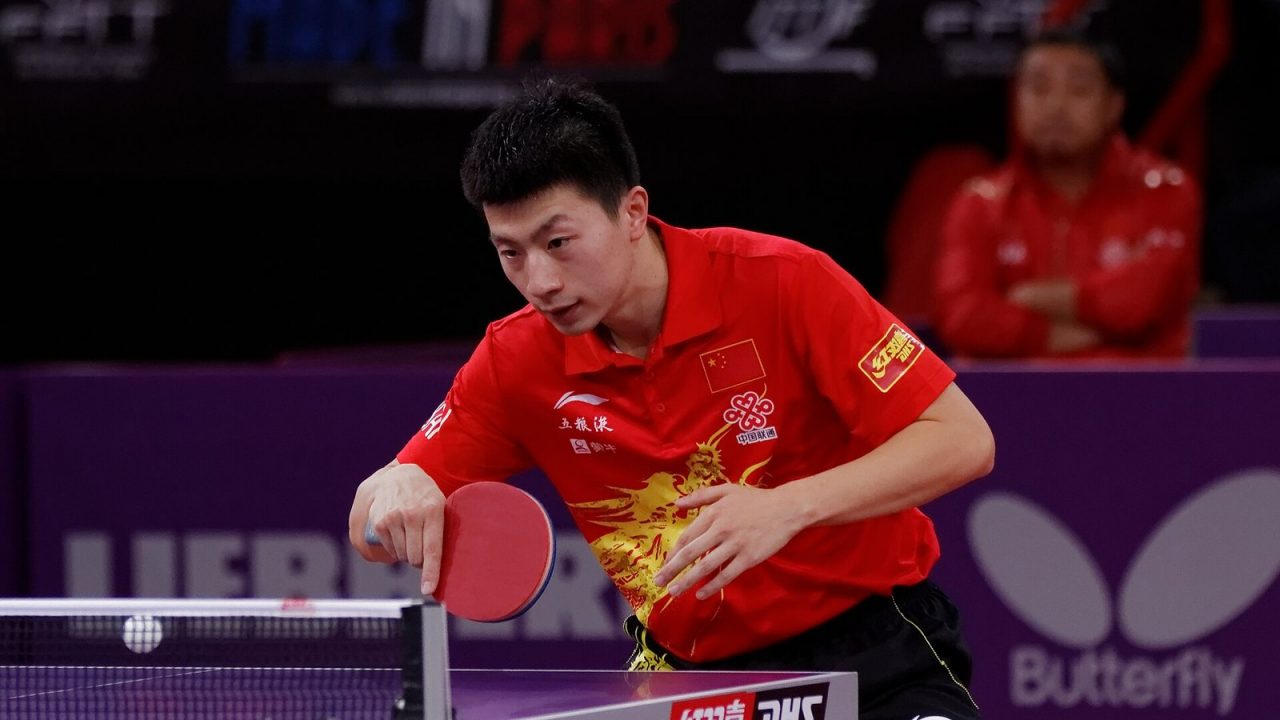
For decades, professional table tennis outside the World Championships and the Olympics was organised as the ITTF World Tour, a circuit of national opens of varying size and prestige. Since the early 2020s, that role has passed to World Table Tennis, usually shortened to WTT. If you watch elite table tennis today, almost every event you see outside the Worlds and the Olympics carries a WTT label: a Grand Smash, a Champions event, a Star Contender or a Contender.
This guide explains where WTT came from, how its tiers differ, how its events feed the world ranking and the season-ending Finals, and how it sits alongside the ITTF’s own championships. It describes the system as of the 2026 season; WTT has adjusted its calendar and formats several times since launch, so details can keep evolving.
What WTT is and why it was created
The International Table Tennis Federation (ITTF) announced World Table Tennis on 30 May 2019 as a commercial vehicle for the sport. The thinking was that the governing body should keep its regulatory and development work, while a dedicated company focused on running and selling a professional events business with bigger prize money, a cleaner calendar and better television presentation.
WTT is headquartered in Singapore and is chaired by former China head coach Liu Guoliang through the WTT Council. Its first event was WTT Macao in November 2020, played during the pandemic, and its full series took shape from 2021, replacing the ITTF World Tour.
Two points are worth keeping clear:
- WTT does not write the rules of the game. The Laws of Table Tennis still come from the ITTF, so everything in our guide to table tennis rules applies at every WTT event.
- WTT does not run the World Championships. The ITTF World Championships remain the federation’s flagship championship, alongside the Olympic tournament.
The tiers at a glance
WTT events are arranged in a ladder. The higher the tier, the smaller and stronger the field tends to be, the larger the prize money and the more ranking points on offer.
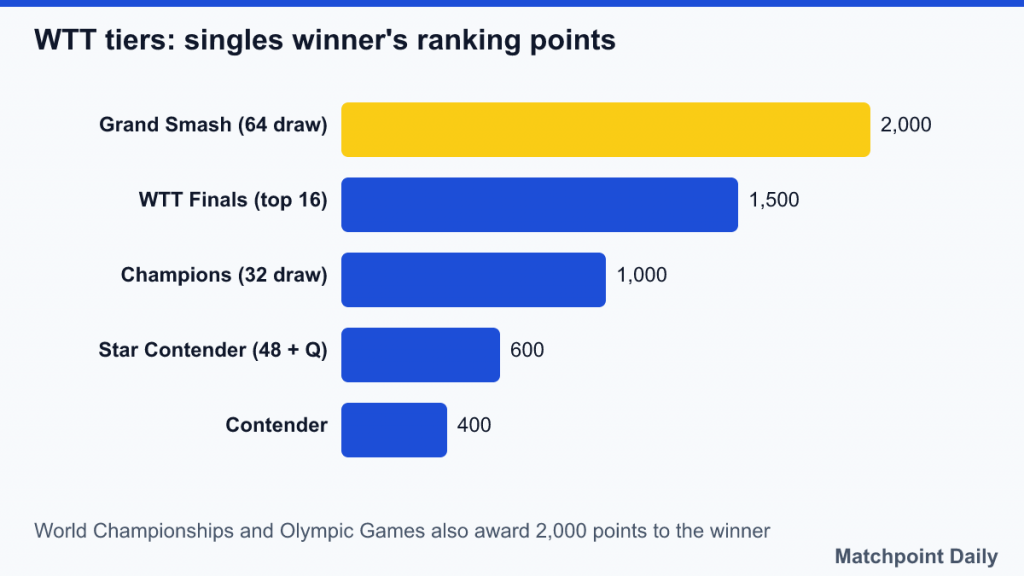
| Tier | Field (singles) | Winner’s ranking points | Role |
|---|---|---|---|
| WTT Grand Smash | 64-player main draw | 2,000 | Flagship events, roughly the “majors” of the circuit |
| WTT Finals | Top 16 singles, top 8 doubles pairs | 1,500 | Season-ending event |
| WTT Champions | 32-player draw | 1,000 | Elite invitational-style events |
| WTT Star Contender | 48-player main draw plus qualification | 600 | Upper middle tier |
| WTT Contender | Larger, flexible draws | 400 | Core development tier |
| WTT Feeder | Open entry | Small | Entry level for emerging players |
The ranking-point figures above are the winners’ values in the ITTF world ranking; lower rounds earn proportionally fewer points. For comparison, the World Championships and the Olympic Games also award 2,000 points to the winner, which puts the Grand Smashes level with the sport’s biggest titles in ranking terms.
Grand Smashes: the top of the pyramid
Grand Smashes are WTT’s biggest events. They are designed to resemble tennis’s Grand Slams: long events (around ten days including qualification), big singles draws of 64, doubles and mixed doubles competitions, and prize pools of up to US$3 million.
WTT’s stated plan is for up to four Grand Smashes per year. Over the first seasons, events have carried the Grand Smash name in Singapore, China, the United States, Europe (staged in Sweden) and Saudi Arabia. The exact line-up changes from year to year, so it is worth checking the current WTT calendar rather than assuming last year’s list will repeat.
Because Grand Smashes offer the same 2,000 winner’s points as the Worlds and the Olympics, they matter enormously for seeding. A deep run at a Smash can lift a player into a seeding band that keeps them away from the top seeds in the next big draw.
Champions, Star Contenders and Contenders
WTT Champions
Champions events are compact, high-quality tournaments with 32-player singles draws for men and women. With no long qualifying rounds, nearly every match features established top players. They are run over about six days and are a favourite for broadcasters because the quality is high from the first round. Several Champions events are held each season, each in a different host city.
WTT Star Contender
Star Contenders have 48-player main draws plus qualification, and include doubles and mixed doubles. They carry 600 points for the winner. For players ranked roughly from the 30s to the 100s, Star Contenders are where a breakthrough result can change a career, because strong showings bring the points needed to qualify for Champions events and Grand Smashes.
WTT Contender
Contenders are the broad base of the professional series. WTT describes the tier as one that lets players throughout the world ranking develop their game, with up to around 14 events per year, typically lasting four days, and flexible draw sizes. A Contender title is worth 400 points.
WTT Feeder
Feeder events sit below the Contenders. They are low-cost, accessible tournaments that give younger players and those from smaller associations a first route into the world ranking. They also help fill the calendar in regions that do not host bigger events, and they are often the first place a talented junior collects senior ranking points.
How rankings link the tiers together
Since 2021, the ITTF world ranking has used a simple principle: a player’s total is the sum of their best eight results from the last year, with continental events counting for at most one of those eight. Points are earned purely by finishing position at recognised events, so the tier of the event matters as much as how far a player goes.
This creates clear strategic choices. A player around 40th in the world might prefer to enter a Star Contender with a realistic chance of a semi-final rather than a Grand Smash where they face a top seed in the first round. Higher-ranked players, by contrast, typically focus on Grand Smashes and Champions events, where both the points and the prize money are greatest.
Rankings also decide direct entry. Main-draw places at the top tiers go mostly by ranking, with qualification rounds and wild cards filling the rest. That is why the ranking and the tiers are best understood together: the ranking is the currency, and the tiers are the different prices.
The WTT Finals
The season closes with the WTT Finals, staged separately for men and women in recent editions. Qualification is based on performance across the season as reflected in the world ranking: the top 16 singles players and the best eight doubles pairs earn places, subject to WTT’s selection rules. The event lasts about five days and offers prize pools of up to US$1.5 million per event, with 1,500 ranking points for the singles winner.
The first two editions, in 2021 and 2022, were called the WTT Cup Finals before the event settled under its current name. Because the field is limited to the season’s strongest performers, every match is effectively a meeting of top-20 players, which makes the Finals a good event for newer fans to sample.
Commitments for top players
Like other professional circuits, WTT sets participation requirements for its highest-ranked players, centred on the Grand Smashes and Champions events, and it can sanction unexplained withdrawals. The details have been revised more than once since launch and have been debated by players over the length of the season, so the current WTT regulations are the place to check exact obligations.
How WTT relates to the World Championships and Olympics
The ITTF World Table Tennis Championships have existed since 1926, when the first edition was held in London. Since 2003, individual championships have been played in odd years and team championships in even years. Doha hosted the 2025 individual championships, and London hosted the 2026 team championships, a century after the first Worlds.
These events are not part of the WTT series, but they are tightly linked to it in practice:
- They award ranking points at the highest level (2,000 for an individual world title), on par with a Grand Smash.
- WTT’s calendar is built around them, leaving windows for the Worlds and, every four years, the Olympic Games.
- The same players dominate both, so form on the WTT circuit is the best guide to who will contend at the Worlds.
The Worlds also keep traditions that the commercial series does not, including historic trophies such as the Swaythling Cup for the men’s team title and the Corbillon Cup for the women’s team title, and the St. Bride Vase for men’s singles.
Tips for following the WTT season
- Start with the Grand Smashes and the Finals. They are the clearest guide to who is in form and they feature the biggest names.
- Use Champions events for quality per match. With 32-player draws, there are few mismatches.
- Watch Star Contenders for breakthroughs. This is where many future stars first win significant titles.
- Check the ranking after each event. Because only the best eight results count, a player’s ranking can move sharply when an old result drops out.
- Learn the strokes you are watching. If you are new to the sport, our guide to table tennis strokes makes rallies easier to read.
The short version: the ITTF governs the sport and runs the World Championships, WTT runs the professional circuit, and the world ranking ties the two together. Once you know the five tiers and the 2,000/1,000/600/400 rhythm of winners’ points, the calendar stops looking like a jumble of names and starts making sense.