How to Choose a Table Tennis Paddle: Pre-Made vs Custom Bats
How table tennis blades are built, what speed ratings and handle shapes mean, pre-made vs custom bats, the ITTF racket rules and a sensible upgrade path.
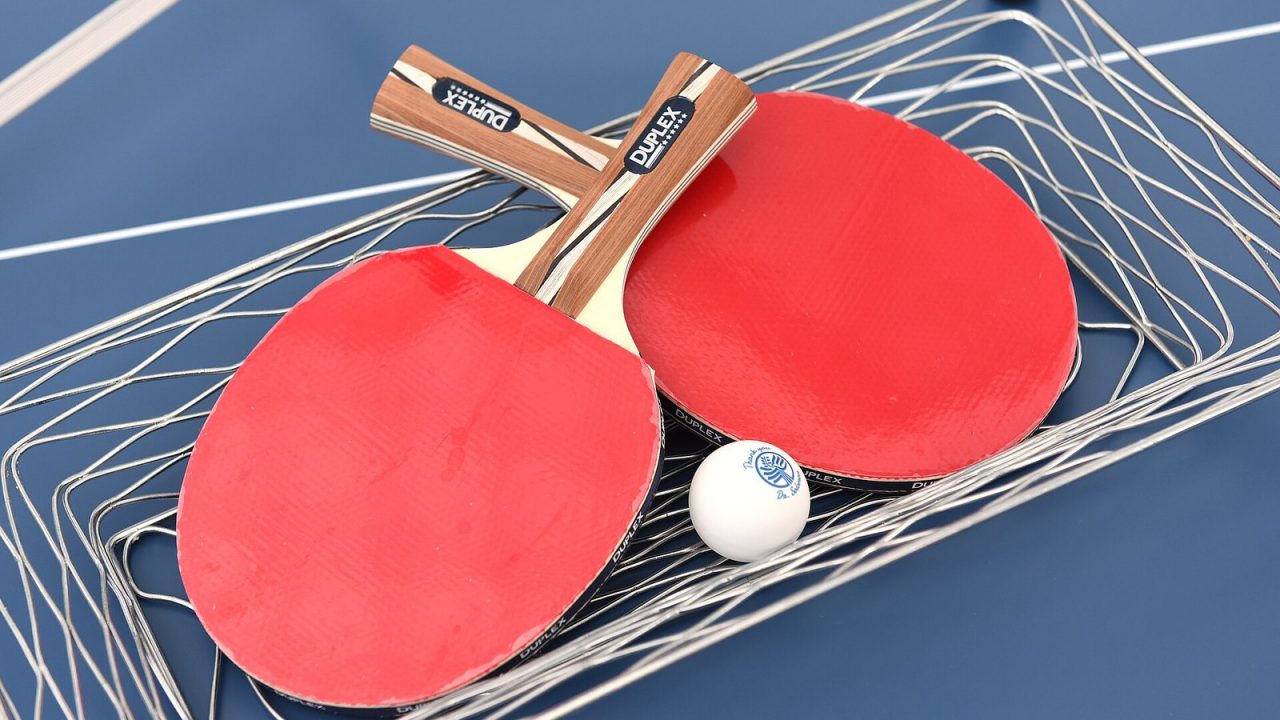
A table tennis paddle (players usually say “bat” or “racket”) looks like a simple piece of wood with rubber on it. In reality it is two separate products, a blade and two rubber sheets, and the combination decides how fast the ball leaves the racket, how much spin you can produce and how much control you have. This guide explains how blades are made, what speed ratings and handle shapes mean, the difference between pre-made and custom rackets, the rules a racket must meet for official play, and a sensible way to progress as you improve. Rubber types are covered only briefly here because they have their own article.
Anatomy of a racket
- Blade: the wooden (sometimes wood-and-composite) paddle including the handle.
- Rubber (covering): on most rackets, a “sandwich” of a sponge layer and a top sheet of pimpled rubber, glued to each side of the blade.
- Handle: part of the blade, shaped in several styles.
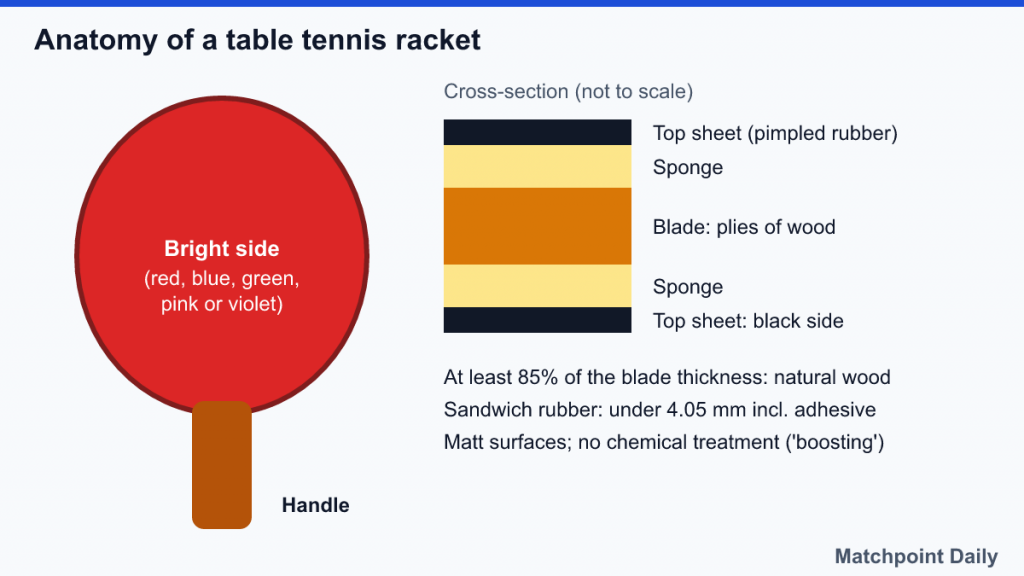
The blade gives the racket its basic speed and feel; the rubber adds grip for spin and its own extra speed. The two interact, so a fast rubber on a slow blade can feel very different from a slower rubber on a fast blade.
What the rules require
Any racket used in sanctioned competition must meet the Laws of Table Tennis. The key requirements in the 2026 ITTF Statutes are:
- The racket may be of any size, shape or weight, but the blade must be flat and rigid.
- At least 85% of the blade by thickness must be natural wood. An adhesive layer within the blade may be reinforced with fibrous material such as carbon fibre, glass fibre or compressed paper, but that layer may not be thicker than 7.5% of the total thickness or 0.35 mm, whichever is smaller.
- A side used to hit the ball must be covered with either ordinary pimpled rubber (pimples out, total thickness including adhesive less than 2.05 mm) or sandwich rubber (pimples in or out, total thickness including adhesive less than 4.05 mm).
- The covering must extend up to, but not beyond, the edges of the blade, except near the handle.
- The surface must be matt, black on one side, and on the other side a bright colour clearly distinguishable from black and from the colour of the ball.
- The covering must be used without any physical, chemical or other treatment, which rules out “boosting” or tuning rubbers with chemicals.
- Before a match, and whenever a player changes racket, they must show it to the opponent and the umpire and allow it to be examined.
National associations add their own regulations. Table Tennis England, for example, requires the covering to be of a brand and type currently authorised by the ITTF for all competitions it regulates. If you plan to play in leagues or tournaments, check that your rubbers are on the ITTF’s authorised list; reputable sellers usually state this.
Rubber colours: not just red and black
For many years, the rule effectively meant one red and one black side. From 1 October 2021, the bright side may also be blue, green, pink or violet, as long as the other side is black. A red-and-black racket remains legal, but it is no longer the only option.
Blade construction: plies, wood and composites
All-wood blades
Blades are built from thin layers of wood called plies. Five-ply and seven-ply constructions are the most common. Generally:
- Fewer, softer plies produce a slower blade with more “dwell time” (the ball stays on the racket a fraction longer), giving control and feel.
- More plies or harder woods produce a stiffer, faster blade with a more direct response.
Composite blades
Composite blades add one or two layers of a fibre material such as carbon, glass fibre or aramid-type fibres between the wooden plies, within the limits set by the laws. These layers usually make the blade faster and enlarge the sweet spot, and they change the feel, which some players love and others find too “dead” for short play.
Speed ratings and categories
Manufacturers commonly sort blades into categories such as defensive (DEF), all-round (ALL), offensive (OFF-, OFF, OFF+), and many also give a numerical speed or control rating. These ratings are useful for comparing blades within one brand’s range, but there is no shared industry standard, so a number from one manufacturer does not translate directly to another.
Handle shapes
| Handle | Shape | Feel and typical use |
|---|---|---|
| Flared (FL) | Wider at the bottom | The most popular shakehand handle; secure grip that resists slipping |
| Straight (ST) | Same width along its length | Easy to adjust grip between forehand and backhand; some players feel it aids backhand play |
| Anatomic (AN) | Bulges in the middle | Fills the palm; preferred by some for comfort |
| Penhold handles | Short (Chinese) or with a cork block (Japanese/Korean) | Designed for penhold grips |
There is no right answer. Try different shapes if you can, and choose the one that lets you hold the racket lightly without it twisting.
Pre-made vs custom rackets
Pre-made (pre-assembled) rackets
These come ready to play, with rubbers already glued to the blade. They are what you see in sports shops and in recreational sets.
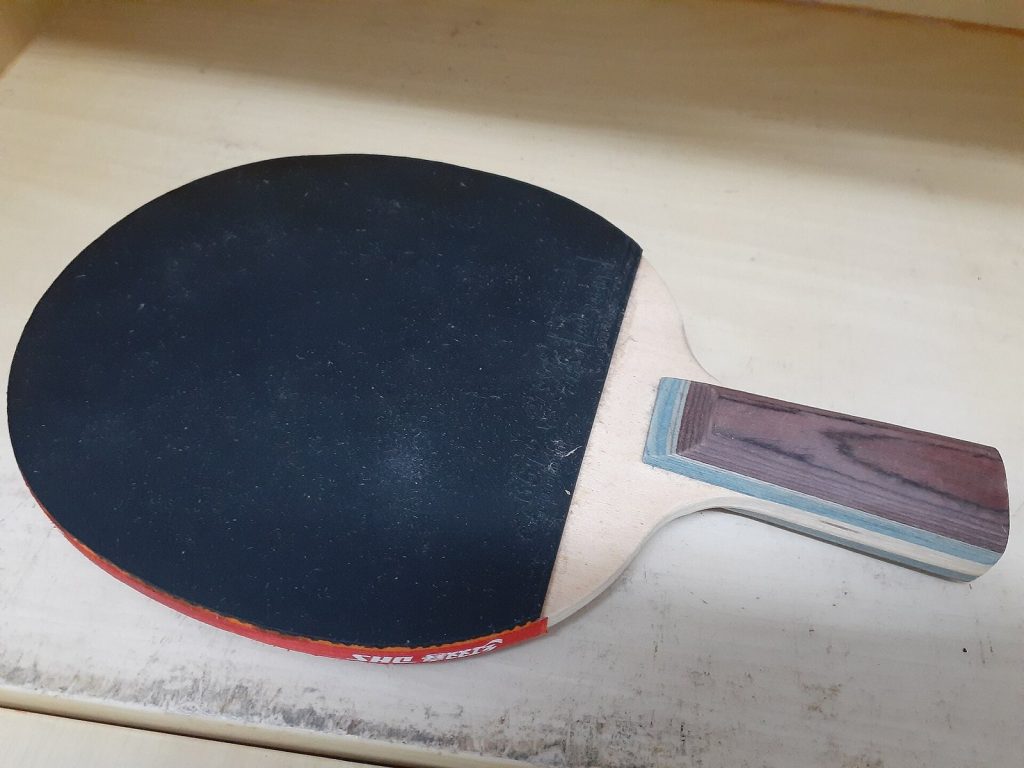
- Advantages: simple, inexpensive, and good ones offer controlled, forgiving play that suits beginners.
- Disadvantages: the rubbers are often harder and less grippy than separately sold rubbers, limiting spin. They usually cannot be easily re-rubbered. Many recreational rackets use rubbers that are not on the ITTF’s authorised list, which matters only if you plan to play in sanctioned competition.
Custom rackets
A custom racket is a blade and two rubbers bought separately and glued together by you or the shop.
- Advantages: you choose each component to suit your style, you can replace worn rubbers without changing the blade, and you can choose different rubbers on the forehand and backhand.
- Disadvantages: more expensive, more choices to make, and it is easy to buy a set-up that is too fast to control.
Rubbers wear out with use and lose grip over time. Regular players often replace them while keeping the same blade for years.
A sensible progression for beginners
- Starting out: a decent pre-made racket designed for control, ideally with rubbers of a recognised brand. Avoid the very cheapest sets with hard, slippery rubber, as they make spin almost impossible.
- Once you play regularly (weeks to months): move to a custom racket built for control: an all-round (ALL or ALL+) wooden blade with medium-speed inverted rubbers in a moderate sponge thickness.
- As strokes become consistent: consider an offensive (OFF-) wooden blade or faster rubbers. Change one component at a time so you can tell what made the difference.
- Advanced play: fast wooden or composite blades and high-performance rubbers, often with different rubbers on each side, chosen with input from a coach.
The most common mistake is buying a very fast composite blade and fast rubbers too early. A racket that is too fast amplifies every error and slows down learning. The strokes covered in our beginner’s guide to table tennis strokes are much easier to learn with a controlled set-up.
Rubbers in brief
The main families are:
- Inverted (pimples-in) rubber: a smooth, grippy surface over sponge. Used by the vast majority of players for spin and speed.
- Short pimples (pimples-out): a flatter, more direct hit with less spin sensitivity.
- Long pimples: long, flexible pimples that tend to return or reverse the incoming spin, used mainly by defensive players.
- Anti-spin: a slick, low-friction inverted surface that deadens spin.
Sponge thickness, hardness and the top sheet’s tackiness all change how a rubber plays. These details are covered in our dedicated rubbers article.
Care and maintenance
- Keep it in a case. Dust, sunlight and knocks damage rubber surfaces and blade edges.
- Clean inverted rubbers with a cleaner made for table tennis or a slightly damp sponge, and let them dry.
- Use edge tape if you often clip the table; it protects the blade’s edges.
- Re-glue properly. Use a water-based glue made for table tennis rubbers, and if you compete, check that your glue and method meet your association’s equipment regulations, since the laws forbid any treatment of the covering.
- Replace worn rubbers. If the surface feels slippery even when clean, the rubber has lost grip.
Forehand and backhand: should the two sides match?
Many players use the same rubber on both sides, which keeps the racket balanced and predictable. Others choose a slightly softer or thinner rubber on the backhand, where strokes are shorter and control matters more, and a faster or harder rubber on the forehand, where most power shots are played. Defensive players often go further, combining an inverted rubber on one side with long pimples or short pimples on the other to vary the spin they return. Because the two sides must be different colours, opponents can see which side you are using, and players are expected to show their racket before the match for exactly that reason.
Whatever combination you choose, consider the total weight. Thicker sponges and heavier rubbers add mass, which can make a racket feel slow on quick backhand exchanges.
Quick checklist
- Beginner? Choose control over speed.
- Planning to compete? Check rubbers are ITTF-authorised and colours are legal.
- Prefer flexibility? Go custom once you play regularly.
- Unsure about handle shape? Flared is the most common starting point.
- Upgrading? Change one component at a time.
Whatever you choose, the racket must comply with the equipment rules covered here and the playing rules in our table tennis rules guide, including the rule that you lose the point if you hit the ball with a non-compliant side of the racket.