Table Tennis Rules Explained: Scoring, Lets, Edges and More
A clear guide to table tennis rules: 11-point games, serve rotation, deuce, lets, edge balls vs side balls, the free hand, volleys and the expedite system.
Most people learn table tennis in a garage or a school hall, and most of them learn a few “rules” that are not actually in the rulebook. You cannot volley? True. Serving has to alternate every five points? Not for more than two decades. A ball that hits the side of the table is good? Only if it hits the top edge. This guide sets out the rules of play as written in the Laws of Table Tennis, which form part of the ITTF Statutes and are reproduced by national associations such as Table Tennis England. Service legality gets only a brief treatment here because it has its own article.
The table, net and ball in brief
The playing surface is 2.74 m long and 1.525 m wide and sits 76 cm above the floor. It must be uniformly dark and matt, with a 2 cm white line along each edge. The net is 15.25 cm high along its whole length. For doubles, a 3 mm white centre line divides each half into two half-courts; the centre line counts as part of each right half-court.
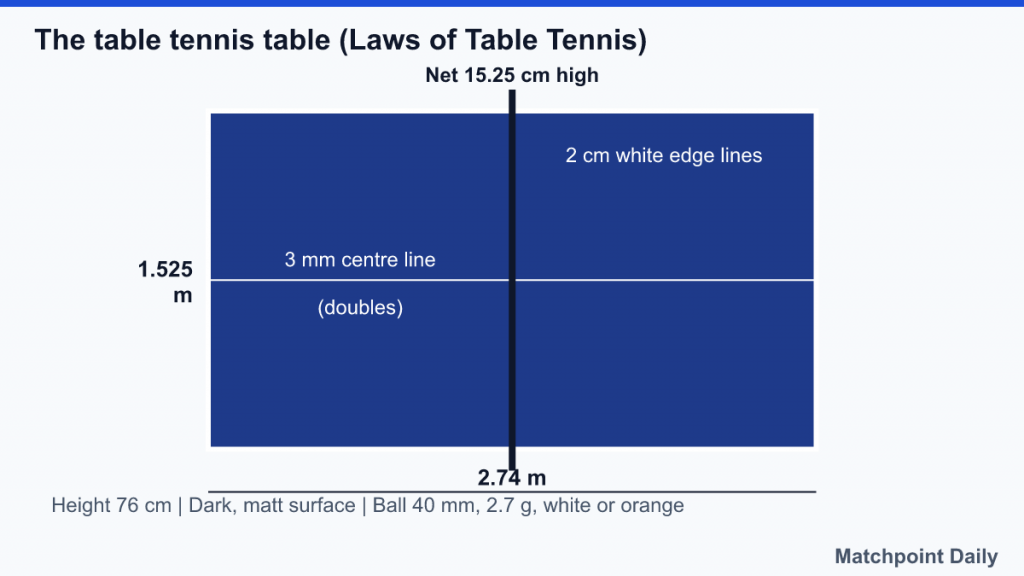
The ball is a 40 mm, 2.7 g plastic sphere, white or orange and matt. One small detail matters for later: the laws state that the playing surface does not include the vertical sides of the tabletop.
How scoring works
Games to 11
A game is won by the first player or pair to reach 11 points, unless both reach 10. At 10-10 (often called deuce) the game continues until someone leads by two points: 12-10, 13-11, 17-15 and so on. There is no cap.
The ITTF switched from 21-point games to 11-point games in 2001, at the same time reducing the service turn from five serves to two. Many recreational players still remember the old format, which is why “five serves each” persists in casual play.
Matches
A match is the best of any odd number of games. In practice that means best of five (first to three games) or best of seven (first to four) in competition, while club leagues and casual games sometimes use best of three. The laws leave the number of games open, so each competition sets its own format in its regulations, and it is worth checking before you play.
Every rally scores
Table tennis uses rally scoring: whoever wins the rally gets the point, no matter who served.
Service order and changing ends
A draw by lot decides who chooses first. The winner may choose to serve, to receive, or to start at a particular end; the other player takes the remaining choice.
- Two serves each: after every two points, the receiver becomes the server.
- At 10-all: the order stays the same, but each player serves only one point in turn until the game ends.
- Next game: the player who served first in a game receives first in the next.
- Ends: players change ends after each game, and in the last possible game of a match (game 5 of a best of five, game 7 of a best of seven) they also change ends when the first player reaches 5 points.
If players serve, receive or stand at the wrong end by mistake, the umpire stops play when it is discovered and restarts in the correct order at the current score. All points scored before the discovery still count.
Doubles adds its own sequence for who serves to whom, including a change of receiving order in the deciding game; that is covered in a separate doubles article.
Lets: when a rally is replayed
A let is a rally whose result is not scored. The most common reasons in practice:
- Net serve: the serve touches the net assembly but is otherwise correct, landing in the right place. It is replayed, and there is no limit on how many times this can happen.
- Receiver not ready: the serve is delivered when the receiver is not ready, provided the receiver does not try to hit it.
- Outside disturbance: a failure to serve or return is caused by something outside the player’s control, such as a ball rolling in from the next table.
- Umpire interruption: play is stopped to correct an error in order or ends, to introduce the expedite system, to warn or penalise a player or adviser, or because conditions of play are disturbed in a way that could affect the rally.
Note the contrast with a net ball during a rally. Once the ball is in play, a return that clips the net and lands on the opponent’s side is perfectly good and play continues. The let only applies to the serve.
Edge balls vs side balls
This is the most argued-about call in club table tennis, and the rule is simpler than people think. Because the playing surface includes the edges of the top but not the vertical sides of the tabletop:
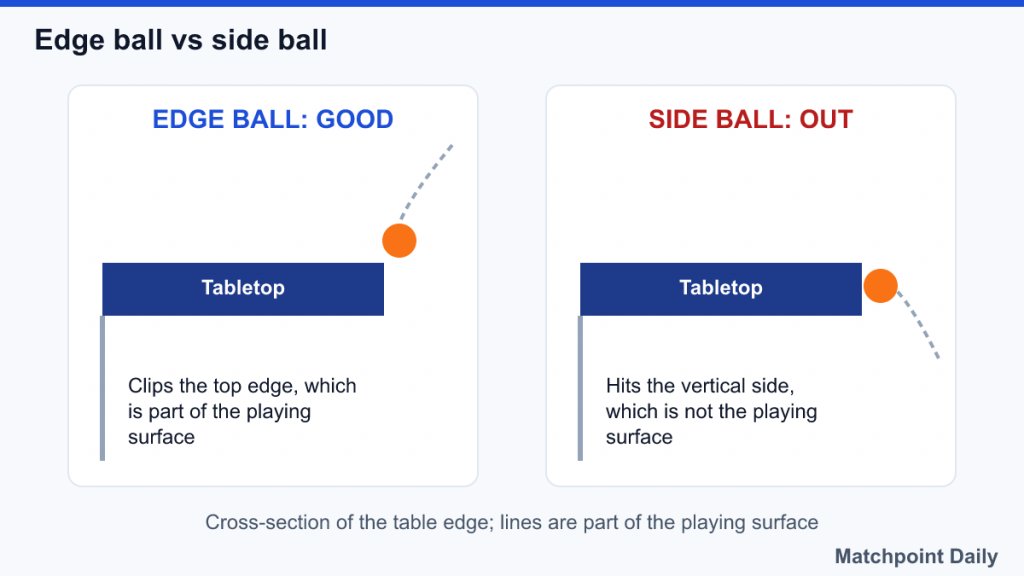
- An edge ball that clips the top edge of the table is good. The ball touched the playing surface.
- A side ball that hits the vertical side of the table is out. It never touched the playing surface.
The problem is deciding which happened. Players commonly judge by how the ball reacts afterwards: a ball that clips the top edge usually changes direction sharply, while one that strikes the vertical side tends to drop away. Where the ball came from also matters: a ball arriving from the hitter’s side of the table, below the level of the playing surface, cannot have touched the top. In umpired matches the umpire decides; in casual play, the honest approach is for the player nearest the contact to call it.
The white side and end lines are part of the playing surface, so a ball landing on a line is in.
Hitting the ball: volleys, double hits and the racket hand
No volleying
A return must be struck after the ball has bounced on your side. If you touch the ball while it is above or travelling towards your side of the table, without it having touched your court since your opponent struck it, you obstruct it and lose the point. This applies even if you are standing well behind the table: if the ball has not bounced on your side and is heading towards your court, catching or hitting it is a point to your opponent. If the ball has already passed your end line without touching your court, it is your opponent’s error and you win the point, so if a ball is clearly sailing long, step aside and let it go.
Racket hand and fingers
The laws define “striking” the ball as touching it with the racket held in the hand, or with the racket hand below the wrist. So a ball that clips your fingers holding the racket and goes over is a legal return. A ball that hits your forearm is not.
Double hits
The current law gives the point to the opponent if a player deliberately strikes the ball more than once in succession. An accidental double contact during a single stroke is not penalised under this wording.
Return path
A return can go over or around the net assembly. A ball hit around the outside of the net post that lands on the opponent’s court is legal. A ball that passes between the net and the post, through the net, or between the net and the playing surface is not.
The free hand, the table and the net
You lose the point if, while the ball is in play:
- Your free hand (the one not holding the racket) touches the playing surface.
- You, or anything you wear or carry, move the playing surface.
- You, or anything you wear or carry, touch the net assembly.
Touching the table with your racket hand, thigh or body is not mentioned as a fault as long as the table does not move. Leaning on it with your free hand is the common mistake. Players who lunge for a short ball and steady themselves on the table with their free hand give away the point.
Other point-ending situations include a ball that touches anything other than the net assembly before the opponent strikes it, and hitting the ball with a side of the racket whose surface does not meet the equipment rules (such as an uncovered side of the blade).
The expedite system
Because defensive players can produce very long rallies, the laws include a time rule to stop games from dragging on. The expedite system comes into operation after 10 minutes of play in a game, or earlier if both players or pairs ask for it. It is not introduced if at least 18 points have been scored in that game.
Once it applies:
- Each player serves for one point in turn until the end of the game.
- If the receiving player or pair makes 13 correct returns in a rally, the receiver wins the point.
- It stays in operation for the rest of the match.
In effect the server must win the point within their first 13 shots of the rally, which forces the server to attack. The system is rarely seen in elite attacking matches but can decide matches between two defensive players.
Serving in one paragraph
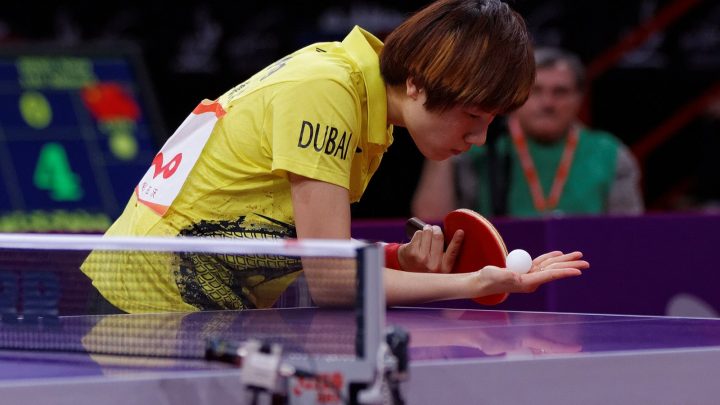
A legal serve starts with the ball resting on the open palm of a stationary free hand. The server tosses it near vertically, without spin, at least 16 cm, and strikes it as it falls so that it bounces first on their own court and then on the receiver’s. From the start of the serve until it is struck, the ball must be above the level of the playing surface, behind the server’s end line, and not hidden from the receiver. Our dedicated service rules article goes through each requirement and how umpires apply them.
Common myths, corrected
- “You get five serves each.” Not since 2001: it is two each, and one each at 10-10.
- “A serve must land in the right-hand box.” Only in doubles. In singles, the serve may land anywhere on the receiver’s side.
- “You can’t hit the ball if it’s not over the table.” You can, once it has bounced on your side. Players routinely hit balls metres from the table.
- “A ball hitting your finger is a fault.” Not if the finger is on the racket hand, below the wrist.
- “Games go to 21.” Official games go to 11, with a two-point lead from 10-10.
Scoring in table tennis is closer to badminton than to tennis, as both use rally scoring with a two-point margin; our badminton scoring guide shows how the shuttle sport handles extended games with a cap instead.