Volleyball Rotation and Overlap Rules Made Simple
How volleyball's six court positions, clockwise rotation and overlap rules work, what changed in the FIVB 2025–2028 rules, and how teams stack legally.
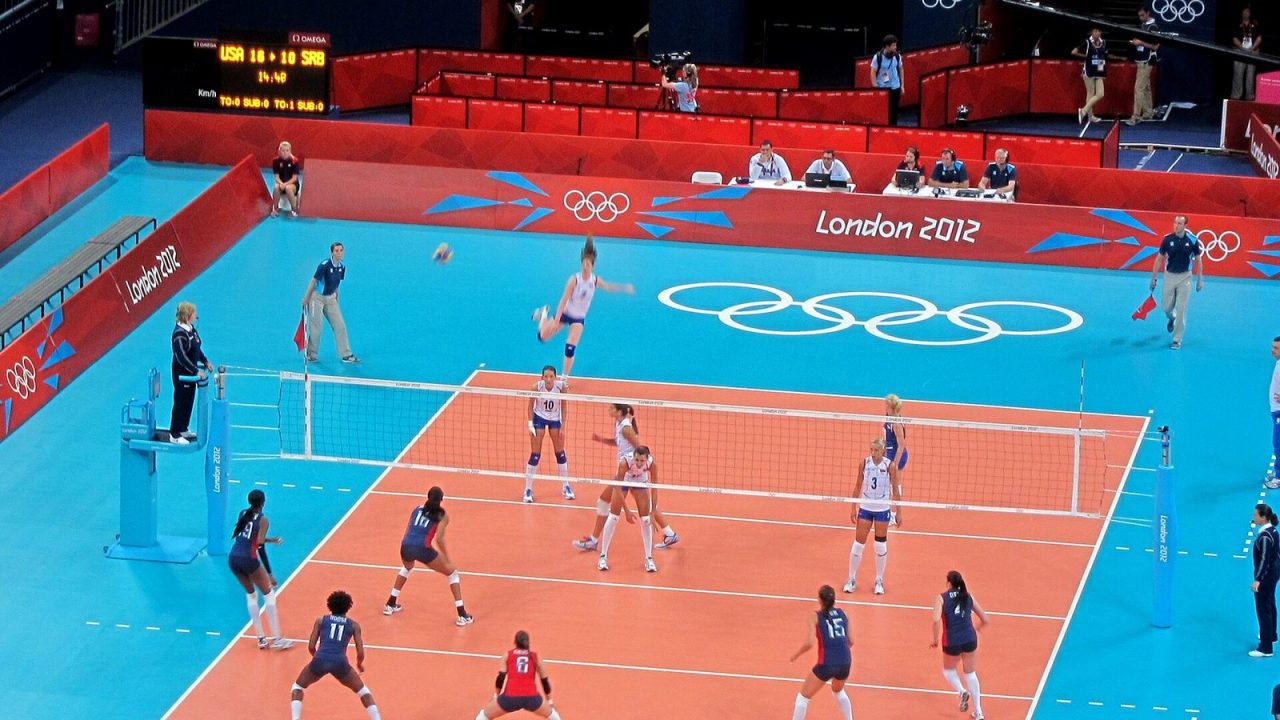
Rotation is the rule that turns volleyball from a free-for-all into a game of structure. It decides who serves, who may block and who may attack from the front. It also explains the strange-looking huddles teams form in the corner of the court before an opponent serves. This guide breaks the topic into simple pieces: the six positions, the rotation itself, the overlap rules, the faults, and the legal tricks teams use to hide the setter and protect weak passers. All rule references are to the FIVB Official Volleyball Rules 2025–2028, which introduced an important change for the serving team.
The six court positions
Each half of the court has six numbered positions. Viewed from behind your own end line, looking at the net:
| Left | Centre | Right | |
|---|---|---|---|
| Front row (at the net) | 4 | 3 | 2 |
| Back row | 5 | 6 | 1 |
Position 1, back-right, is the server’s position. The numbers run anticlockwise from there, which looks odd at first but makes sense once you see the rotation move clockwise through them.
These numbers describe where a player stands in the rotational order at the moment of the serve. They are not the same as playing roles such as setter or middle blocker; our article on volleyball positions covers those roles in detail.
The starting line-up and clockwise rotation
Before each set, the coach submits a line-up sheet showing which six players start and in which positions. That order defines the rotational order, and it must be kept for the whole set.
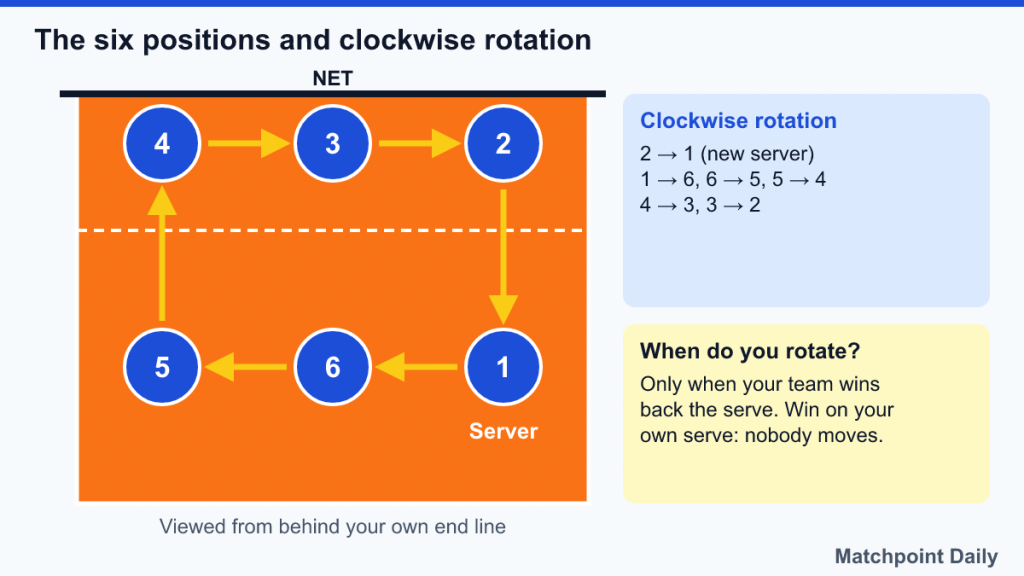
Rotation happens only at one moment: when the receiving team wins a rally and so earns the right to serve. Its players then move one position clockwise before serving:
- 2 moves to 1 (and becomes the server)
- 1 moves to 6
- 6 moves to 5
- 5 moves to 4
- 4 moves to 3
- 3 moves to 2
If the serving team wins the rally, nobody rotates and the same player serves again. A team that wins a long run of points on serve therefore stays in the same rotation throughout, which is why a strong server can dominate a set.
Over a full cycle, every player passes through all six positions, spending three rotations in the front row and three in the back row. A team has six rotations in total, often called “rotation 1” to “rotation 6” by coaches, usually numbered by where the setter is.
The overlap rules: who must be where at the serve
At the moment the server hits the ball, the players of the receiving team must be in their correct rotational order. “Correct order” is defined by two relationships, judged by the position of players’ feet in contact with the floor:
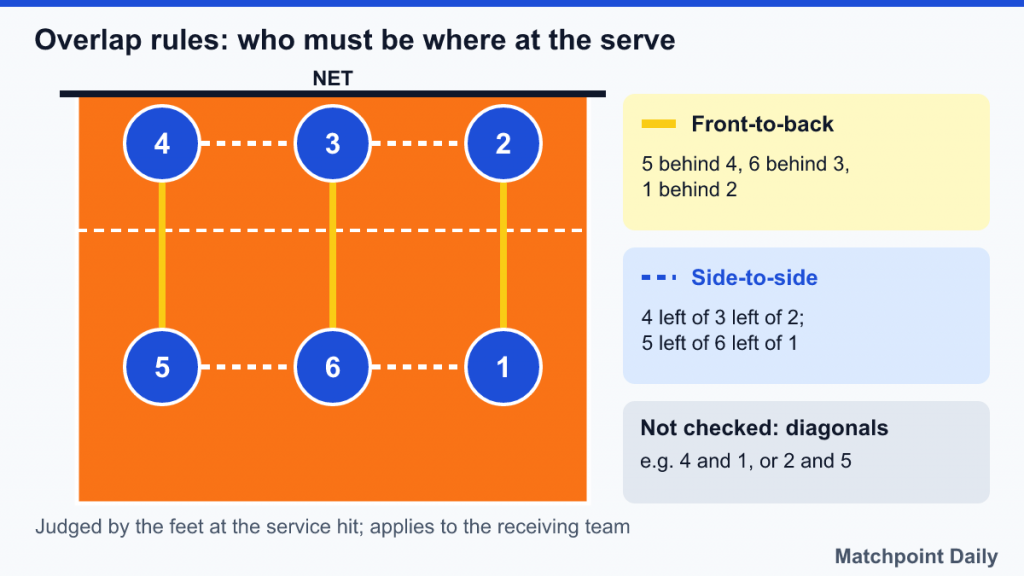
Front-to-back
Each back-row player must be further from the centre line than the corresponding front-row player. The pairs are:
- Position 5 behind position 4
- Position 6 behind position 3
- Position 1 behind position 2
In practice, at least part of one foot of the back-row player must be level with or further from the centre line than the front foot of the corresponding front-row player.
Side-to-side
Within each row, players must keep their left-to-right order:
- Front row: 4 is left of 3, which is left of 2
- Back row: 5 is left of 6, which is left of 1
Each right (or left) side player must have at least part of one foot level with or closer to the right (or left) sideline than the foot of the middle player in that row that is furthest from that sideline.
What is not checked
Only adjacent relationships matter. Position 4 has no restriction relative to position 1 or position 6, for example, and position 2 has no restriction relative to position 5. Diagonal players can be anywhere relative to each other. This is the gap that teams exploit when they stack.
One more requirement applies to everyone: at the service hit, each team must be within its own court, apart from the server. Once the serve is struck, everyone may move anywhere on their side and into the free zone.
The 2025–2028 change: the serving team is free
Under the previous FIVB edition (2021–2024), rule 7.4 required each team to be in its rotational order when the ball was served. The 2025–2028 edition rewrote the rule: the receiving team must still be in rotational order at the service hit, but “the players of the serving team, however, are free to occupy any position at the service hit.”
In practice this means:
- The serving team can position its setter, blockers and defenders wherever it wants before the serve, so long as everyone except the server is on its own court.
- Rotation still matters for the serving team: the correct player must serve, and front-row and back-row status still applies after the serve. A back-row player still cannot block or attack above the net from the front zone just because they started near the net.
- Overlap faults in elite competition now concern the receiving team.
National federations, school associations and college bodies adapt the FIVB rules in their own rulebooks and on their own timetable, so in local leagues both teams may still be checked. If you play or referee domestically, confirm which version your competition uses.
Positional fault vs rotational fault
These two terms are often confused.
| Fault | What happens | Penalty |
|---|---|---|
| Positional fault | A player is not in their correct position at the service hit (an overlap by the receiving team), or a player is on court through an illegal substitution when play restarts | Point and service to the opponent; positions corrected |
| Rotational fault | The serve is not made according to the rotational order, i.e. the wrong player serves | Point and service to the opponent; rotational order corrected; points scored by the faulty team since the fault are cancelled if the moment can be determined |
The rules also settle what happens when faults combine. If the server commits a fault at the moment of the service hit (for example a foot fault or the wrong server) and the opponent is out of position, the serving fault is penalised. If the serve is struck correctly but then becomes faulty, for example it lands out, while the receiving team was out of position, the positional fault is counted, because it happened first.
Stacking: legal ways to hide players
Because only adjacent relationships are checked and everyone may move as soon as the serve is struck, receiving teams arrange themselves in clusters called stacks. The goals are usually to:
- keep the setter out of serve receive and close to the net;
- put the best passers (often the libero and outside hitters) in the middle of the court;
- start attackers near the spot they want to hit from.
Example: setter in position 1
The setter is back-right and must start behind the player in position 2 and to the right of the player in position 6. A common solution is for the position 2 player to stand close to the net on the right, with the setter tucked just behind them near the right sideline. As soon as the ball is struck, the setter steps forward to the target area while the passers cover the court.
Example: setter in position 4
The setter is front-left and must be left of position 3 and in front of position 5. Teams often squeeze the position 3 player and the setter towards the left of the net, sometimes only a step apart. After the serve, the setter runs along the net to the right-centre target and the middle blocker moves into the middle.
In each case, a simple check is to look at each adjacent pair at the moment of the serve: is the back player’s foot behind the front player’s foot? Is the left player’s foot left of the middle player’s foot? If both answers are yes for every pair, the stack is legal, however strange it looks.
How referees check it
Under the FIVB rules, the second referee, who stands on the floor opposite the first referee, is responsible for whistling positional faults of the receiving team. The first referee rules on faults by the server. Before a set, the coach’s line-up sheet is checked against the players on court, and either team’s game captain may ask the referees for authorisation to verify the positions of the teams while the ball is out of play. Any discrepancy found before the set starts is simply corrected with no penalty.
If a player is found to be in the wrong position on court later in the set, the team must return to the correct order, the opponent receives a point and the serve, and points the faulty team scored from the moment of the fault are cancelled.
Tips for players learning rotation
- Know your neighbours. Identify the player in front of or behind you and the players beside you. Those are the only people you must be correctly placed against.
- Use the feet. Position is judged by feet on the floor, not by where your body leans.
- Wait for the contact. Do not move to your playing spot until the server hits the ball.
- Write it down. Many teams keep a simple diagram of each rotation’s receive formation on the bench or on a wristband.
- Talk. A quick “you’re behind me” between neighbours prevents most overlaps.