The History of Table Tennis: From Parlour Game to Olympic Sport
How a Victorian after-dinner game became an Olympic sport: the ping-pong trademark, the ITTF, sponge rubber, ping-pong diplomacy and modern reforms.
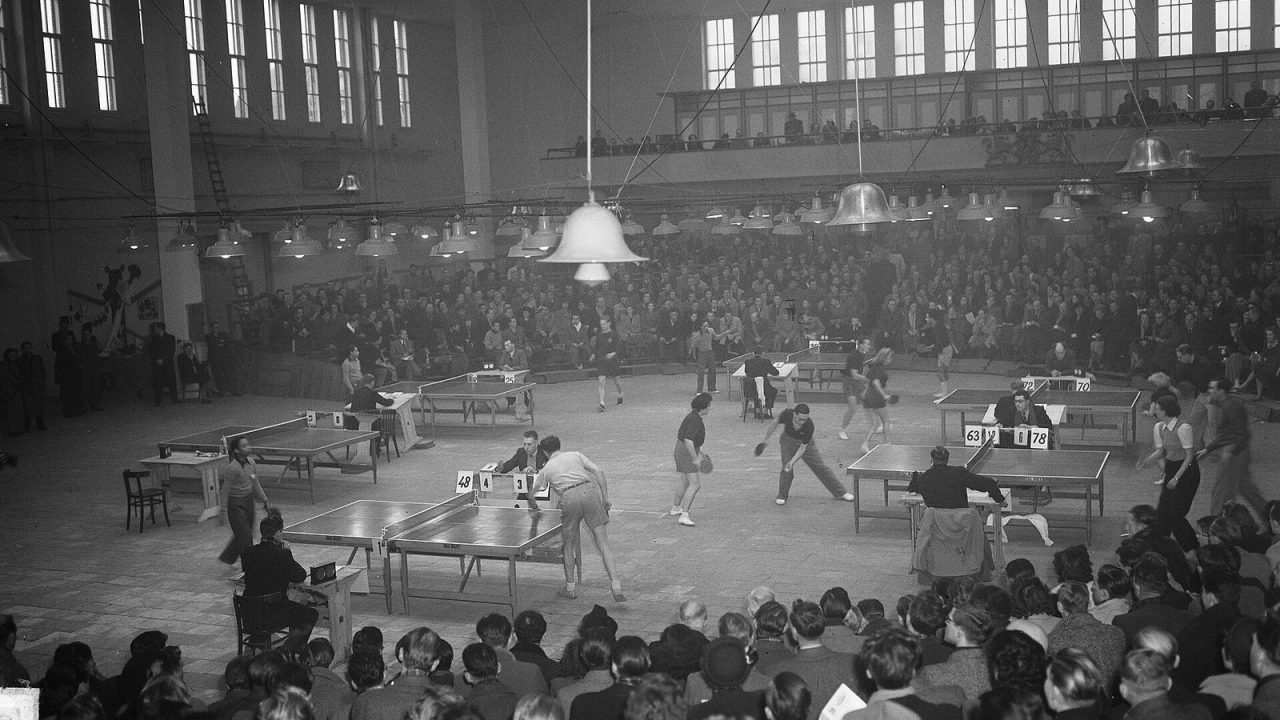
Few sports have travelled as far from their origins as table tennis. It began as an improvised game on dining tables in Victorian England, played with books for a net and whatever balls and bats were at hand. Today it is an Olympic sport with professional circuits, players who generate extraordinary spin and speed, and a competitive culture centred on China. Along the way it even played a small but famous part in world diplomacy.
This article traces the main chapters: the parlour-game origins and the battle over the name “ping-pong,” the founding of the international federation, the equipment revolutions that transformed the way the game is played, the diplomatic episode of 1971, Olympic recognition in 1988, and the reforms that produced the modern sport.
A Victorian after-dinner game
Table tennis began in England in the late 19th century as a parlour game among the upper classes, often played after dinner. It may also have had makeshift versions among British officers in India in the 1860s or 1870s, much like badminton. Equipment was improvised: a row of books stood in for the net, and players used whatever came to hand as rackets and balls, including golf balls.
Because it was essentially a miniature version of lawn tennis brought indoors, manufacturers saw a commercial opportunity. In 1883, the sporting goods company Slazenger filed a patent for a table tennis net, and David Foster is credited with an invention relating to the game in 1890. Various sets were sold under different trade names as the craze grew.
“Ping-pong” versus “table tennis”
The name “ping-pong” is onomatopoeic, imitating the sound of the ball hitting the bat and the table. It became valuable commercial property. In 1901, the English firm J. Jaques & Son trademarked the name, and in the United States, Parker Brothers held and enforced the “Ping-Pong” trademark in the 1920s.
That legal situation pushed organised players towards the generic name “table tennis.” Associations adopted it so they could run competitions without trademark complications. To this day, many players use “ping-pong” for the casual game and “table tennis” for the organised sport, though both describe the same activity.
1901: the inventions that made the sport possible
Two innovations around 1901 turned a novelty into a real game:
- The celluloid ball. James W. Gibb, an English enthusiast, found that celluloid balls were ideal for the game: light, lively and consistent. Celluloid remained the standard ball material for more than a century.
- The rubber-covered bat. E. C. Goode attached a sheet of pimpled rubber to a wooden blade, creating the basic form of the modern racket and giving players far more control and some ability to impart spin.
With a reliable ball and a racket that could grip it, table tennis became a game of skill rather than a parlour toy.
Organisation: the ITTF and the first World Championships
A national Table Tennis Association was founded in England in 1921, and in 1926 the International Table Tennis Federation (ITTF) was established. The same year, the first official World Championships were held in London. The United States formed its own national association in 1933.
The World Championships quickly developed their own traditions, including the trophies still awarded today: the Swaythling Cup for the men’s team title, the Corbillon Cup for the women’s team title, the St. Bride Vase for men’s singles and the Geist Prize for women’s singles, among others.
Not every country embraced the game. In the Soviet Union, table tennis lost popularity in the 1930s, partly because official policy favoured team and military sports and partly because of a belief that the game was bad for health.
Sponge rubber and the Japanese breakthrough
The next revolution was in equipment. In the early 1950s, sponge-backed rubbers arrived, allowing players to generate much more speed and spin. Japanese players adopted sponge early, and it played a major role in the World Championships of that period.
The symbolic moment came at the 1952 World Championships in Bombay, where Japan’s Hiroji Satoh won the men’s singles title using a sponge racket. Satoh’s victory, Japan’s first world title of any kind since the war, signalled that the game’s centre of power was moving from Central Europe to Asia. In Britain, the company S. W. Hancock Ltd introduced rubber-and-sponge rackets to the market.
Equipment changes kept coming. In the mid-1980s, players began using speed glue to re-glue their rubbers before matches, making them even faster and spinnier. Governing bodies spent the following decades adjusting equipment rules to slow the game down, as covered in our guide to choosing a table tennis paddle, which explains what is legal on a bat today.
1971: ping-pong diplomacy
Table tennis’s most famous moment outside sport came at the 1971 World Championships in Nagoya, Japan. The United States and the People’s Republic of China had had no official contact for more than two decades. During the championships, American player Glenn Cowan boarded the Chinese team’s bus by mistake, and Chinese star Zhuang Zedong greeted him. The friendly encounter was photographed and widely reported.
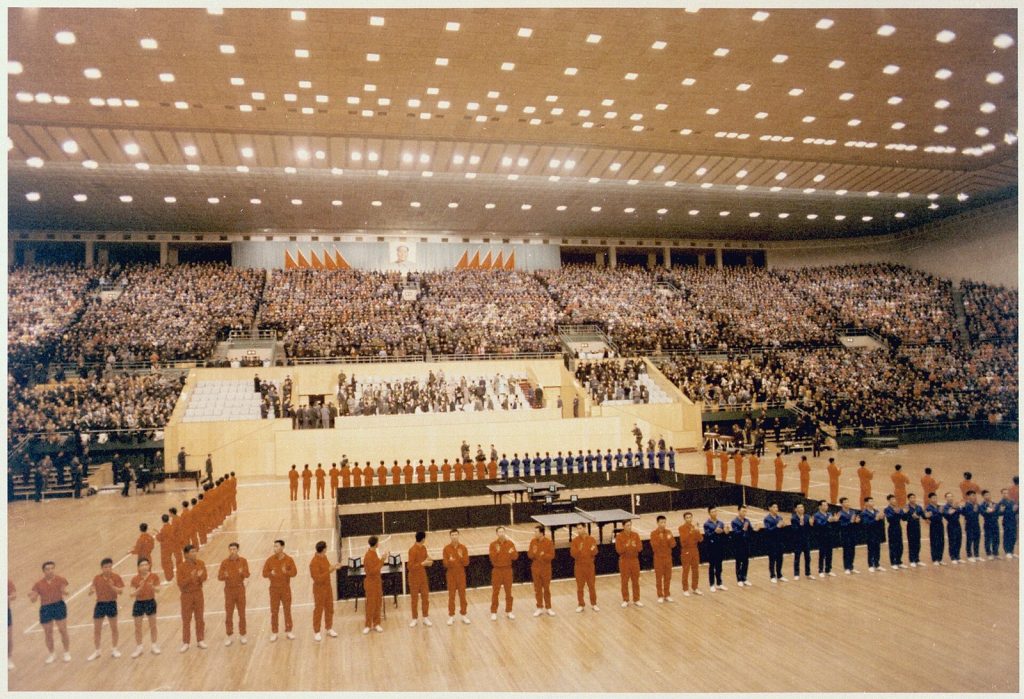
Two days later, the US team received an official invitation to visit China, and in April 1971 it became the first official American delegation to visit the Chinese capital since 1949, touring several cities and meeting Premier Zhou Enlai. The visit took place under the slogan “Friendship First, Competition Second.”
The thaw that followed led to President Richard Nixon’s visit to China in February 1972, the first by a US president to mainland China, which produced the Shanghai Communiqué. In April 1972 a Chinese table tennis team made a return visit to the United States and met Nixon. The episode is remembered as “ping-pong diplomacy,” a rare case of a sporting contact opening a diplomatic door.
Olympic status and the age of reform
Table tennis became an Olympic sport at the 1988 Seoul Games, giving it a new level of global exposure and government investment in many countries. By then, China had become the sport’s dominant nation, a position it has maintained; it leads the all-time World Championships medal table by a wide margin.
Around the turn of the millennium, the ITTF introduced a series of reforms intended to make rallies longer and the game easier to watch on television:
| Date | Change | Main purpose |
|---|---|---|
| October 2000 | Ball size increased from 38 mm to 40 mm | Slow the game slightly for longer, more watchable rallies |
| September 2001 | Games shortened from 21 to 11 points; serve changes every two points instead of five | More decisive moments, shorter games |
| 2002 | New service toss and visibility rules take effect | Stop hidden serves that receivers could not read |
| July 2014 onwards | Polymer (“plastic”) balls replace celluloid at all events | Move away from celluloid as the ball material |
The service reforms are explained in detail in our guide to legal serves in table tennis, and the scoring rules that resulted from the 2001 change are covered in table tennis rules explained.
The modern era
The structure of elite competition has also changed. Since 2003, the World Championships have alternated between individual events in odd years and team events in even years. London, host of the first Worlds in 1926, hosted the team championships again in 2026, a hundred years later. Alongside the ITTF championships, professional events are now run by World Table Tennis, the commercial circuit created by the ITTF, which is explained in our guide to how WTT works.
What has not changed is the essential appeal that made the game popular in Victorian drawing rooms: it can be played almost anywhere, by almost anyone, and even a casual rally is fun. At the top level, though, the game is unrecognisable from its origins: players stand several metres back from the table exchanging heavy topspin at high speed, using equipment that would have astonished the people who once played with books and golf balls.
Common misconceptions
“Table tennis was invented in China.” China is the sport’s modern superpower, but the game originated in England, and its first international federation and world championships were organised from London.
“Ping-pong and table tennis are different sports.” They are the same game. The two names survive mostly because the word “ping-pong” was once a protected trademark, which pushed organised players to adopt “table tennis.”
“The equipment has barely changed.” Almost every element has been reworked: the ball’s size and material, the rubbers and sponge, the glues players are allowed to use, and even the scoring. A top player from the 1950s would recognise the table and the net, but very little else.
“Ping-pong diplomacy was a planned event.” The famous first contact in Nagoya began with a chance meeting on a team bus. What followed was very deliberate, but the spark was accidental.
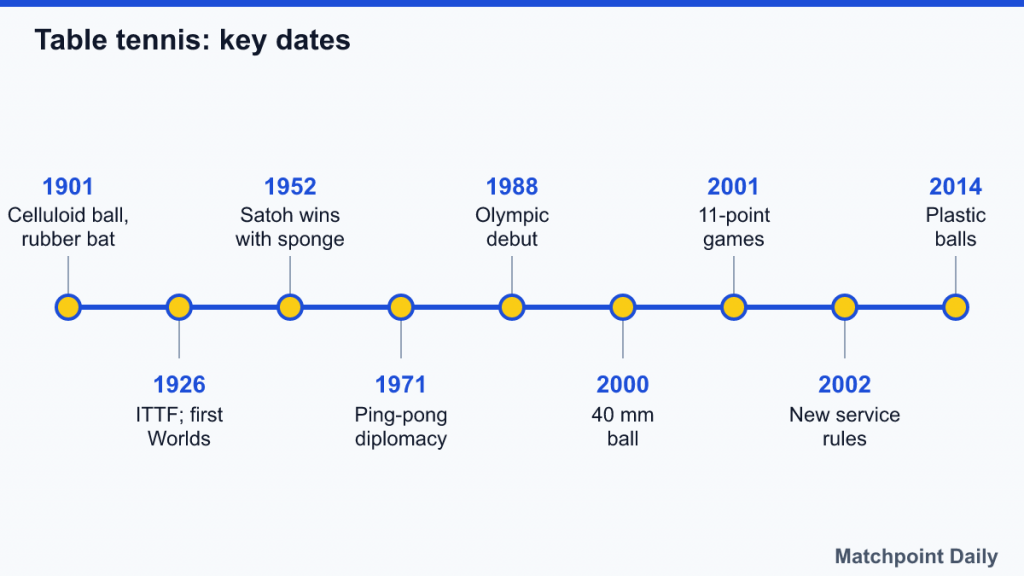
Key dates
- 1880s: parlour game emerges in England.
- 1901: “Ping-pong” trademarked by J. Jaques & Son; celluloid ball and rubber-covered bat introduced.
- 1926: ITTF founded; first World Championships in London.
- 1952: Hiroji Satoh wins the world title with a sponge racket.
- 1971: Ping-pong diplomacy begins at the Nagoya World Championships.
- 1988: Olympic debut in Seoul.
- 2000–2002: 40 mm ball, 11-point games and new service rules.
- 2014: Plastic balls replace celluloid.