Volleyball Glossary: 60 Terms Every Fan Should Know
Sixty indoor and beach volleyball terms in plain English, from ace and side-out to pipe, joust, roof, tool and pokey, grouped by theme.
Volleyball commentary can sound like a private language. In a single rally you might hear that a team “shanked the pass,” the setter “ran a slide,” the hitter “tooled the block” and the libero “pancaked” a dig. None of it is complicated once you know the words, and learning them makes matches far easier to follow.
This glossary collects 60 of the most useful terms for indoor and beach volleyball, grouped by theme so related ideas sit together. Definitions are kept short and practical. Where a term has an official meaning in the FIVB rules, the definition follows that meaning; slang terms are explained the way players and commentators use them. If you are brand new to the sport, our beginner’s guide to volleyball rules is a good companion to this list.
Scoring and match terms
- Rally scoring: the scoring system in which a point is won on every rally, whichever team served. It has been standard in international volleyball since 2000.
- Set: a single game within a match. Indoors, sets go to 25 points (the deciding fifth set to 15); on the beach, sets go to 21 (the deciding third set to 15). A two-point margin is always required.
- Side-out: winning a rally while receiving serve, which also wins the right to serve. A team’s “side-out percentage” measures how often it scores on the opponent’s serve.
- Break point: a point won by the serving team. Winning break points is usually what decides close sets.
- Set point / match point: the moment a team needs one more point to win the set or the match.
- Time-out: a break requested by a team. Indoors, each team may request two per set, each lasting 30 seconds under the FIVB rules.
- Technical time-out: an automatic break. In FIVB beach volleyball, one 30-second technical time-out occurs in sets one and two when the combined score reaches 21.
- Rotation: the clockwise movement of players through the six court positions each time a team wins back the serve.
- Rotation (positional) fault: a fault committed when players of the receiving team are out of their correct positions relative to each other at the moment of serve. Under the current FIVB rules, the serving team may stand anywhere when the ball is served.
- Challenge: a request for video review of a call, available at elite events that use a video challenge system.
Serving and receiving terms
- Ace: a serve that wins the point directly, either because it lands untouched or because the receiver cannot keep it in play.
- Float serve: a serve hit with little or no spin, so that it wobbles and moves unpredictably in the air.
- Jump serve: a serve hit after a running jump, usually with heavy topspin for power. A “jump float” combines a jump with a no-spin contact.
- Serve receive: the formation and skill a team uses to pass the opponent’s serve.
- Pass: the first contact, usually a forearm pass, aimed at delivering the ball to the setter.
- Platform: the flat surface formed by the forearms held together for a forearm pass.
- Shank: a badly mishit pass that flies off in an unintended direction, often out of play.
- Perfect pass (or “3 pass”): a pass that gives the setter every option. Many coaches grade passes on a 0–3 scale.
- Seam: the gap between two passers. Servers often target seams to create confusion over who takes the ball.
- Service zone: the area behind the end line from which the server must serve. Indoors, the server has eight seconds after the referee’s whistle; on the beach, five seconds.
Setting and attacking terms
- Set (the skill): the second contact, usually an overhand pass, that places the ball for a hitter to attack.
- Setter dump: when the setter attacks the second ball over the net instead of setting, usually tipping or pushing it into an open spot.
- Kill: an attack that directly wins the point.
- Spike (or hit, attack): a powerful overhead strike of the ball into the opponent’s court.
- Approach: the footwork a hitter uses to build momentum before jumping to attack, typically three or four steps.
- Quick (or “1”): a very fast, low set to a middle blocker who is already in the air or jumping as the ball is set.
- Slide: an attack by a middle blocker who runs along the net behind the setter and jumps off one foot, rather like a layup in basketball.
- Pipe: a back-row attack from the middle of the court, behind the attack line. It adds a fourth attacking option.
- Back-row attack: an attack by a back-row player, legal only if the player takes off from behind the attack line or the ball is not entirely above the net.
- Tip: a soft attack placed over or around the block with the fingertips. Legal indoors as long as the ball is not caught or thrown; open-handed tips are a fault on the beach.
- Roll shot: an off-speed attack hit with topspin so it drops just over the block.
- Tool (or “wipe”): a deliberate attack off the opponent’s block so that it deflects out of bounds, winning the point for the attacker.
- Line shot / cross-court shot: attacks hit straight down the sideline or diagonally across the court.
- Combination play: a coordinated attack in which two or more hitters approach at different times or places to confuse blockers.

Defence and blocking terms
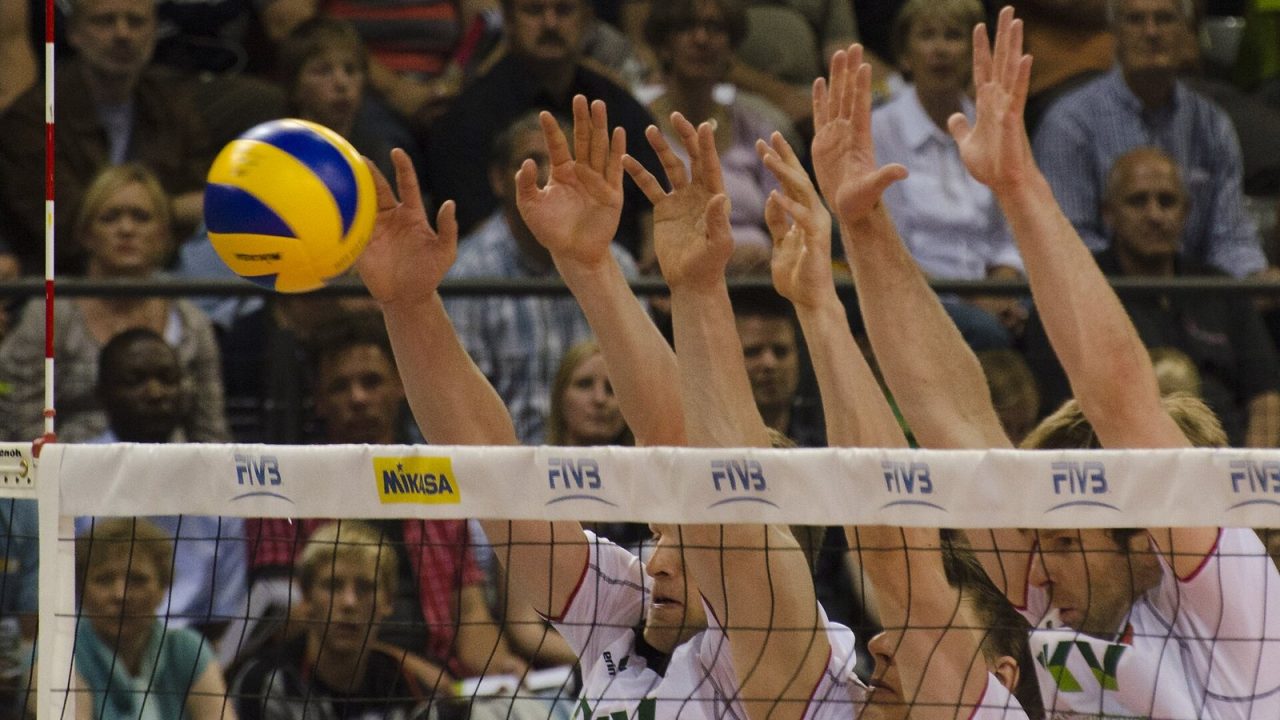
- Block: the action of players close to the net reaching above it to intercept an attack. Indoors, a block contact does not count as one of the team’s three hits; on the beach, it does.
- Roof (or stuff): a block that sends the ball straight back down onto the attacker’s side for a point.
- Soft block: a block with hands angled back to deflect the ball upward for a teammate to play, rather than to stop it dead.
- Penetration: how far a blocker’s hands reach over the net into the opponent’s space, which is legal as long as the blocker does not play the ball before the opponent’s attack.
- Read block: blocking by watching the setter and reacting, rather than committing early to a particular hitter.
- Commit block: a blocker jumps with a particular attacker (often the quick hitter) regardless of where the set goes.
- Dig: a defensive contact that keeps a hard-driven attack in play.
- Pancake: an emergency dig in which a defender slides a flat hand along the floor so the ball bounces off the back of the hand.
- Transition: the switch from defence to offence after a dig or block, or the reverse.
- Free ball: an easy ball sent over the net without an attack, giving the receiving team a chance to run its full offence.
- Overpass: a pass or dig that accidentally goes straight over the net, often punished by the opponent.
- Joust: when players from both teams contact the ball simultaneously above the net. Play continues, and the team on whose side the ball lands receives a fresh set of three hits.
Positions and roles
- Setter: the playmaker who takes most second contacts. See our guide to volleyball positions for full role profiles.
- Outside hitter: attacks mainly from the left side and plays a major role in serve receive.
- Opposite: lines up opposite the setter in the rotation, usually a powerful right-side attacker.
- Middle blocker: the team’s main blocker and quick attacker in the centre of the net.
- Libero: a back-row defensive specialist in a contrasting jersey who may replace any back-row player without a formal substitution, but may not attack when the ball is entirely above the net.
- Defensive specialist: a substitute brought on for back-row defence and serve receive.
- 5-1 / 6-2 / 4-2: offensive systems describing how many hitters and setters a team uses.
Beach volleyball terms and slang
- Blocker / defender split: the common beach arrangement in which one partner blocks at the net and the other defends the court behind.
- Block signal: the hand signal a blocker shows behind the back to tell the partner which shot or area the block will take away.
- Cut shot: a sharply angled attack that drops close to the net near the sideline.
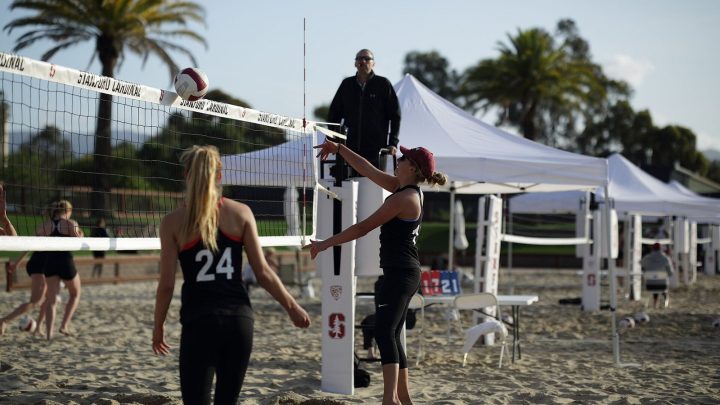
- Pokey: a shot played with the knuckles to place the ball over or around the block, used because open-hand tips are not allowed on the beach.
- Skyball: a serve hit extremely high into the air so that it drops almost vertically, making it hard to judge, especially in sun or wind.
- Side switch: teams change ends every seven points in the first two sets and every five points in the deciding set, to share wind and sun conditions fairly.
- Serving order: the order in which the two partners serve, which must be maintained throughout a set, even though there are no fixed court positions.

How to use this glossary
The fastest way to learn volleyball vocabulary is to watch a match with a few terms in mind. Pick one theme at a time: in one match, pay attention to serve receive (passes, shanks, aces); in the next, watch the setter (quicks, slides, dumps). Commentators repeat the same words constantly, so a handful of matches is enough to make most of this list feel natural.
A few terms vary by country and level. Set-calling systems in particular use different numbers and names from coach to coach, and some slang (such as “roof” versus “stuff”) is regional. When in doubt, the official FIVB rule wording is the reference for anything to do with what is legal.