Volleyball Rules Explained: A Complete Beginner’s Guide
A plain-English guide to indoor volleyball rules: court and net heights, six players, three touches, rally scoring, common faults, timeouts and substitutions.
Volleyball looks simple from the stands: keep the ball off your floor and put it on theirs. Once you start playing or watching closely, though, the whistle goes for things that are not obvious at first glance. Why was that a fault when the ball never touched the floor? Why did the referee stop play before the serve? This guide walks through the indoor game from start to finish, using the FIVB Official Volleyball Rules 2025–2028, which apply to international competition and form the basis of most national rulebooks.
Local leagues, schools and colleges sometimes modify details, so check your own league’s adaptations.
The court, the net and the ball
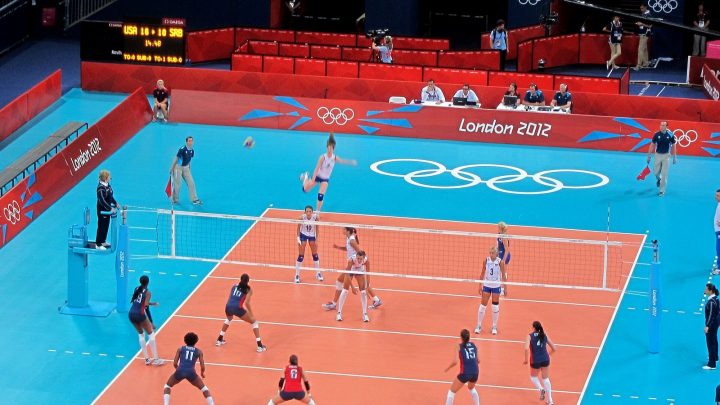
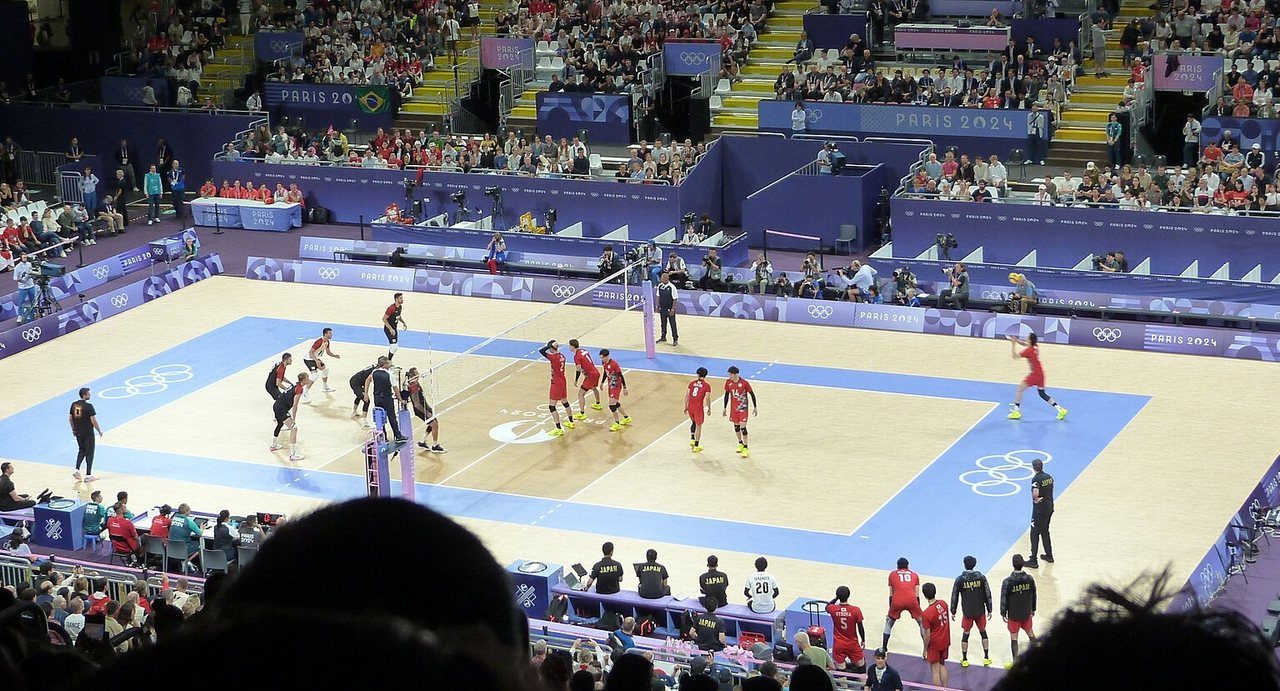
An indoor court is a rectangle measuring 18 x 9 metres, split by a centre line into two square halves of 9 x 9 m. Around it runs a free zone at least 3 m wide on all sides; at FIVB, world and official competitions the free zone grows to 5 m from the side lines and 6.5 m from the end lines, and the free playing space above the floor must be at least 12.5 m high.
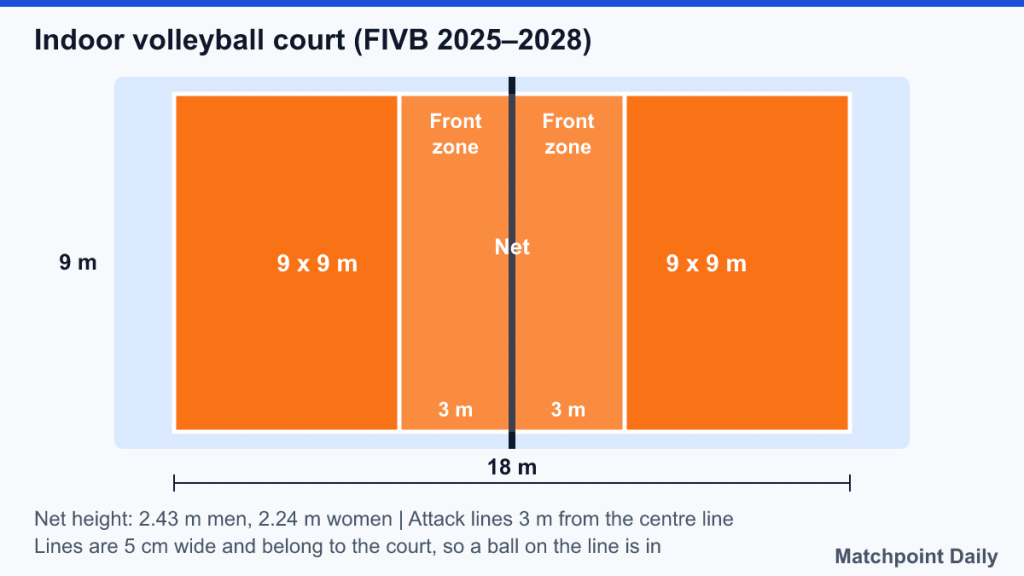
On each half, an attack line is drawn 3 m back from the centre line. The area between the centre line and the attack line is the front zone, and it matters a great deal for who may attack and how. Behind each end line is the 9 m wide service zone.
The net is 1 m deep and hangs over the centre line. Its top is set at:
- 2.43 m for men
- 2.24 m for women
The height is measured at the centre of the court, and it must be identical over both side lines. Two antennae, 1.80 m long and rising 80 cm above the net, mark the sideways limits of the crossing space. A ball that crosses outside the antennae, or touches them, is out.
The official ball has a circumference of 65–67 cm, weighs 260–280 g and is inflated to 0.30–0.325 kg/cm². All lines are 5 cm wide and belong to the area they enclose, which is why a ball that clips the line is “in”.
Teams, players and the basic flow of a rally
Each team has six players on court at all times. Under the FIVB rules a team may list up to 12 players for a match, and in senior FIVB, world and official competitions up to 14 may be recorded on the score sheet. Teams may also designate up to two liberos, defensive specialists in a contrasting jersey with their own set of restrictions.
A rally starts with a serve from behind the end line and continues until the ball is grounded, goes out, or someone commits a fault. In between, each team is allowed a maximum of three hits to return the ball over the net. In practice the classic sequence is a pass (often called the dig or reception), a set, and an attack, but the rules only care about the count, not the type of contact.
Two important details about hits:
- The same player may not touch the ball twice in a row, with exceptions for blocking and for the team’s first contact.
- A block contact does not count as one of the three team hits. After a ball deflects off the block, the blocking team still has three hits, and the player who blocked may even make the next one.
The ball may touch any part of the body, including the feet. What it may not do is come to rest: catching or throwing it is a fault.
How scoring works: rally points, sets and matches
Indoor volleyball uses rally-point scoring: every rally produces a point for someone, whichever team served. FIVB adopted rally scoring in 1999 and made it compulsory in 2000, replacing the old side-out system in which only the serving team could score.
The key numbers:
| Element | Rule |
|---|---|
| Sets 1–4 | First to 25 points with a lead of at least two (26-24, 27-25 and so on) |
| Match | Best of five: first team to win three sets |
| Deciding 5th set | First to 15 points, again with a two-point lead |
| Change of courts | After every set except the 5th; in the 5th, teams switch when the leading team reaches 8 points |
| Interval between sets | Three minutes (the break between sets 2 and 3 can be extended up to 10 minutes on the organiser’s request) |
When the serving team wins the rally, the same player serves again. When the receiving team wins, it earns the serve and its players rotate one position clockwise before serving. That rotation is a topic in itself, and it has a dedicated article on this site.
Serving: the basics
The serve is made by the player in the back-right position (position 1), standing in the service zone. The server must hit the ball with one hand or arm after a single toss or release and has 8 seconds from the first referee’s whistle to do so. Bouncing the ball beforehand is fine; tossing it, letting it drop and tossing again is not.
At the moment of the hit, or at take-off for a jump serve, the server may not touch the court or the end line. Landing inside the court after contact is allowed, which is why jump servers routinely finish a metre or two inside the line.
A serve is also a fault if it touches a teammate, fails to cross the net through the crossing space, or lands out. A serve that clips the net and continues over is legal and in play. Teammates of the server are not allowed to screen, meaning they cannot wave arms, jump, or stand grouped so that the receivers cannot see the serve and its flight path. The rules also forbid serving-team players from raising their hands above their heads during the serve.
The most common faults explained
Most whistles in a beginner match come from a handful of faults. Here is what each means and why it is called.
Four hits
The team used more than three contacts before sending the ball over. Remember that a touch on the block does not count, but every other contact, including accidental ones, does.
Double contact
A player hits the ball twice in succession, or the ball touches different parts of their body one after another. The exception is the team’s first contact: when receiving a serve or digging an attack, the ball may contact several body parts in a single action without penalty. This is why referees are far stricter on a double touch during an overhead set than on a scrappy dig.
Catch (often called a “lift”)
The ball must rebound from the hit. If it visibly comes to rest in the hands or is pushed along, it is a catch. Many players still call this a “lift” or “carry”; the FIVB rule simply says the ball must not be caught or thrown.
Net touch
Touching the net between the antennae is a fault when it happens during the action of playing the ball, which includes take-off, the hit or attempt, and landing. It is also a fault to use the net for support, grab it, or touch it in a way that hinders an opponent. A brush of the net by a player who is nowhere near the play is not automatically a fault, and touching the net outside the antennae is generally allowed.
Centre-line violations
Players may reach under the net and even touch the opponent’s court with a foot, provided part of the foot stays in contact with or directly above the centre line and there is no interference. A foot that lands completely across the line is a fault. Other parts of the body may touch the opponent’s court as long as they do not interfere with play.
Foot faults on serve and back-row attacks
A server stepping on the end line before contact commits a foot fault. A back-row player may attack the ball above net height only if they take off from behind the attack line; their feet must neither touch nor cross it at take-off, though they may land in the front zone.
Reaching over and illegal blocks
Blockers may reach beyond the net, but they may not touch the ball in the opponent’s space before the opponent has made its attack hit. Only front-row players may complete a block, the libero may never block or attempt to, and blocking an opponent’s serve is forbidden.
Positional and rotational faults
When the serve is struck, the receiving team must be in its correct rotational order. The 2025–2028 rules state that players of the serving team are free to occupy any position at the service hit, so the overlap check now applies to the receiving side. Serving out of turn is a rotational fault. Both are penalised with a point and service to the opponent.
Timeouts and substitutions
The only regular interruptions in an indoor match are timeouts and substitutions. Under the FIVB rules each team may take a maximum of two timeouts and six substitutions per set.
- Timeouts last 30 seconds and may be requested by the coach (or the game captain if there is no coach) when the ball is out of play, before the whistle for service. In FIVB competitions the length can be adjusted with FIVB approval.
- Substitutions are restricted: a starting player may leave the game once per set and come back once, but only into their original position in the line-up. A substitute may enter only once per set and can only be replaced by the starter they came in for.
Libero replacements are separate from this system. They do not count as substitutions and are unlimited, though there must be a completed rally between two libero replacements. If a player is injured and no legal substitution is possible, the rules allow an “exceptional substitution” outside the normal limits.
Many domestic, school and youth competitions allow more substitutions, so this is one area where local rules most often differ from the FIVB version.
Common beginner misconceptions
- “You can’t kick the ball.” You can. Any part of the body is legal.
- “The ball can’t touch the net on a serve.” It can, as long as it crosses through the crossing space.
- “A ball on the line is out.” Lines are part of the court, so any contact with the line is in.
- “Blocking counts as a touch.” Not indoors. It does in beach volleyball, which is one of the biggest differences between the two games.
- “You always rotate after every point.” You rotate only when you win back the serve.
Quick reference summary
| Topic | Indoor rule (FIVB 2025–2028) |
|---|---|
| Court | 18 x 9 m, attack line 3 m from centre line |
| Net height | 2.43 m men, 2.24 m women |
| Players on court | 6 per team |
| Hits per side | Max 3 (block not counted) |
| Set | 25 points, two-point lead; 5th set to 15 |
| Match | Best of five sets |
| Serve time | 8 seconds after the whistle |
| Timeouts | 2 per set, 30 seconds each |
| Substitutions | 6 per set (libero replacements not counted) |
Once these basics are second nature, the tactical layer opens up: odd-looking formations before the serve, the libero’s role in defence, and setters sprinting into position the instant the ball is struck.