Badminton Rules and Scoring Explained, Including the Move to 3×15
How badminton scoring works under the current 21-point system, court lines, faults and intervals, plus what changes when BWF's 3x15 format starts in January 2027.
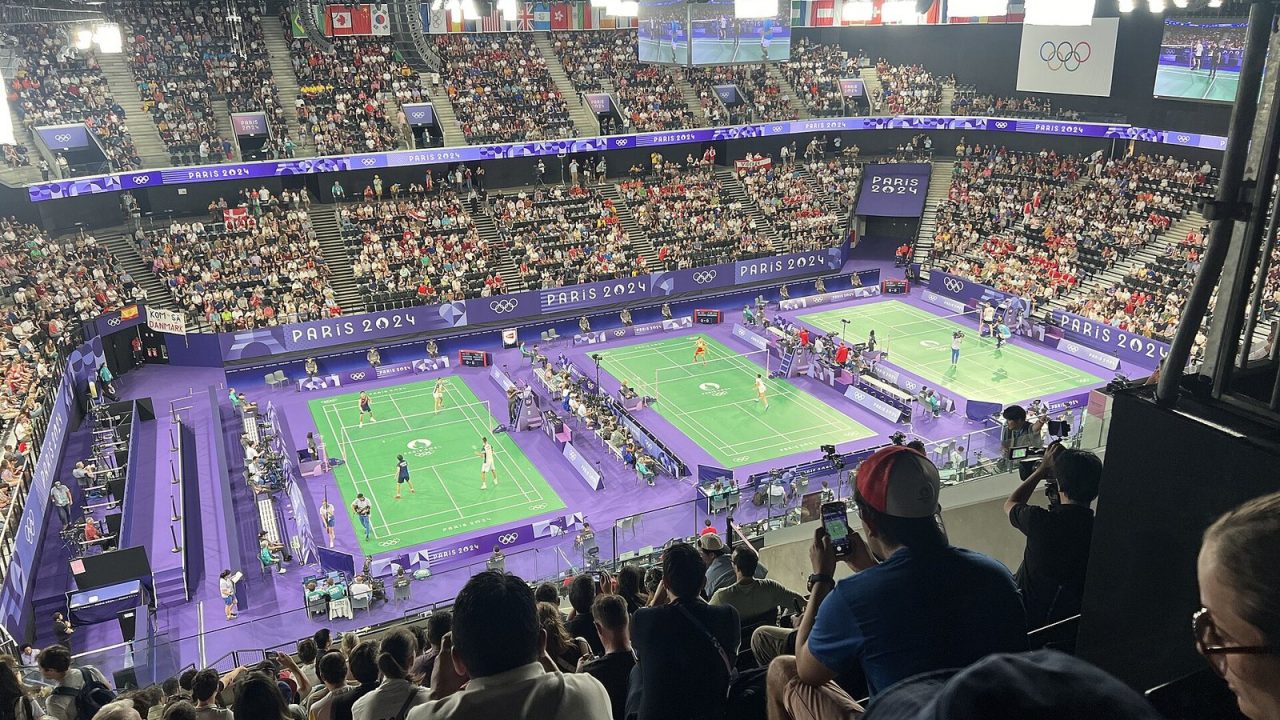
Badminton has one of the simplest scoring systems in racket sport, and one of the least understood sets of court markings. It is also in the middle of a historic change: the Badminton World Federation (BWF) has voted to replace 21-point games with 15-point games from January 2027. This guide explains the rules that apply through the end of 2026, then sets out exactly what the new format changes.
The match format in force through 2026
Under the BWF Laws of Badminton that apply until 3 January 2027, a match is the best of three games, and each game is played to 21 points using rally-point scoring. Every rally produces a point, whichever side served.
- The first side to 21 wins the game.
- At 20-all, play continues until one side leads by two points (22-20, 23-21 and so on).
- At 29-all, the side that scores the 30th point wins. A game can never go beyond 30.
- The winner of a game serves first in the next game.
Badminton moved from the old “side-out” system, in which only the server could score and most games went to 15 points (women’s singles to 11), to 21-point rally scoring in 2006, after trials that began in December 2005. The 3×15 change is therefore the second major scoring overhaul in two decades. Indoor volleyball made a similar shift from side-out to rally scoring around the same era, as explained in our volleyball rules guide.
Intervals and changing ends
The current laws allow short breaks within and between games:
| Break | Current rule (21-point games) |
|---|---|
| Mid-game interval | Up to 60 seconds when the leading score reaches 11 points |
| Between games | Up to 120 seconds between games 1 and 2, and between games 2 and 3 |
| Change of ends | After game 1, after game 2 if a third is needed, and in game 3 when the leading side reaches 11 |
For televised matches, the referee may decide in advance that intervals are mandatory and of fixed length. Outside those breaks, play is meant to be continuous: players cannot leave the court, receive coaching or delay play without permission.
The court: which lines count, and when
A full badminton court is 13.4 m long and 6.1 m wide. The singles court uses the same length but a narrower width of 5.18 m. The net is 1.55 m high at the posts and 1.524 m at the centre, so it sags slightly in the middle.
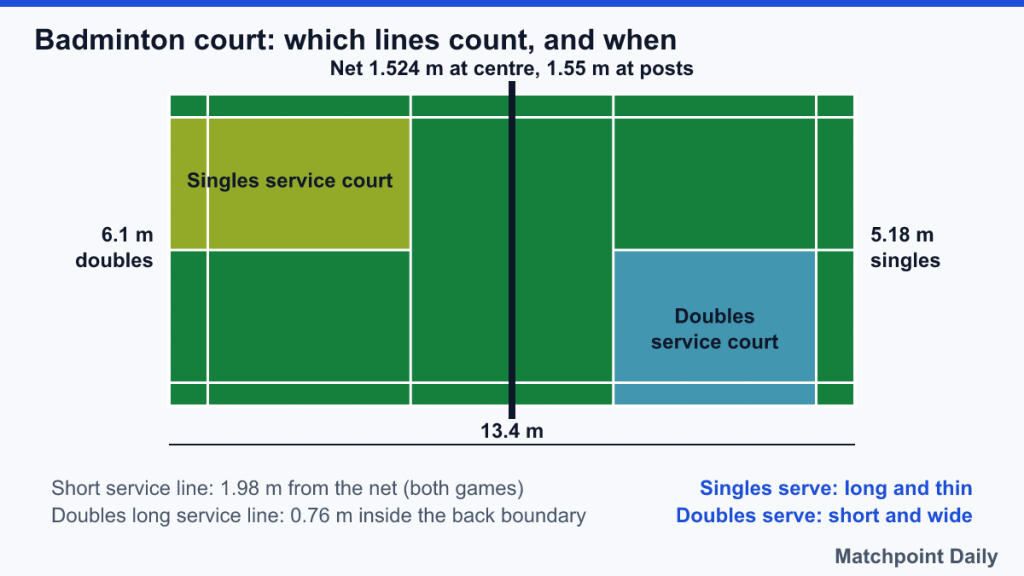
The lines are where beginners get lost, because which lines count depends on whether you are serving or rallying, and on whether it is singles or doubles:
- Short service line: 1.98 m from the net. A serve must reach beyond it.
- Doubles long service line: 0.76 m inside the back boundary. In doubles, a serve that lands between this line and the back line is out.
- Inner side lines: the singles side lines.
- Outer side lines: the doubles side lines.
| Situation | Width boundary | Back boundary |
|---|---|---|
| Singles serve | Inner (singles) side line | Back boundary line |
| Singles rally | Inner (singles) side line | Back boundary line |
| Doubles serve | Outer (doubles) side line | Doubles long service line |
| Doubles rally | Outer (doubles) side line | Back boundary line |
In short: singles serves are “long and thin”, doubles serves are “short and wide”. Once the rally starts in doubles, the full back court comes back into play. As in most court sports, a shuttle landing on a line is in.
Serving: who, where and how
Serves are always diagonal, into the opponent’s service court. Which side you serve from depends on your score:
- Even score (0, 2, 4…): serve from the right service court.
- Odd score (1, 3, 5…): serve from the left service court.
In singles this is all you need. In doubles, players do not switch service courts when they win a point on the opponents’ serve; only the serving side’s players swap when they win a point on their own serve. That is why doubles players sometimes take a moment to check who should be serving.
The key technical requirements of a legal serve under the laws include:
- Both server and receiver stand within their diagonally opposite service courts without touching the boundary lines, and part of both feet must stay in contact with the floor until the serve is made.
- The server’s first contact must be on the base (cork) of the shuttle.
- At the moment of contact, the whole shuttle must be below 1.15 m from the court surface. This fixed-height rule, mandatory at high-level tournaments since December 2018, replaced the older waist-based test.
- The racket must move forward continuously from the start of the serve until the shuttle is struck; no stop-start feints.
- The shuttle must travel upwards off the racket, pass over the net and land in the receiver’s service court if not returned.
Service faults and service-specific rules have a dedicated article of their own later in our badminton series.
Common faults during a rally
Besides an incorrect serve, the laws list the situations that end a rally with a point to the other side. The ones that come up most often are:
- The shuttle lands outside the boundaries, passes through or under the net, or fails to cross it.
- The shuttle touches the ceiling or side walls, or touches a player or their clothing.
- A player touches the net or its supports with their racket, body or clothing while the shuttle is in play.
- A player invades the opponent’s court over the net with racket or body, except that a follow-through after hitting the shuttle on their own side is allowed.
- A player invades the opponent’s court under the net in a way that obstructs or distracts the opponent.
- The shuttle is caught and held on the racket and then slung during the stroke.
- The same player hits the shuttle twice in succession, or a player and their partner hit it successively.
- A player deliberately distracts an opponent, for example by shouting or gesturing.
A let stops play without a point, and the last server serves again. Lets are called, for example, when the server serves before the receiver is ready, when a returned shuttle gets caught on top of the net or in the net after passing over it, when the shuttle disintegrates and its base separates completely, or when an unforeseen or accidental situation occurs. Note the difference on the serve itself: a served shuttle that is caught on the net is a fault, not a let.
The move to 3×15: what changes in January 2027
At its 87th Annual General Meeting in Horsens, Denmark, on 25 April 2026, the BWF membership approved the 3×15 scoring system by the required two-thirds majority. Reports from the meeting put the vote at 198 to 43. The new system takes effect on Monday 4 January 2027, and the BWF’s amended Laws carry the same effective date, with the 2025 Laws applying until then.
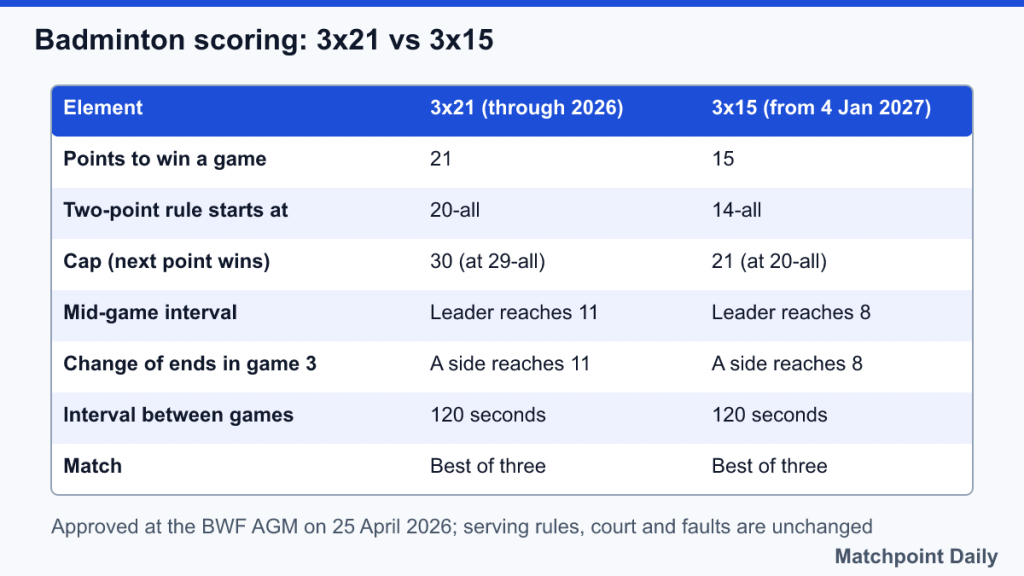
Here is how the two systems compare, based on the amended Laws and the key changes circulated to member associations:
| Element | 3×21 (through 2026) | 3×15 (from 4 January 2027) |
|---|---|---|
| Match | Best of three games | Best of three games |
| Points to win a game | 21 | 15 |
| Two-point rule starts at | 20-all | 14-all |
| Cap | 30 (next point at 29-all wins) | 21 (next point at 20-all wins) |
| Mid-game interval | 60 seconds when the leader reaches 11 | 60 seconds when the leader reaches 8 |
| Change of ends in game 3 | When a side reaches 11 | When a side reaches 8 |
| Interval between games | 120 seconds | 120 seconds (unchanged) |
| Scoring type | Rally point | Rally point (unchanged) |
Serving rules, court dimensions and faults are unaffected; the change is about game length and the points at which breaks occur.
Why the BWF made the change
The BWF has framed the change around more consistent match durations, easier scheduling for organisers and broadcasters, and possible benefits for player welfare and recovery. Before the vote, the 3×15 format was trialled for more than a year at selected events, including national competitions and lower-grade tournaments. Some national associations moved early: Badminton Association of India, for example, announced that its domestic ranking tournaments and national championships for Under-13, Under-15 and Under-17 categories would use 3×15 from July 2026 as preparation for the switch.
Not everyone was in favour. Several leading players publicly questioned whether shorter games would reduce the scope for comebacks and favour different player types. How much the change reshapes tactics will only be clear once the 2027 season is under way.
Common questions
Does the server have to win the rally to score?
No. Since 2006, every rally scores a point, whoever served. Under both the old and the new system, the side that wins a rally also serves next.
Can the shuttle touch the net on a serve?
Yes. A serve that clips the net and lands in the correct service court is good; it is not replayed as in tennis.
Can I reach over the net?
You must make contact on your own side. Your racket may follow through over the net after a legal hit, but it may not touch the net.
What happens to matches already scheduled in early 2027?
From 4 January 2027 the new format becomes the standard under the BWF Laws. Individual organisers and competitions follow the rules in force for their event, so check the regulations of a specific tournament if you are playing in one.
Quick reference
- Through 2026: best of three games to 21, two clear points from 20-all, capped at 30.
- From 4 January 2027: best of three games to 15, two clear points from 14-all, capped at 21.
- Serve: diagonal, below 1.15 m, from the right on even scores and the left on odd scores.
- Singles serve: long and thin. Doubles serve: short and wide.
- Lines are in.